


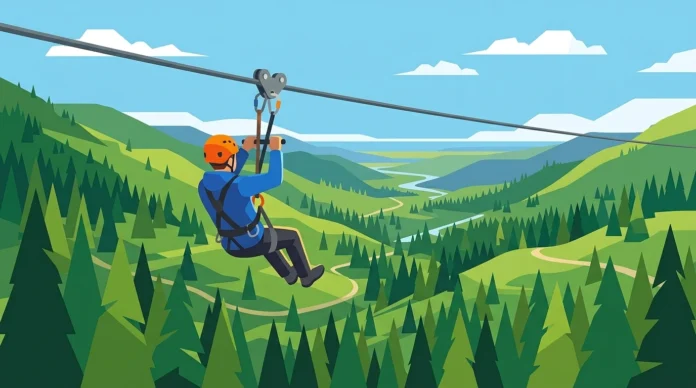
A zipline weight limit isn’t one universal number, and it isn’t really about whether the cable can hold you. The cable can hold thousands of pounds. The limit is about speed and momentum, too light and you stall out partway across, too heavy and you come into the platform too fast. And clearing the number on the scale is only half of qualifying. Whether you ride safely also comes down to harness fit and how well your body braces and brakes at the end of the line. Here’s how to figure out where you actually stand.
You’d think the weight limit on a zipline is there because the cable might snap. It isn’t. Zipline equipment is built and tested to hold several thousand pounds, far more than any rider weighs. So if the steel isn’t the worry, why does the scale at check-in matter so much? The answer is physics, and your own body’s ability to handle the ride, and those two things together decide whether you’re ready.
How A Zipline Actually Moves You
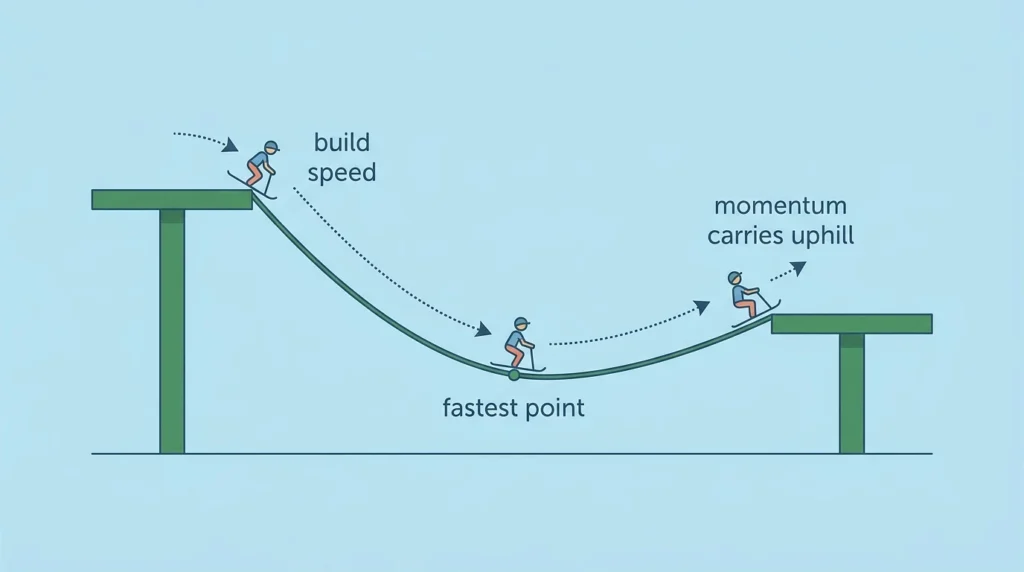
To get why the limits exist, you have to picture how the line works. A zipline runs from a high platform down to a lower one, and the cable isn’t pulled tight. It’s strung with a deliberate sag in the middle. If it were drum-tight you’d rocket across way too fast, so that dip is there on purpose to control your speed.
When you launch, gravity pulls you down toward the lowest point of that sag and you pick up speed. Once you pass the bottom, the momentum you built carries you back uphill toward the landing platform. That’s the whole mechanism. And it’s entirely dependent on you carrying the right amount of weight to make the trip work.
Why There’s A Minimum, Not Just A Maximum
Most people assume weight limits are about being too heavy. But the minimum is just as real, and for lighter riders it’s the one that matters.
If you don’t weigh enough, you don’t build enough momentum to clear that uphill stretch to the next platform. You slow down, and you can come to a dead stop in the middle of the cable, dangling there until a guide has to come out and pull you in. It’s usually not dangerous, but it’s uncomfortable, a little scary while you wait, and it holds up everyone behind you in your group.
This is also why kids’ courses set their own lower minimums rather than just waving small riders onto the adult line. A child still needs enough mass to coast the full distance. Put them on a line built for heavier adults and they’ll strand mid-cable.
Why There’s A Maximum
The maximum isn’t about the cable failing either. It’s about speed. The heavier you are, the more momentum you build heading down, and the faster you arrive at the landing platform.
Come in too fast and you risk a hard landing or a collision with the platform itself, the kind of thing that causes real injuries. The braking system at the end has to be able to slow you down and stop you safely, and every system has a ceiling on how much momentum it can absorb. The maximum weight limit is set so the brakes can do their job for everyone who rides.
So How Do You Determine The Actual Number?
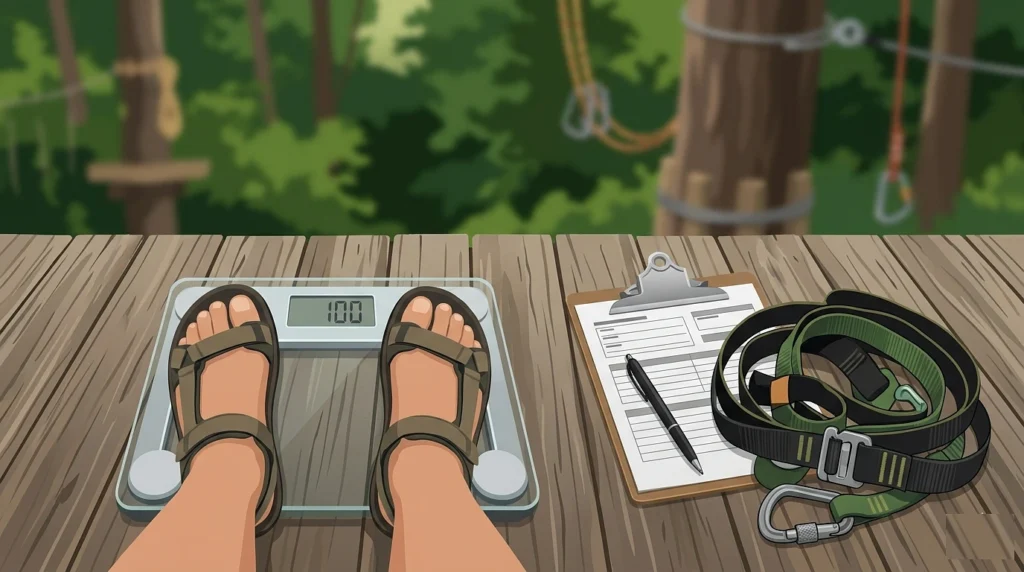
Here’s the part that trips people up. There is no single national zipline weight limit That’s why two courses an hour apart can have completely different rules.
That said, the published ranges cluster in a recognizable band, so you can roughly gauge where you’ll fall before you book:
- Most courses require riders somewhere in the rough range of 65 to 275 pounds, though it varies by operator.
- Adult course minimums commonly sit around 70 to 75 pounds, with maximums often landing between 250 and 285 pounds depending on the course.
- Kids’ courses run their own separate windows, for example 40 to 180 pounds on some children’s lines.
- Some operators set the limit per pulley, which matters for tandem rides, your combined weight with a partner has to come in under that ceiling.
A few courses also factor in height and build alongside weight, on the reasoning that taller riders carry weight differently and get better leverage when braking, which can shift the threshold. The practical takeaway is simple: the only number that counts is the one published by the specific course you’re booking, and if you’re near either edge, call ahead. Many operators have a small grace window, and some run alternate lines with different limits.
And don’t fudge it. Weigh-ins at check-in are standard, often on a digital scale, and misrepresenting your weight puts you and the staff at genuine risk. If you don’t meet the requirement you’re typically offered an alternative activity or a refund, not turned away with nothing.
The Part The Scale Doesn’t Measure Your Body On The Line
This is where readiness goes beyond a number, and it’s the piece most “what’s the weight limit” articles skip entirely. Passing the weigh-in gets you cleared. It doesn’t mean the ride asks nothing of your body.
A few physical demands the line quietly places on you:
- Harness fit and tolerance. The harness has to cinch correctly around your waist and thighs to hold you safely, and not every harness adjusts to every body type the same way. If it can’t be fitted properly, that can affect whether you ride regardless of what the scale says. The harness also bears down on your body during the ride, so it helps to be comfortable with that pressure.
- Bracing and grip at the stop. You arrive at each platform with momentum that has to be absorbed, and on many courses you participate in your own braking and landing. That asks something of your grip, your core, and your ability to hold position and follow instructions in the moment, not Olympic fitness, but more than sitting still.
- General mobility. Ziplining usually involves some walking along trails between lines, climbing to platforms, and handling yourself at height. Being reasonably steady on your feet is part of the package.
None of this requires you to train like an athlete. But if you think of clearing the weight limit as the whole test, you’re only looking at half of it. The line also rewards being able to hold on, brace, and move with a little confidence.
When You Should Sit It Out Regardless Of Weight
Weight and fitness aside, operators commonly advise against ziplining if certain conditions apply, because the speed, the heights, and the harness forces can aggravate them. Courses frequently flag these:
- Pregnancy.
- Back, joint, or bone problems.
- Recent surgery.
- Heart conditions or other issues that react badly to high speed or heights.
- Being under the influence, which is a hard no at any reputable operator.
If any of these is in play, the right move is to talk to the operator before booking, or check with your doctor, rather than assuming the weight limit is the only gate.