


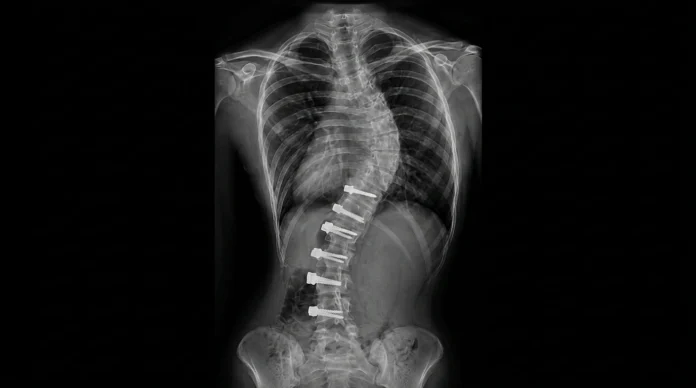
A curve gets measured, it’s under the surgical threshold everyone quotes, and the plan becomes “observation, recheck in one year.” On paper that looks reasonable. The problem is that it reads the number on the X-ray and ignores the calendar next to it.
In a child who hasn’t finished growing, a mild curve is not a static finding. It is a moving target, and twelve unmonitored months during a growth spurt is enough time for a watch-and-wait curve to quietly cross into surgery territory before anyone looks again.
Why Growth Matters More Than The Number
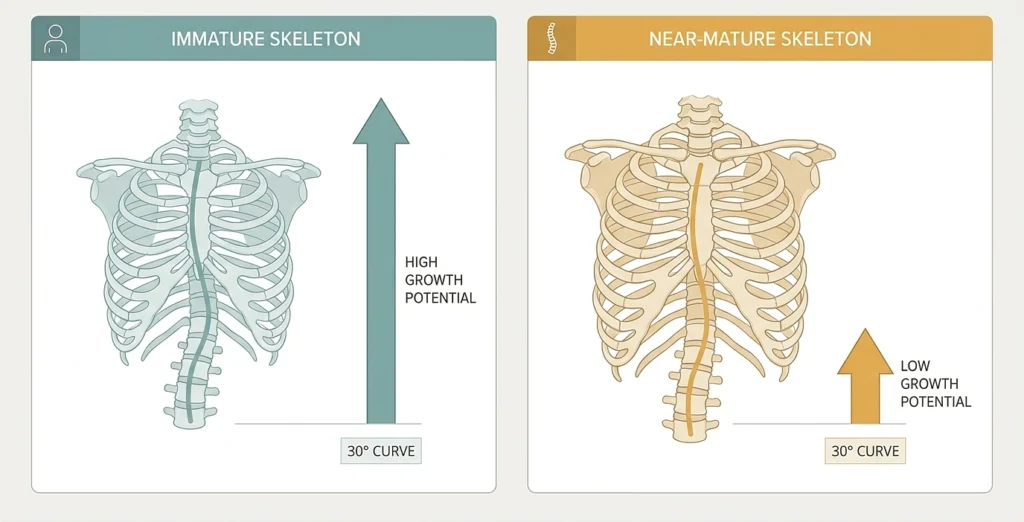
A curve doesn’t worsen on a fixed schedule. It worsens against how much growth is left. More growth remaining means more risk a given curve deepens, because every bit of spinal growth is another chance for it to progress.
Two patients can have the same Cobb angle and need opposite plans:
- Mild curve, lots of growth left. A 30-degree curve in a child who hasn’t started their growth spurt has real runway to worsen. This is the situation that needs close monitoring, sometimes every few months.
- Mild curve, growth nearly finished. The same 30 degrees in a teenager who finished growing two years ago has largely landed. This one is usually genuinely safe to watch on a relaxed schedule.
The image is identical. The plan is not. That’s why the curve number alone never answers the question.
The Two Questions That Protect Any Patient
You don’t need to read an X-ray to avoid the “recheck in a year” trap. Ask for both numbers, not just one:
- “What is the Cobb angle?” This is the curve measurement, the number families usually get.
- “What is the Risser sign?” This estimates how much skeletal growth is left. A mild curve with a Risser of 0 or 1 is the combination that needs rechecking in months, not a year.
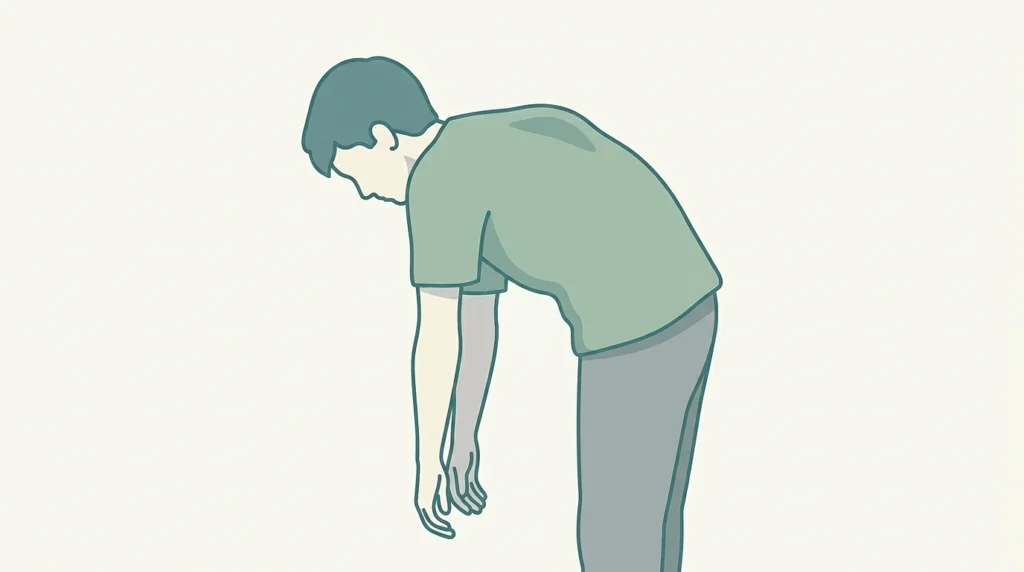
The forward-bend test (Adam’s test). Have the person bend forward at the waist, arms hanging, and look at the back from behind at eye level. A rib hump or one side sitting higher is the asymmetry screenings look for. It costs nothing and can be repeated monthly.
Does Catching It Earlier Actually Change Anything?
Surgery for a larger curve is a good operation with good long-term results. A child who eventually needs a fusion was not failed, sometimes the curve was always heading there. So earlier monitoring is not the difference between disaster and rescue.
But it is often the difference between a brace and an operation. A mild curve monitored closely through the growth spurt has a real chance of being held with bracing and never reaching the operating room. The same curve given a 12-month gap can cross the threshold unseen. The payoff isn’t life-or-death. It’s frequently one fewer major surgery, which for a growing child is worth a great deal.
What The Evidence Says About Bracing
This isn’t just clinical opinion. The BrAIST trial, published in the New England Journal of Medicine in 2013, showed bracing meaningfully reduced the rate of curves progressing to the surgical threshold, and the benefit scaled with how many hours a day the brace was actually worn. The takeaway that matters for monitoring: the window where a brace can help is the active-growth window. Miss it and you’ve missed the only window in which the curve could have been steered.
The Calm Version, And Your Next Step
If the curve is mild and the patient is still growing, this is manageable, not an emergency. The single most protective thing is matching the recheck interval to the growth left, not to the calendar.
If there’s a curve and growth isn’t finished, ask the clinician one direct question, “Given the Risser sign, should we be rechecking in months instead of a year?” When the curve is mild but the spine is still immature, the answer is usually yes.