



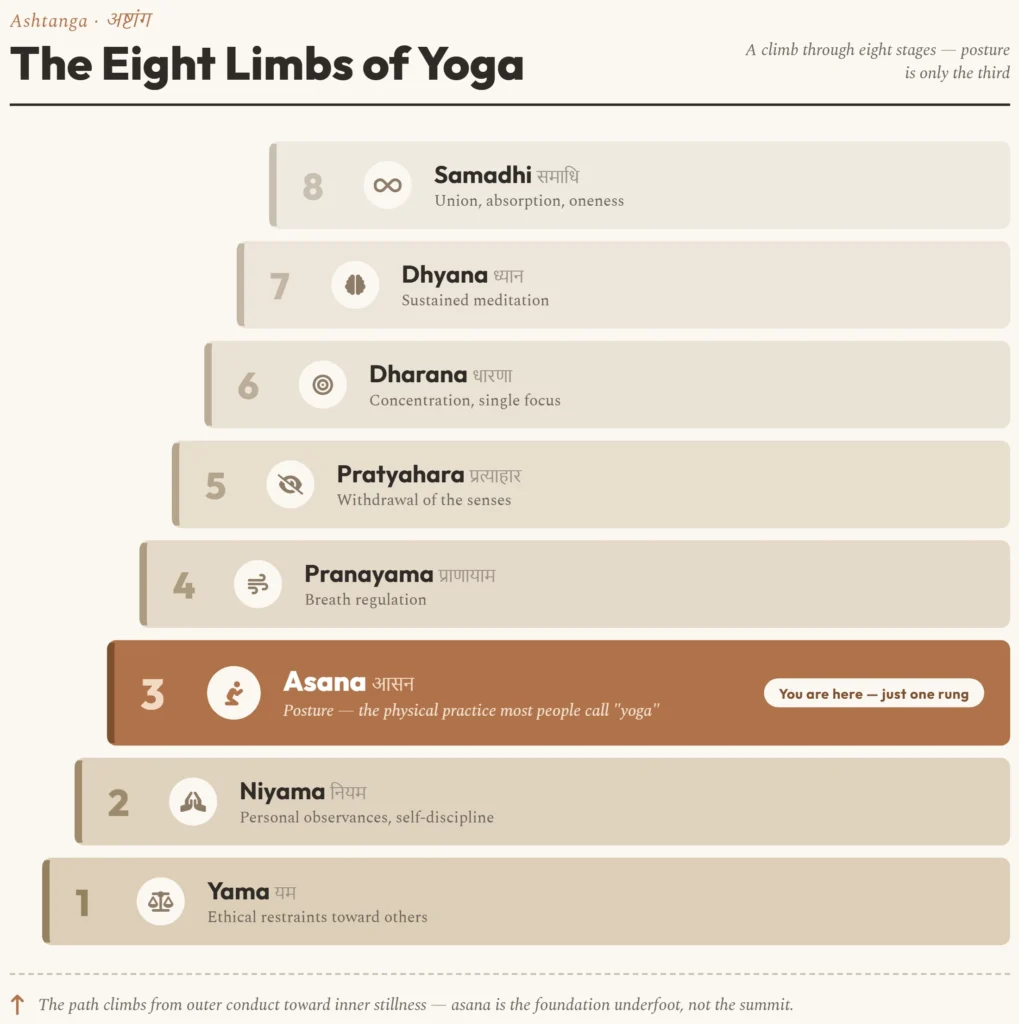
The eight limbs of yoga are not only physical postures, but also ethical and personal disciplines Yamas and Niyamas to be practiced in daily life. These are principles such as breathing and meditation which take the practitioner on a journey to a mindful, compassionate life. Learn more about these core ethics at rub-maps.com.
Open any yoga feed on June 21 →
Patanjali wrote about eight limbs in the Yoga Sutras roughly two thousand years back, and only one of them, asana, has anything to do with what your body does on a mat. The word started out meaning “seat” just a steady, comfortable way to sit. The bending and balancing got added much later. The other seven limbs are where most of the actual work sits, and they don’t make good photos, which is probably why they slipped out of the version of yoga that gets sold to people.
The Two Limbs That Come Before You Ever Stretch
Patanjali doesn’t start with poses. He starts with how you behave and how you hold yourself the yamas and niyamas. He put them first on purpose. His point was simple: there’s not much use training a body if the person running it hasn’t worked out how to treat other people, or themselves.
Yama – How You Treat The World
The yamas are five rules that point outward, toward everyone else. Take non-violence. It isn’t just “don’t hurt anyone.” It runs into how you talk, the snap judgments you make, the little nasty habits most of us let slide. Truthfulness gets messy quick, because Patanjali ties it to non-violence so you don’t get to swing honesty around like a bat. Hitting someone with a hard truth just to feel like the bigger person breaks both rules in one go.
The five, short version:
- Ahimsa – Non-violence, in how you think and speak, not just what you do.
- Satya – Truthfulness, but not when it’s used to wound.
- Asteya – Not taking what isn’t yours, time and credit included.
- Brahmacharya – Moderation, spending your energy where it counts.
- Aparigraha – Not clinging, holding your stuff loosely.
Niyama How You Treat Yourself
The niyamas face inward: cleanliness, contentment, discipline, self-study, and surrender. Contentment is the tricky one if you grew up being told to always do better. It asks you to be okay with things as they are, right now. Sounds easy, even lazy, until you actually try it for a day and clock how much of your head is just quiet complaining about the moment you’re in.
Neither of these touches a mat. Both are tougher than any pose you’ll ever hold.
The One Limb Everyone Already Knows
Asana – The Seat
This is the pose. The part the feed has more than covered. But here’s the thing worth saying out loud: in Patanjali’s text, asana barely comes up, and where it does, it’s talking about a steady, comfortable seat for sitting still not a string of shapes. Moving your body well is fine. It’s just the front door, not the whole house.
Breath As The Hinge
Pranayama – Working The Breath
The fourth limb, pranayama, is breath of life work, and it lands in a smart spot right after asana. The order makes sense. You need the body settled before you can do anything deliberate with the breath, and the breath is the one place where the parts of you that run on autopilot meet the parts you can steer.
You can’t tell your heart to slow down or your stomach to digest faster. But you can stretch out an exhale, and a long exhale tips the nervous system toward calm through the vagus nerve. This is one of the rare spots where old practice and actual physiology line up neatly. A longer exhale than inhale switches on the parasympathetic side the “rest and digest” gear.

What pranayama asks is that you pay attention to something you’ve ignored your whole life, exactly because it handles itself. That’s the off-the-mat piece: catching your breath gone tight and shallow halfway through a tense meeting, and remembering you’ve got a lever you can pull.
The Four Limbs Almost No One Reaches
This is where the feed goes quiet, because the last four limbs all happen inside you, one leading into the next, and none of them turn into anything you can hold up to a camera.
Pratyahara – Pulling Back From The Senses
Turning down the firehose of input on purpose. In a world built to grab your attention, that’s almost a rebellious move. It’s the practice of not jumping at every ping, every itch, every little thing that goes off around you.
Dharana – Concentration
Keeping your attention parked on one point. Not the loose, sliding focus you give a screen, but real holding, dragging your mind back every time it drifts.
Dhyana – Meditation
Concentration that’s gone smooth and unbroken, where you stop having to haul your attention back and it just stays put on its own.
Samadhi – Absorption
The eighth limb. The texts describe it as the point where the “you” doing the watching melts into the thing being watched. It’s what the whole system is aiming at, and the catch is you can’t force it by gritting your teeth harder. It shows up, if it shows up at all, as a side effect of the seven limbs underneath it.
Notice none of these four can be performed. There’s no pose for concentration, no way to prove you’ve pulled back your senses. They go on quietly, for years, and leave nothing behind to show for it.
Why Only One Limb Survived
It’s no mystery why asana became the whole of yoga in most people’s heads. It’s the only limb you can see, teach to a room full of people, and put a price on. You can fill a class, sell a pass, snap a photo, build a brand. The other seven shrug all of that off. Nobody’s selling you contentment in a forty-minute block, and a photo of someone deep in concentration just looks like a photo of someone sitting there.
This doesn’t make asana a fraud. Moving well is part of the road, and for plenty of people, it’s the door they walk through to find the rest of it. The trap is mistaking the door for the house. Once the pose becomes the entire point, yoga shrinks into a stretchy workout with good lighting, and a system meant to rearrange how you live shrinks down to how you spend an hour.
What The Other Seven Ask
So on a day built around photographing the one limb you can see, the better question is what the rest of the thing is actually asking for. It asks you to watch how you treat people when being decent costs you something. To sit with the present instead of forever remodeling it. To notice your own breathing. To put the phone down on purpose. To hold your focus on one thing long enough that it stops sliding off.
None of that makes a good post. It makes a different kind of life, which was the whole idea from the start. The mat is where some people begin. It was never meant to be where the practice stops.
References:
- Patanjali, Yoga Sutras (Bryant, E. translation, 2009)
- Iyengar, B.K.S., Light on the Yoga Sutras of Patanjali (1993)
- Gerritsen, R.J.S. & Band, G.P.H., “Breath of Life: The Respiratory Vagal Stimulation Model of Contemplative Activity,” Frontiers in Human Neuroscience (2018)

