



So how long does 18 holes of golf take when you walk it? Four hours is the number you’ll hear if you ask around, and it’s close enough to be useful and wrong enough to leave you stranded at the turn wondering why your legs already feel like they’ve done a full shift.
Walking 18 holes is a different animal than riding. The ride flattens everything into one experience: cart path, hit, cart path, hit. Walking stretches the round out, fills it with small decisions and quiet stretches, and turns the time question into something you can’t answer with a single number. The honest answer depends on a handful of things nobody mentions when they toss out “about four hours.”
The Walking Round Versus the Riding Round
A riding foursome at a typical US public course moves through 18 in roughly four to four and a half hours. That pace is baked into how courses sell tee times. They space groups about eight to ten minutes apart and the carts keep everybody bunched at a steady clip.
Walking changes the math in two directions at once. You’re not waiting for a cart partner to drive you around, so a walking single or twosome with an open course ahead can fly. I’ve finished 18 walking in under three hours on an empty Tuesday morning, and it didn’t feel rushed. But walking also adds real distance to your day, and that distance accumulates. By the back nine, a slower walker is moving more deliberately between shots, and the round stretches.
Here’s the part that surprises people on a busy weekend, walking and riding finish in nearly the same time. When the course is packed, everybody waits on the group ahead regardless of how they’re getting around. The cart doesn’t help you when you’re standing on the tee box watching the foursome ahead search for a ball in the trees. Pace gets set by the slowest group on the course, not by your transportation.
So What’s the Real Number for Walking 18
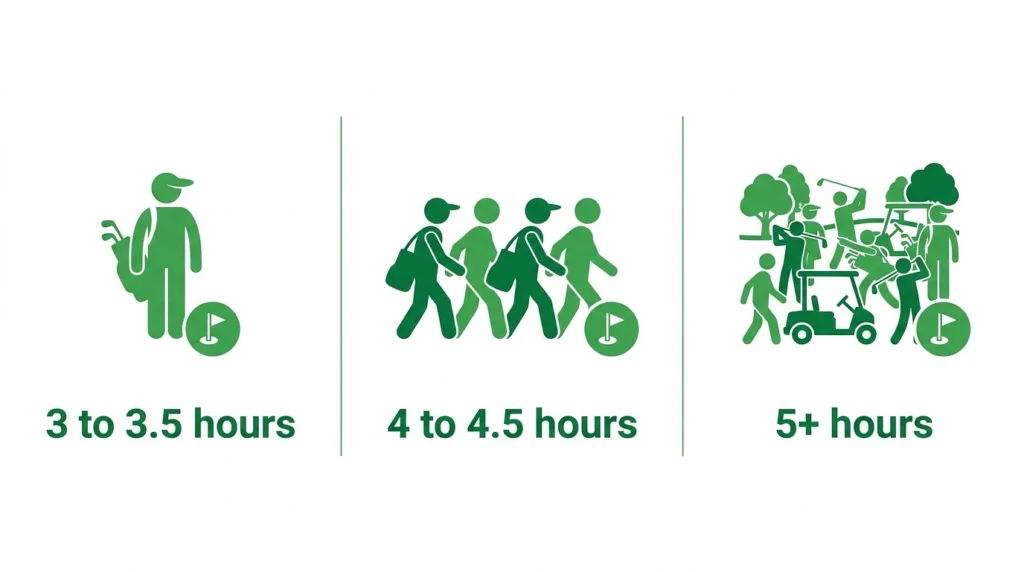
It depends almost entirely on your group size and how crowded the course is:
- Single walker or tight twosome, open course: three to three and a half hours at a comfortable pace.
- Foursome walking together: four to four and a half hours, the same window as a riding group.
- Busy course, holiday weekend, or resort with lots of beginners: five hours or more, walking or riding.
The foursome takes longer for a simple reason. Four people have to all hit, all walk, all reach the green, all putt out. The bottleneck isn’t the walking. It’s four people doing everything in sequence.
So the cleanest way to think about it your fitness barely changes the total time. What changes it is how many people are in your group and how crowded the course is.
The Distance You’re Actually Covering
A regulation 18-hole course runs between 6,000 and 7,000 yards from tee to green. But that’s just the playing distance in a straight line. When you walk, you’re not walking straight lines. You’re going from the green to the next tee, wandering off to find a ball, doubling back for your bag, walking up to read a putt and back to your ball.
Most walkers cover four to five miles over a full round. Fitness trackers usually clock 11,000 to 16,000 steps for 18 holes on foot. Hilly courses push that higher, both in distance and in effort, because elevation turns an easy walk into something your legs notice by hole 14.
That’s a genuine workout, and it’s the main reason people walk in the first place. You burn meaningfully more calories than riding, you keep your body loose between shots instead of stiffening up in a cart seat, and a lot of golfers swear they play better because the walk keeps them in rhythm.
What Actually Slows You Down
If your walking rounds drag past four hours when the course isn’t even busy, the culprit is almost never the walking itself. It’s the small stuff:
- Looking for lost balls. The USGA suggests a three-minute search limit, and most casual golfers blow past it without noticing. A single lost-ball search can cost a group five or six minutes once everybody pitches in to look.
- Slow green play. Reading a putt from four angles, marking and re-marking, taking three practice strokes before a two-footer. It feels careful in the moment and it backs up the entire course behind you.
- Not being ready to hit. Walking gives you time between shots to think about your club and target, but a lot of golfers don’t use it. They wait until they’re standing over the ball to start the whole decision process, and that dead time multiplies across 18 holes.
The fix for all three is the same thing experienced walkers do without thinking: be ready. Pick your club while you’re walking up. Line up your putt while others are putting. Pick up and move on when you’ve clearly lost a ball and the group behind is waiting. Walking actually makes this easier, because you’ve got the whole walk to the ball to prepare instead of sitting trapped in a cart.
Carry, Push Cart, or Caddie
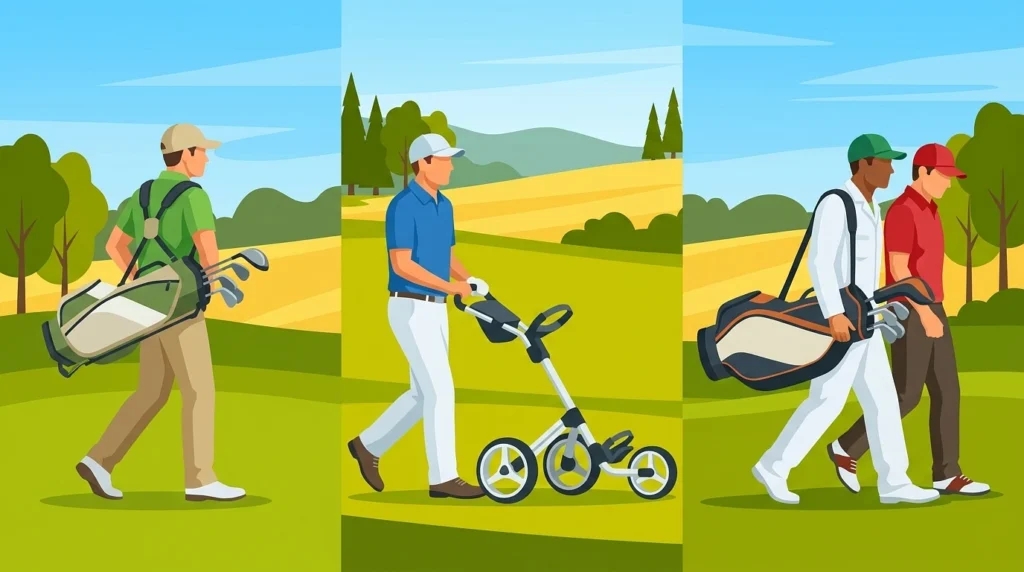
How you move your clubs changes your walking experience more than people expect, even if it barely changes the clock.
- Carrying: the purest version and the most tiring. A full bag with 14 clubs, balls, and water runs 25 to 35 pounds, and you feel every one of those pounds on the back nine. Fine for fit players, a grind for everyone else. A lightweight stand bag helps, but it’s still weight on your shoulders for four-plus miles.
- Push cart: the sweet spot for most walkers. All the benefits of walking with none of the load on your back, and modern three-wheel carts roll easily over almost any terrain. Your round time stays the same, but you arrive at the 18th green a lot fresher. If you walk regularly and aren’t using one, it’s the single best change you can make.
- Caddie: the luxury version. You walk free of any weight, you get help reading greens and picking clubs, and the round often moves faster because a good caddie keeps the group organized. Mostly a private-club and resort thing in the US, and it costs real money, but it’s a genuinely different way to experience the walk.
Planning Your Day Around a Walking Round
If you’re scheduling around golf, here’s the practical version:
- The round itself: block out four to five hours for a normal group at a normal time. That gives you margin for a crowded course without making you late for whatever’s next.
- Before the round: add 30 to 45 minutes for arriving, checking in, hitting a few range balls, and getting to the first tee.
- At the turn: add another 15 to 20 minutes if you want to grab something between nines, which a lot of walkers do because four-plus miles burns through your energy.
So a full walking golf outing, door to door, realistically eats five to six hours of your day once you count everything around the round. That’s the number to give your spouse when they ask when you’ll be home, not the optimistic three hours you tell yourself in the parking lot.
Early tee times are your friend if you want speed. The first groups out have open course ahead of them, and a walking twosome off the first tee at sunrise can be done before the course ever gets crowded. The later you start, the more you inherit the pace of everyone in front of you.

