


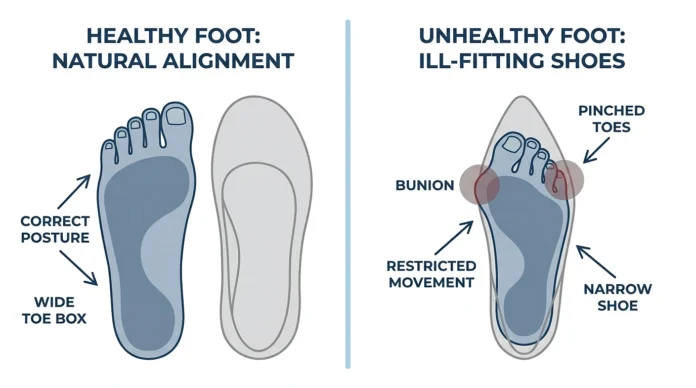
Buldt and Menz ran the numbers in the Journal of Foot and Ankle Research and landed somewhere between 63 and 72 percent. That many adults are walking around in shoes that don’t match the actual length and width of their feet. Not what people guess their size is. What their feet measured, sitting inside the shoes they already bought.
Guess your own foot length right now. Then go measure it. Most folks who try this little exercise are off, and usually by more than they’d like.
Your Feet Have Been Changing The Whole Time
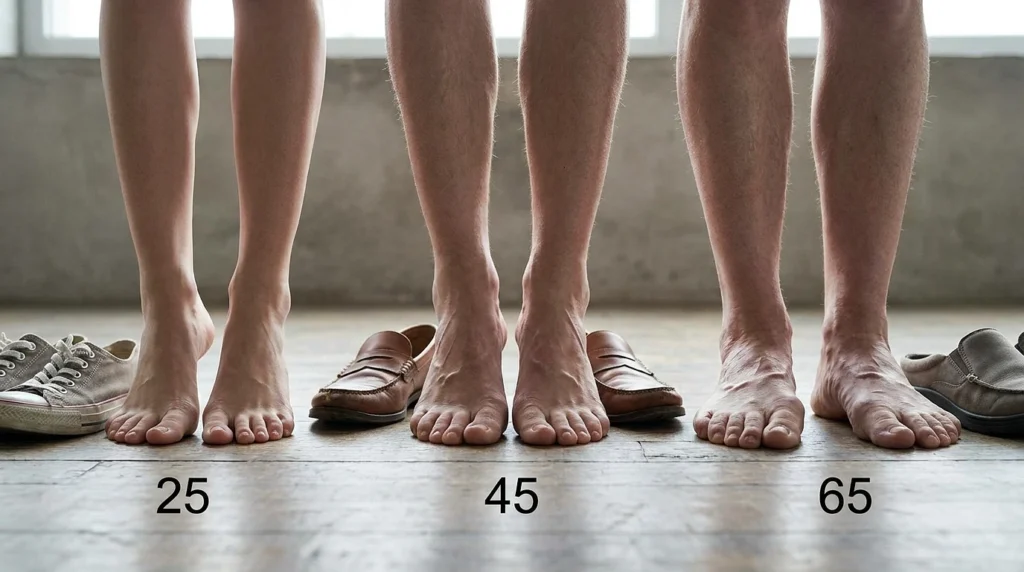
The foot you had at 25 isn’t the foot you’ve got at 45, and the one waiting for you at 65 is different again. The arch drops a little. The ligaments soften. The whole foot lengthens and spreads.
Pregnancy does it fast. Half a size, sometimes a full size, and a lot of the time it sticks, which is why a pair of old work flats starts pinching and the person wearing them has no clue what changed.
Weight gain spreads the forefoot. Age quietly takes the arch down. Even how much you’re on your feet shifts their working shape, because the muscles that hold a foot together respond to load the same way every other muscle in your body does. Use them differently and they change.
And almost nobody is measuring. That’s the part that gets me a little. People pick a number somewhere around college and stay loyal to it for the next forty years like it’s a wedding vow.
The Shoe Industry Isn’t Much Help Here
In a nutshell, it’s doing almost nothing.
A size 9 in one brand shows up as an 8.5 in the next and a 9.5 in a third. The UK, US, and European systems don’t agree with each other. And the molds shoes get built around, the lasts, vary so much from brand to brand that the same printed number can hand you two completely different fits out of two boxes sitting side by side on the shelf.
So you order shoes online, they turn up, they feel weird, and you decide your feet are the problem. Your feet are fine. The number lied.
What A Bad Fit Actually Does To A Foot
A shoe that doesn’t fit doesn’t just sit there being uncomfortable. Give it enough years and it starts remodeling the foot to match its own shape. Over a lifetime that matters a lot more than the blister did, and it’s the bit the quick advice tends to skip.
Bunions, Which Almost Everyone Misreads
A bunion is the bump you can see at the base of the big toe. Underneath the skin, the first metatarsal has drifted out toward the edge of the foot while the big toe has leaned in toward the second one. The joint capsule stretches. The cartilage wears. The bone ends up living in a spot it was never built for.
Genetics is in the mix. The NCBI Bookshelf overview on bunions is clear that tight shoes aren’t the single main cause, and some people grow bunions despite a lifetime of roomy footwear.
But footwear’s part in speeding the whole thing along is well documented. Pointed toe boxes shove the big toe inward. Heels load the joint and push it sideways at the same time. Do that for years and the bone goes where the shoes kept telling it to go. The bunion may have been coming anyway for genetic reasons. The shoes decide whether it shows up in your thirties or your seventies.
And a bunion doesn’t keep to itself. The big toe is one of the main things stabilizing your arch every time you push off to take a step. Knock it out of line and the arch loses a key support, the foot gets worse at soaking up shock, and the knees, hips, and low back upstairs start covering for the slack. Plenty of people end up chasing pain realif that traces all the way down to a foot that’s been quietly losing its job for two decades.
Hammertoes Stay Fixable Longer Than You’d Think
A hammertoe is a toe that’s curled up at the joint instead of lying flat. Something holds it out of position long enough that the muscles and tendons tighten around the bent shape, and eventually they’re so tight the toe won’t straighten even with the shoe off.
Cramped toe boxes are the usual culprit. So are the shoes kids keep wearing for months after their feet outgrew them. Heels do it too, jamming the toes into the front of the shoe step after step.
The useful part, and it surprises people a toe that’s bent but still bendy can often be coaxed back. Toe spacers, a few foot-strengthening moves, a wider toe box, and sometimes it straightens out again. Not always. Some toes don’t answer the gentle stuff for reasons nobody’s fully pinned down. But often enough that it’s worth a try before the toe goes stiff and surgery is the only door left.
The window is the whole game. Once that toe locks up rigid, the gentle fixes barely touch it.
Morton’s Neuroma, The Phantom Pebble
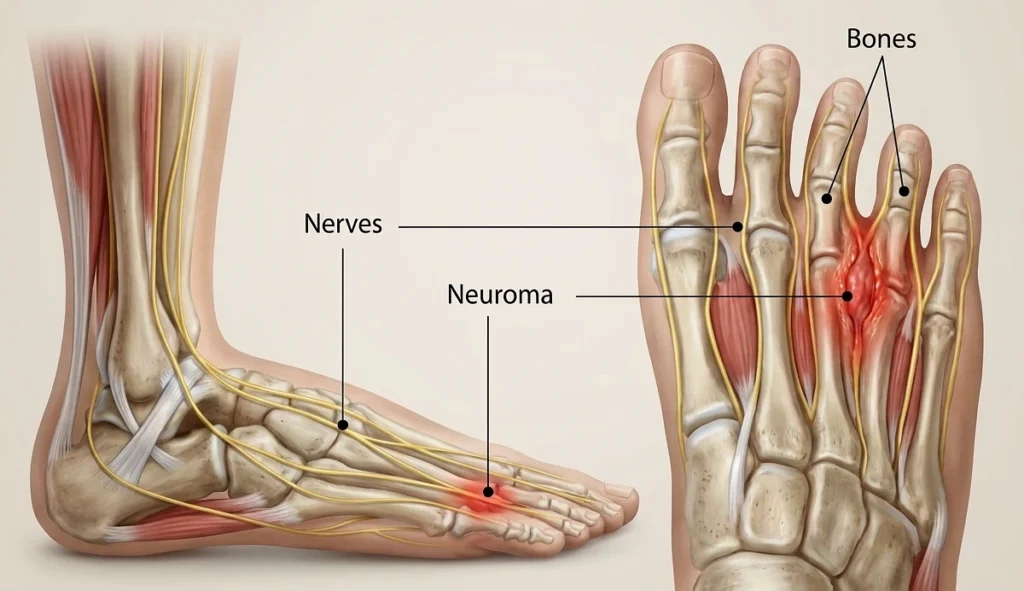
Morton’s neuroma is a thickening of the nerve that runs between the third and fourth toes. The way people describe it is oddly consistent. A pebble in the shoe they can never shake out. A fold in the sock that isn’t actually there. A sharp, burning line of pain shooting from the ball of the foot up into the toes, often with some numbness riding along.
The cause is plain mechanics. Narrow toe boxes, heels especially, squeeze the forefoot until the heads of the metatarsal bones press in on the nerve sitting between them. The nerve thickens to cope, and once it’s thickened, it stays thickened.
Wider shoes with real toe room take the squeeze off. Caught early, a neuroma can settle within weeks of a footwear change. Left to advance, it heads into orthotics, cortisone injections, and sometimes cutting the nerve out altogether.
The hard part of this one is what it implies. The shoes someone wore to the office for fifteen years are the shoes that built it. Tough news, expensive closet. Until the squeezing stops, the nerve just keeps getting poked.
Corns And Calluses Are Friction With A Memory
Skin thickens where something keeps rubbing it. In the short run that’s your foot defending itself, sensible enough. It turns into a real problem when the rubbing never stops, because the shoe never fit in the first place.
For someone with diabetes, or thin older skin, this stops being cosmetic. A callus on a healthy 40-year-old foot is an annoyance. The same callus on a 70-year-old foot with nerve damage can break down, ulcerate, and turn into an infection that ends in an amputation. The diabetic foot-care literature is loud about shoe fit for exactly this reason, and it’s right to be.
Four Rules That Fix Almost Every Pair You Buy
None of this is complicated. You can run all four in any store, on any shoe, in about five minutes.
- Measure both feet at the end of the day. Feet swell as you use them, and most adults have one foot bigger than the other. A morning measurement sells your real working size short.
- Size to the bigger foot. If the left is a 9 and the right is a 9.5, you’re a 9.5. A shoe too small for the bigger foot damages it, and a little room on the smaller foot never hurt anyone.
- Leave a thumb’s width at the front. Somewhere around 12 to 15 millimeters between your longest toe and the end of the shoe. Toes need room to spread on impact, and the foot stretches a touch under load.
- Walk the store and watch your heel. It shouldn’t slide up and down. A slipping heel means your foot is shoving forward into the toe box with every step.
And the rule everybody forgets is socks. Thick work socks, athletic socks, wooly hiking socks, they all eat up real room inside a shoe. A boot fitted over thin dress socks will choke your foot the day you wear it with the socks you actually own. Bring the socks. Try the shoes on over them.
The Break-In Myth Needs To Die Quietly
You hear it in every shoe store in the country. Give them a couple weeks, they just need breaking in.
There’s a small grain of truth in there. Good leather softens and molds to the foot. A new running shoe loosens across the upper as the materials flex. Real effects, worth a few wears before you judge the thing.
Anyhow, that grain is small. What does not happen is a shoe of the wrong shape or size turning into the right shape and size because you kept wearing it. A toe box that’s too narrow doesn’t get wider. The foot inside it just gets packed into a tighter shape. A shoe that’s too short doesn’t grow, so the toes curl, then they stay curled, then the curl turns structural and now it’s a hammertoe.
If a shoe hurts one specific spot the second you put it on, that spot is going to keep hurting until either the shoe falls apart or your foot reshapes in a direction you really don’t want.
The Next Pair You Buy
The foot problems that come from years of bad fit have two things in common. They build slowly, and they’re largely preventable with a shoe that fits. The bunion that needs surgery at sixty was being drawn up in year one. The hammertoe that locks rigid in your sixties was loose and fixable in your forties. The neuroma getting an injection in your fifties was an odd burning in your thirties that you waved off, because the shoes felt fine for the first hour.
The boring fixes are the ones that work. Get measured properly, end of the day, on a Brannock device. Bring the socks you actually wear. Walk around the store in the shoes. Watch for heel slip. If it hurts in the store, put it back, because the shoe is not going to fix itself and neither, as long as you keep wearing it, is your foot.
Whatever’s on your feet right now is either part of the problem or the start of the way out. The cost of choosing the second one is usually zero. It just takes measuring instead of guessing.