


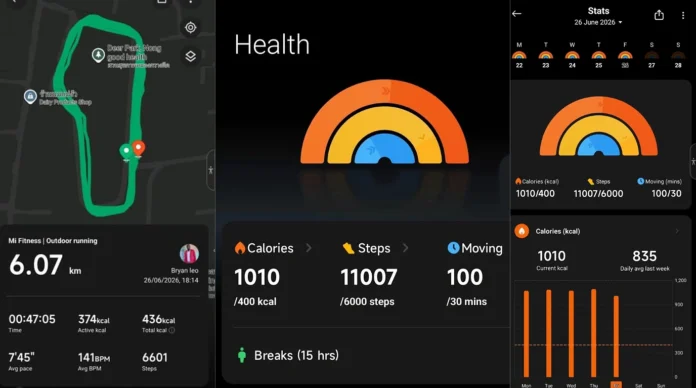
The watch buzzed at 6:14 tonight, same as it does every evening out at Deer Park. 6.07 km. Forty-seven minutes, five seconds. Pace of 7’45”. Heart rate steady at 141 the whole way around. Nothing remarkable about it, honestly. That loop has been run a hundred times by now. But there’s a reason the boring version of running is the one that actually sticks, and it took years of getting it wrong to finally understand that.
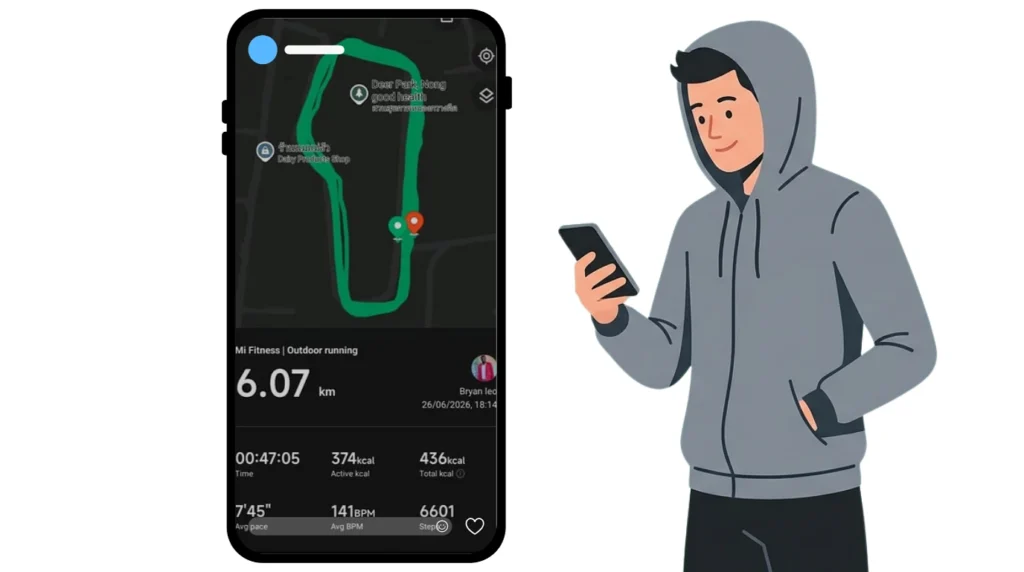
Back in the day, a good run meant coming home destroyed. Burning lungs, shaking legs, the works. No suffering meant no progress, or so the thinking went. Funny thing is, that mindset never lasted more than three weeks before the whole routine fell apart. Every single time.
The Number Most People Glance Right Past
That heart rate up there, the 141, is the one that actually matters. Everyone checks the distance first. Wrong instinct.
At that pace, 141 bpm sits in what coaches call Zone 2, the moderate zone. Sounds too easy to be useful. It isn’t. The moderate zone is where the body quietly rebuilds itself, and that’s the part nobody bothers to explain:
- The heart gets more efficient with every steady session.
- Muscles get better at pulling in and using oxygen.
- The body learns to burn fat for fuel instead of leaning on quick sugar.
Sprinting until you’re sick doesn’t build any of that. Steady time does, run after run. Forty-seven minutes at a comfortable 141 beats ten minutes of all-out effort, and it isn’t close.
Here’s the bigger payoff, though. A heart rate that stays moderate means the tank isn’t empty at the end. No wreckage. No limping around the next morning. Finish, shower, sleep fine, go again tomorrow. That’s the secret nobody handed over until it had to be learned the hard way.
Running the Exact Same Loop Is a Feature, Not a Rut
Plenty of people ask why the route never changes. Same oval around the park every evening, starting near the dairy shop, up past the Deer Park sign, back around to the same corner. Day after day, no variation.
The sameness is the entire point. Boredom isn’t the enemy here, it’s the protection. Think about what gets removed:
- No decisions to make. Planning a route is the exact moment a tired brain finds a reason to skip the whole thing.
- Nothing to chase. A loop run a hundred times has no segment to beat, so the pace never creeps up into the territory that hurts.
- The run is known before it starts. Same shape, same pace, roughly 47 minutes. There’s no room left to negotiate your way out of it.
A 7’45” kilometer is barely faster than a brisk walk for someone reasonably fitness. You could hold a phone conversation through the whole thing. And that’s precisely why it survives the bad days. Make it harder, and it becomes the kind of run that’s easy to talk yourself out of.
Five Closed Rings Beats One Good Day, Every Time
A single run means very little on its own. The week is where the real story shows up.
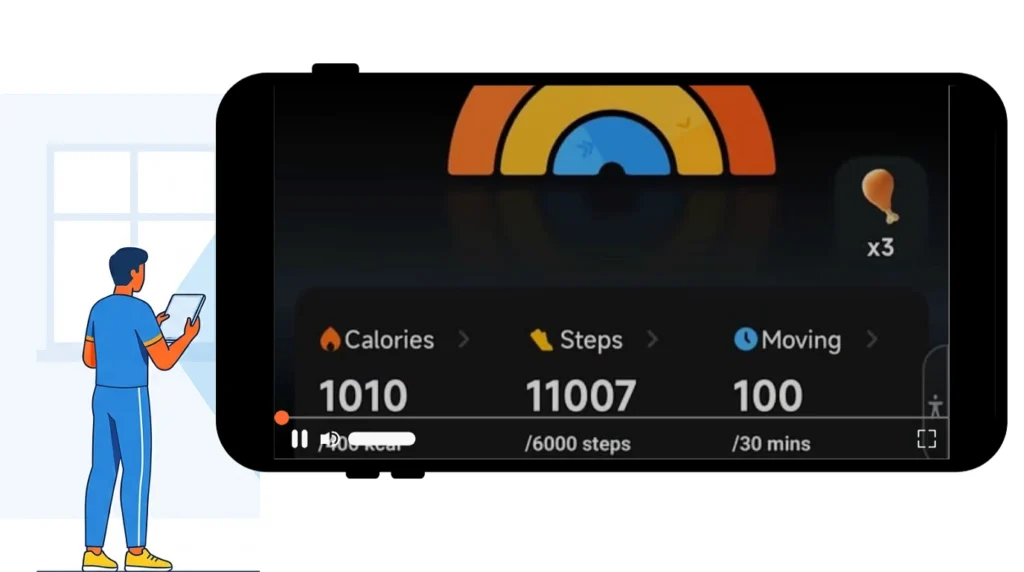
Monday through Friday, every activity ring closed. Tonight’s totals alone:
- 1,010 calories against a daily goal of 400.
- 11,007 steps against a target of 6,000.
- 100 moving minutes against a floor of 30.
Every one of those numbers cleared its goal by a wide margin. Some doubled it. The trend chart tells the part actually worth being proud of: last week’s daily average sat at 835 calories. This week, every day from Monday on cleared 900, with Thursday and Friday both pushing past 1,000.
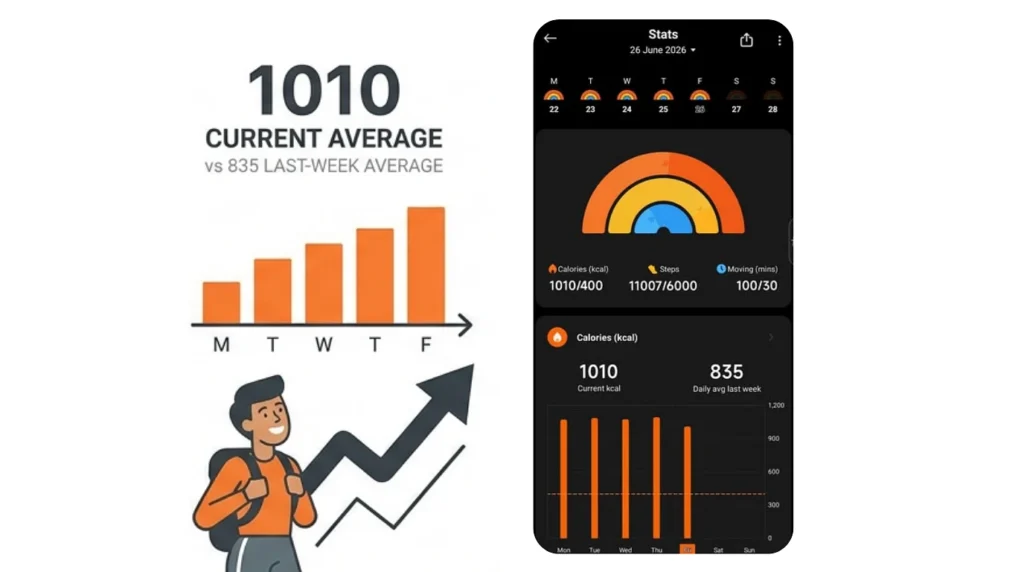
The line is climbing. The daily routine producing it is dead boring. Both true at the same time, and the boring part is exactly why the line climbs.
Quitting used to be a pattern. Go too hard, get sore, miss two days, never come back. Same story on repeat for years. This week the rings are stacked five deep. Saturday and Sunday are still empty, no question. But the week’s still alive and the chain hasn’t broken. That part is genuinely new.
A Word on the “18 Pounds a Year” Claim
There was a real temptation to drop a big number here. The math looks great on paper: an extra 175 calories a day works out to about 64,000 over a year, divide that by 3,500 and you get roughly 18 pounds of fat.
It’s not worth lying about, because real life didn’t play out that cleanly. Here’s the honest breakdown:
- The body adapts. Get fitter, maybe lighter, and the same loop burns a little less. The gap shrinks instead of holding flat.
- Hunger catches up. More running often means more eating. A slightly bigger dinner can quietly erase the calories the run just burned.
- That 3,500 rule is a rough guide, not a law. Weight change comes from total balance, not the run by itself.
The truthful version lands softer and still holds up. Keep the diet steady, avoid eating back everything that gets burned, and a loop like this contributes to a few real pounds over a year, not eighteen. That’s a solid return on 47 minutes of jogging without inflating it into something it isn’t. The mechanism works regardless of the exact number. No supplement does this. No app does this. A repeated park loop, run without skipping, does.
What This Whole Thing Comes Down To
The Friday run isn’t the achievement. Five nearly identical runs stacked across one week is the achievement.
Six kilometers tonight, on its own, is forgettable. Six kilometers again on Monday is the thing that actually moves the chart, and the body underneath it. The watch is going to buzz at 6:14 again on Monday. The loop is going to be the same shape around the same park. And the numbers, slow and quiet and undramatic, are going to keep climbing.
Years got wasted on the belief that results required suffering. They didn’t. What it took was simpler and harder all at once: show up, keep the effort easy enough to show up again tomorrow, and let the boring days pile into something that stops being boring.

