


Key takeaways
- Estrogen is directly signaling fibroblasts to produce collagen and elastin, and suppressing the enzymes that break collagen apart
- Perimenopause, not menopause, is when the fluctuation and decline in that signaling is starting to show on skin
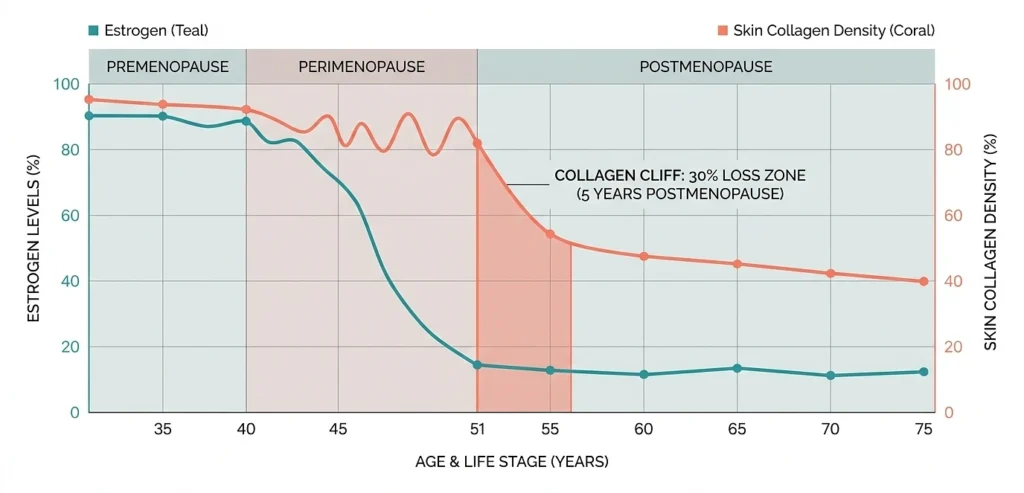
- Up to 30% of skin collagen is being lost in the first five years post-menopause, more correlated with estrogen deficiency duration than with chronological age
- Menopausal hormone therapy is producing measurable improvements in skin thickness and collagen content in peer reviewed trials, most pronounced when initiated within ten years of menopause
- Retinoids, sunscreen, and dermatologist supervised topical estrogen are the topical interventions with the strongest evidence base
- Most anti aging beauty products are working on the surface of a problem that has its mechanism several layers down, in the fibroblast receptor signaling that only estrogen is restoring
The women who are getting the most from midlife skincare are the ones who understand which layer of the problem they are actually treating. Cell turnover is one layer. Barrier function is another. UV protection is another. The estrogen fibroblast axis is the one underneath all of them, and that layer is only being reached by hormonal intervention, not by anything on a beauty counter.
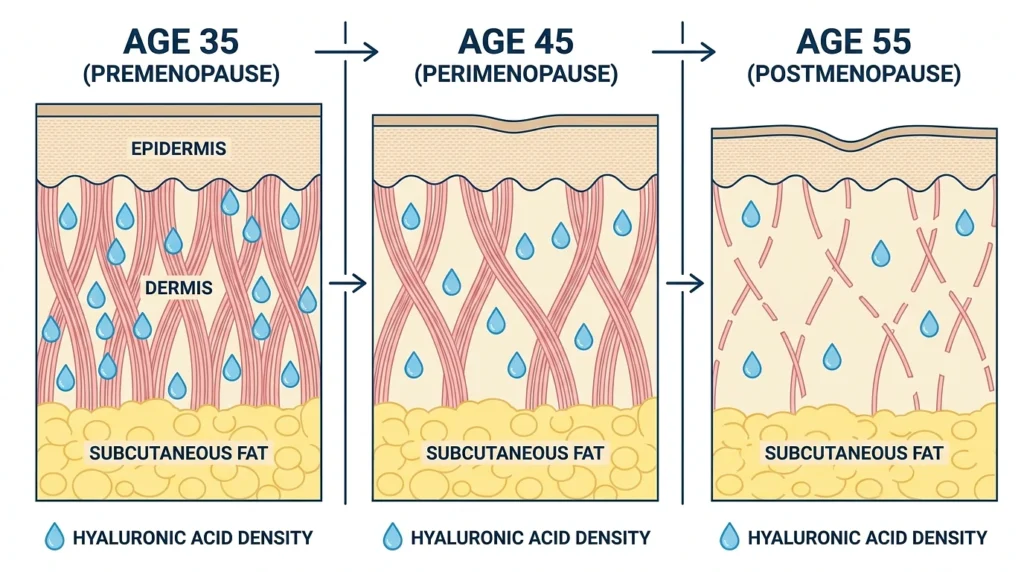
The verdict up front. In the first five years after menopause, women are losing up to 30% of the skin collagen they carried into midlife. Not gradually. Not slowly. In five years. And most of that loss is starting during perimenopause, before menopause is even confirmed, which is why so many women are describing their skin as changing overnight in their early forties.
That collagen cliff is not caused by aging. It is caused by estrogen dropping, and the mechanism is specific enough that dermatology has been studying it since the 1960s.
The 30 Percent Number, And Where It Actually Comes From
The figure cited across every menopause skin resource traces back to a widely referenced Climacteric review, and it has been reproduced in later dermatology and endocrinology literature. The finding is consistent across multiple decades of research.
| Timeline | What is happening to skin collagen |
| Perimenopause (typically ages 40 to 51) | Estrogen is fluctuating, then declining. Collagen loss is beginning but the rate is still gradual. |
| First 5 years post-menopause | Up to 30% loss of cutaneous collagen. This is the sharpest decline of any period in adult life. |
| Years 5 to 20 post-menopause | Approximately 2% loss per year, continuing steadily. |
| After 20 years post-menopause | The rate slows again but the cumulative loss is over 60% from pre-menopausal baseline. |
The Climacteric review specifically noted that the collagen loss is more closely correlated with duration of estrogen deficiency than with chronological age. That distinction matters clinically. A woman who reaches menopause at 45 and lives to 75 has thirty years of estrogen deficient skin. A woman who reaches menopause at 55 has twenty. Same age at death. Very different skin.
What Estrogen Is Actually Doing Inside Skin Cells
Skin is an endocrine organ. That is not a marketing claim, it is standard dermatology language, and it means the skin is not just responding to hormones circulating in the blood. It has receptors for those hormones built into its own cells.
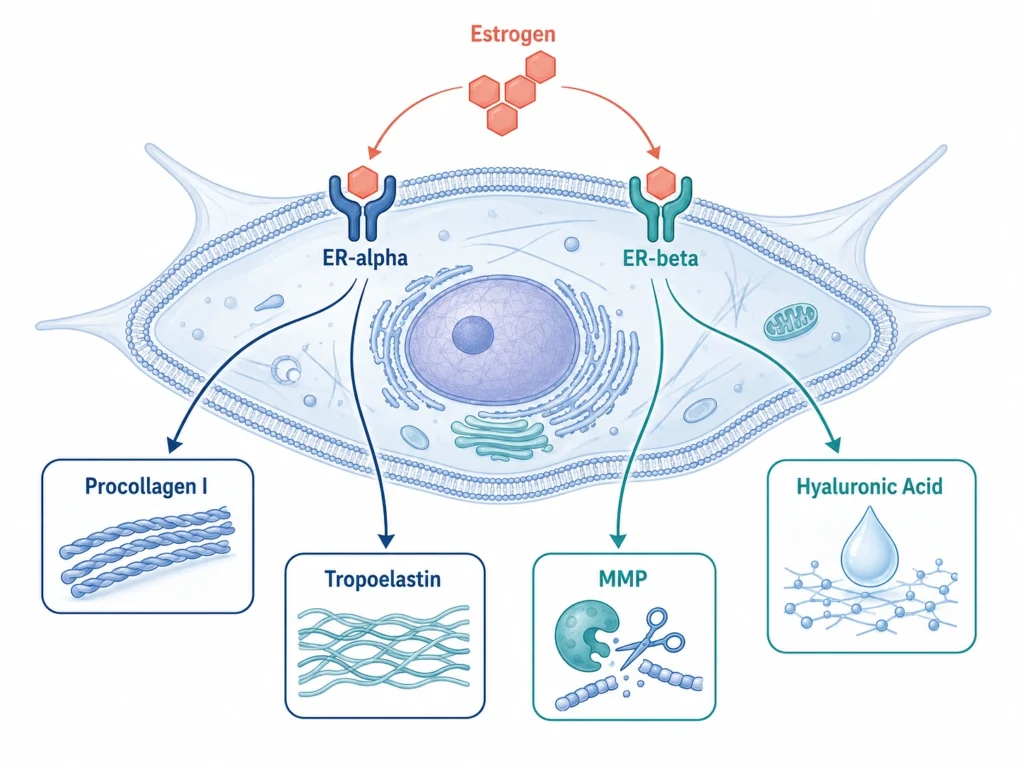
The specific receptors that matter here are estrogen receptor alpha and estrogen receptor beta, and they sit on the surface of dermal fibroblasts. Fibroblasts are the cells that build collagen. When estrogen binds to those receptors, four things are happening at once:
Procollagen I Production Is Being Stimulated
Procollagen I is the precursor molecule that gets processed into mature type I collagen, the dominant structural protein in the dermis. Estrogen binding to fibroblast receptors is increasing the transcription of the procollagen I gene. Less estrogen means less procollagen. Less procollagen means less collagen. That is the primary mechanism.
Elastin Components Are Being Maintained
Estrogen is also stimulating tropoelastin and fibrillin production. These are the components that form elastic fibers, the tissue that gives skin its ability to snap back into place after being stretched. When estrogen drops, elastin quality is declining alongside collagen quantity, which is why skin at 50 looks different from skin at 40 in ways that are not only about wrinkle depth.
Collagen degradation is being suppressed
This is the mechanism most beauty content skips. Estrogen is downregulating matrix metalloproteinases, or MMPs. MMPs are the enzymes that break collagen apart. When estrogen is present, MMP-1 and its relatives are held in check. When estrogen drops, MMP activity increases. So the collagen loss during and after menopause is not just about lower production. It is also about faster breakdown. Both mechanisms are working against skin at the same time.
Hyaluronic Acid Synthesis Is Being Supported
Estrogen is stimulating fibroblast production of hyaluronic acid, the molecule responsible for holding water in the dermis. Skin water content in postmenopausal women who are not on hormone therapy is measurably lower than in premenopausal women, and this is one specific reason skin is feeling drier and thinner during the transition, independent of what any moisturizer is doing on the surface.
Why Perimenopause Is When The Changes Are Showing Up, Not Menopause
Half the beauty industry is treating this as a menopause issue. It is not. It is a perimenopause issue that continues through and after menopause.
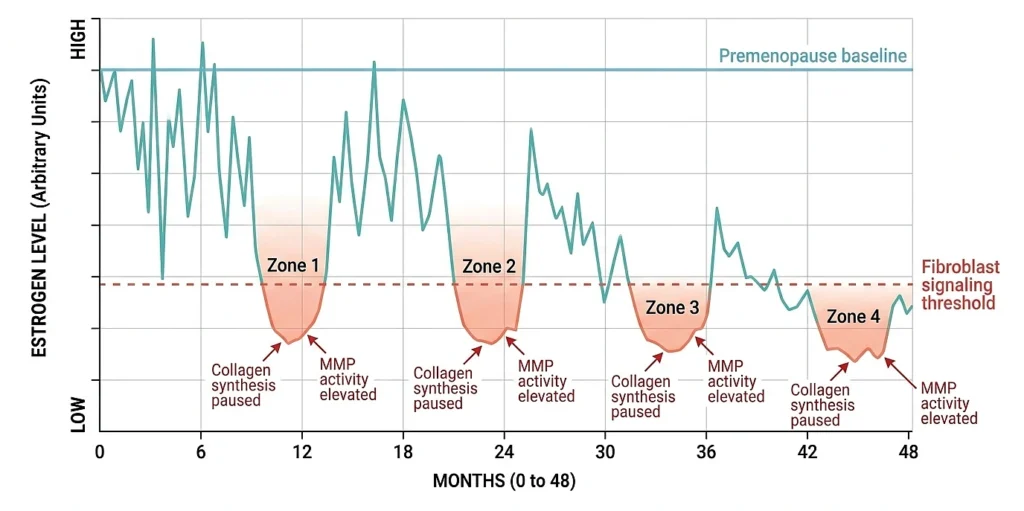
Perimenopause is the transition phase, typically starting in a woman’s early to mid forties and lasting an average of four to seven years before menopause is confirmed by twelve consecutive months without a period. During those years, estrogen is not steadily declining. It is fluctuating unpredictably, with some months at nearly premenopausal levels and other months significantly lower. The fibroblasts are receiving inconsistent signaling. Collagen synthesis is becoming erratic.
This is why so many women in their early forties are describing their skin as changing suddenly. The change is not sudden. The signaling is.
Now consider what that looks like practically. A woman is 43 and her estrogen dropped hard for three months while her fibroblasts stopped receiving the consistent signal to produce procollagen. MMP-1 activity increased during those three months. Her skin lost some collagen density she is not going to easily rebuild. Estrogen bounces back for a few months and her fibroblasts start producing again, but they are working from a lower baseline. That is the collagen cliff starting, years before the menopause diagnosis is going to be made official.
The Research On Menopausal Hormone Therapy And Skin
This is the part where beauty influencers and dermatology researchers are in very different places. Let me lay out what the peer reviewed evidence is actually saying.
Systemic estrogen replacement is increasing skin collagen content. A study cited in the European Medical Journal clinician’s review found a 6.49% increase in skin collagen after 6 months of oral estrogen therapy. Dermal thickness increased by 30% in a separate trial. Sator and colleagues published a prospective randomized double-blind placebo-controlled trial in Climacteric in 2007 showing measurable improvements in skin aging parameters with menopausal hormone therapy in postmenopausal women.
Topical estrogen is producing visible effects on treated skin. Verdier-Sevrain’s 2007 Climacteric review concluded that topical estrogen application is highly effective and safe when supervised by a dermatologist with expertise in endocrinology. The mechanism is direct binding at local estrogen receptors in the treated area, producing measurable increases in collagen density and skin thickness.
Timing matters more than dose. Later reviews are consistently finding that the beneficial effects on skin, along with the broader beneficial effects on bone and cardiovascular outcomes, are most pronounced when hormone therapy is initiated within ten years of menopause. Starting hormone therapy in the mid-fifties for a woman who has been menopausal since 47 is producing weaker results than starting it earlier.
Hormone therapy is not being prescribed solely for skin, and it should not be. This is the correction to the wellness industry version of the story. Verdier-Sevrain herself is clear on this point. Menopausal hormone therapy carries real risks and real benefits. Skin health appearance is not sufficient justification to take on those risks. But when a woman is already considering hormone therapy for hot flashes, sleep disruption, bone protection, or genitourinary symptoms, the skin benefit is a real additional consideration in the risk-benefit calculation, not a marketing add-on.
What Is Genuinely Working Topically For Perimenopausal Skin
This is the shorter section because the honest evidence base is smaller than the beauty aisle is suggesting.
- Retinoids – The most evidence-based topical intervention for aging skin at any age, working through a completely different mechanism than estrogen and additive to it. Prescription tretinoin or over-the-counter retinol are both increasing cell turnover and stimulating collagen synthesis through retinoic acid receptor signaling.
- Sunscreen – UV radiation is upregulating the same MMP enzymes that estrogen decline is failing to suppress. Photoaging and estrogen deficient skin aging are combining, not adding. Daily broad-spectrum SPF 30 or higher is preventing the amplification.
- Peptides – Some peptide sequences are showing modest evidence for stimulating collagen synthesis in vitro and in small clinical trials. The effect is real but small compared to retinoids or systemic estrogen.
- Topical estrogens under dermatological supervision – Genuinely effective per the Verdier-Sevrain review, and different from over the counter phytoestrogen products which are largely unsupported by evidence.
- Collagen peptide supplements (oral) – The evidence is modest but consistent. Hydrolyzed collagen peptides at 5 to 10 grams daily for at least 8 to 12 weeks are showing measurable improvements in skin elasticity in multiple trials.
Everything else in the anti aging aisle is marketing. Bio-tech ingredients, plant derived exosomes, lab grown vegan collagen, cellular longevity serums, all of it is downstream of the same question. Are you rebuilding what estrogen is no longer signaling for. Most of it is not.
The Correction To The Beauty Industry Story
Half the internet is telling women in their forties that the right skincare routine can address perimenopause skin changes. That is not what the research is saying.
The 30% collagen loss in the first five years post-menopause is not being reversed by a moisturizer. It is being reversed, per the peer reviewed literature, by systemic or topical estrogen delivered under medical supervision. Retinoids are helping. Sunscreen is helping. Sleep and protein intake and resistance training are helping. But the fundamental mechanism, the fibroblast estrogen receptor signaling, is only being restored by estrogen.
That is not a recommendation for every woman in perimenopause to start hormone therapy. It is a correction to the story that all of this can be handled at the drugstore.