

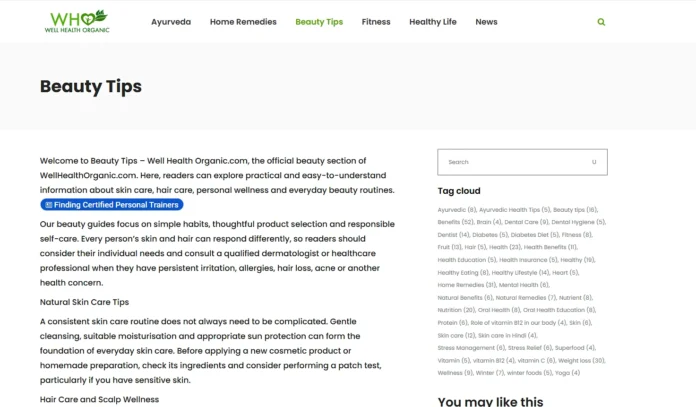
This is our post two of creating wellness content awareness to keep you safe from online scams. Today we found another fake keyword people are promoting to scam online and the search term is Beauty Tips – WellHealthOrganic.com.
There is no such service or website officially selling any products in India for this, all the domains, even the screenshot we attached, the site is giving a sense of the logo of WHO you can see above. This is very confusing. What these sites do is they may take your card information and may save it. No product would be delivered because no such product exists, it’s fake.
What is Beauty Tips – WellHealthOrganic.com?
This is a search phrase, not a single verified publisher. It refers to natural skincare and haircare content associated with the WellHealthOrganic name, covering home remedies, Ayurvedic practices, diet and daily routines for skin and hair.
The complication is that no single confirmed source sits behind the term. When you search it, several different websites appear, more than one of them using a slightly altered spelling of the domain while writing as though they are the original.
What the search results actually contain:
- Two near-identical domains competing for the same phrase. One is spelled wellhealthorganice.com. Another is wellhealthorganik.com. Both address readers as though they are the site the keyword names, and one opens with “Welcome to beauty tips – well health organic.com” while sitting on a different address altogether.
- A fabricated-looking statistic. One top-ranking page states that switching to chemical-free beauty products reduces skin irritation by 65 percent. No citation appears anywhere on that page, and no study producing that figure can be located. A precise percentage with no source is the most common form of invented data in health content, because specific numbers persuade readers more effectively than general claims.
- Paid placement presented as coverage. One result sits on a national newspaper’s website under a
partner-exclusivespath, which is that publisher’s own label for advertising rather than journalism. It quotes an unnamed college student praising the platform, a testimonial constructed so that it cannot be verified. - Unsourced authority claims. Another page calls the brand “a very trusted website” and “globally renowned,” without saying trusted or renowned by whom.
- No named authors, reviewers or clinicians on any of them. No dermatologist, no trichologist, no editorial credentials of any kind.
What this means for you: the beauty advice on those pages is not all wrong. Coconut oil, adequate sleep, hydration and leafy vegetables are all reasonable. But because none of the pages cite sources, you cannot tell which parts were checked against research and which were generated to fill space around a high-volume keyword.
This guide below covers the same ground with sources attached to every claim.
How To Check Any Beauty Or Health Page in Under a Minute
Three questions, worth applying well beyond this particular search.
- Does it cite a source for its numbers? Not “studies show” or “research proves.” A named study, journal, or professional body you can open.
- Does it name a human being? A dermatologist, a trichologist, an author with credentials that can be looked up. “Our team of experts” is not a name.
- Does these domains match what the page claims to be? A page presenting itself as a brand’s official site while sitting on a differently spelled address has answered the question for you.
Hair Care: This is Where The Evidence is Clearest
American Academy of Dermatology guidance is unglamorous and it works.
- Shampoo the scalp, condition the lengths. Most people do the reverse. Shampoo is a detergent designed for where oil is produced. Conditioner belongs on the oldest and most damaged inches.
- Dry with a cotton t-shirt or a soft towel. Terry towelling roughens the cuticle, which is what creates frizz.
- Wide-tooth comb on wet hair, because that is when hair stretches and snaps most easily.
- Limit flat irons and curling tools. Heat is the biggest avoidable damage source and no oil reverses it.
- Avoid tight styles worn every day. Repeated tension at the hairline produces traction alopecia, and it is often permanent by the time anyone notices.
Oil Massage, Described Accurately
Coconut and almond oil massage is the standard recommendation in Indian households and it does have a mechanism, though not the usual one.
Oil does not nourish hair. Hair is dead protein. What oil does is reduce the swelling and protein loss that occur when hair absorbs water during washing, which is why applying it before a wash achieves more than applying it after.
Amla earns its place for a specific reason. It is among the richest natural sources of vitamin C, and vitamin C is required for collagen synthesis. That is biochemistry, not tradition.
The Ubtan, Including The Part That Complicates It
Besan, haldi and chandan is more than ritual.
Curcumin has documented anti-inflammatory and antioxidant activity, with clinical studies on colourless turmeric extract showing reductions in fine lines and hyperpigmented patches. Besan is a mild exfoliant, gentler than sugar or salt scrubs because it lifts dead cells without causing microtears. Sandalwood contributes santalol.
Now the complication. A randomised study found a turmeric and sandalwood cream reduced radiation dermatitis in cancer patients. A separate, larger trial then found curcumin on its own performed no better than placebo, which suggests the sandalwood oil carried much of the effect.
Turmeric is not useless. It is probably not the ingredient doing most of the work in the combination it gets credited for.
Patch test before use. Turmeric causes contact dermatitis in a minority of people. Apply a little behind your ear a day before it goes near your face.
Supplements Help Only If You Are Actually Deficient
The point most beauty guides skip entirely.
If hair loss is sudden, heavy or unusual, the useful next step is a blood test rather than a bottle. Ferritin, vitamin D, thyroid function and hormones are the standard checks, and any of them coming back low explains more than a hair oil will.
Supplements taken without a confirmed deficiency are mostly expensive urine. Taken when you are genuinely low, they change things measurably.
Sources
- American Academy of Dermatology, hair care and damage prevention: https://www.aad.org/public/everyday-care/hair-scalp-care/hair/healthy-hair-tips
- Turmeric, Curcumin, and Curcuminoids: A Dermatologic Review: https://practicaldermatology.com/columns/clinical-focus-1/turmeric-curcumin-and-curcuminoids-a-dermatologic-review/23377/
- Clinical Studies on Topical Curcumin, Skin Pharmacology and Physiology: https://karger.com/spp/article/36/5/235/870348/Clinical-Studies-on-Topical-Curcumin
- Sandalwood oil and turmeric cream for radiation dermatitis, randomised study: https://www.ncbi.nlm.nih.gov/pmc/articles/PMC5622378/

