


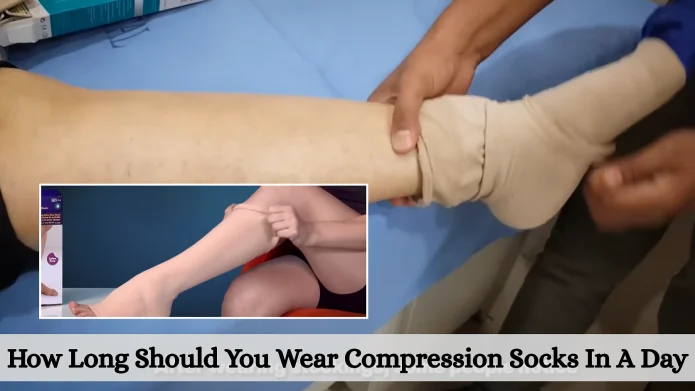
Swelling in the lower legs begins within minutes of standing up. Fluid that drained back toward the heart overnight runs down into the ankles as soon as the feet take weight, and a sock that squeezes the leg is useful from that minute until the leg is flat again at night. That is the reason every patient leaflet gives the same answer to the hours question. The socks go on first thing in the morning and come off at bedtime, which for most people is 12 to 16 hours, and the count matters a lot less than the 2 ends of it.
The mornings, the nights, long flights, the weeks after an operation, the signs of a pair that fits wrong and the people who should not wear one at all are each covered below, and the last section is about the sock itself, which gives out long before it looks worn.
Put them on before your feet touch the floor, take them off when you get into bed, and do not sleep in them unless a doctor has given a reason to.
Why They Go On Before Your Feet Touch The Floor
The legs are at their thinnest first thing in the morning, after 7 or 8 hours lying flat with the blood and fluid drained back toward the heart. Within a few minutes of standing, fluid starts pooling again in the ankles and feet, and by mid morning a leg that swells can be a size bigger than it was in bed. A sock put on at that point is fighting swelling that has already arrived. A sock put on while still sitting on the edge of the bed is holding a leg that has not swollen yet, which is a much easier job, and it is the reason every patient leaflet says the same thing about the morning.
Keep the pair on the nightstand, not in a drawer across the room. Sit up, swing the legs over the side, put the socks on, then stand. If the legs have been up for more than 10 minutes, lie down again for 10 before putting them on, which is what the vascular nurses tell people to do.
They are hard to get on, and that is normal, since a sock that slides on easily is not squeezing anything. MedlinePlus lists the tricks: dry legs, a little cornstarch or powder, rubber dishwashing gloves to grip the fabric and smooth it up, or a frame called a stocking donner for anyone who cannot reach their feet. No lotion right before, because the sock will not slide over it, and no folding the top over, because a folded band doubles the pressure in one ring and cuts off the very flow the sock is there to help.
What Happens If You Sleep In Them
For most people, nothing much either way. Lying flat, the veins do not have to push blood uphill, so the squeeze the sock gives is doing a job that does not need doing. Meanwhile the skin under the sock has been covered for 16 hours already and would rather have the night to breathe, and a sock that bunches behind the knee in sleep can press hard in one spot for hours without anyone feeling it. The manufacturers say take them off at night for that reason, and the vascular units say the same.
The exception is the hospital kind. After certain operations, and in the days after a diagnosed clot, patients are told to keep the stockings on day and night, sometimes for 2 weeks, because a person lying still with the calf muscles not pumping is at real risk of a clot forming, and in that situation the sock is doing a different job. That instruction comes from a surgeon or a ward, in writing, with a date on it. It is not something to copy for an ordinary swollen ankle.
If the legs ache at night even with the socks off, the position is usually what needs changing. Legs up on a pillow so the ankles sit above the heart drains them the way standing all day filled them, and the sleeping positions post on this site goes through where the pillow goes for that and a few other complaints.
How Many Hours Is Too Many
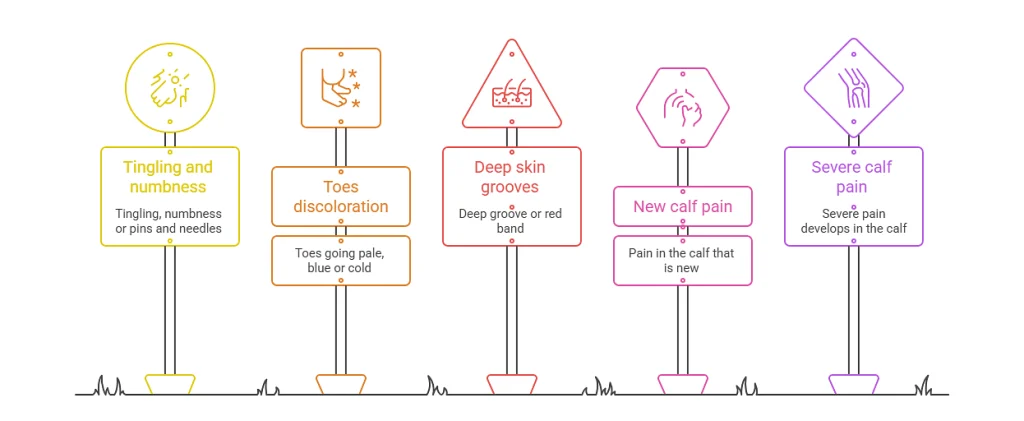
There is no number. None of the clinical guidelines set a maximum, and a person with chronic venous disease wears them from waking to bed every day for the rest of their life without harm. A 16 hour day in a well fitted pair is normal. What is too many is any number of hours in a pair that does not fit, and the body will show it.
- Tingling, numbness or pins and needles in the foot while the sock is on.
- Toes going pale, blue or cold compared with the other foot.
- A deep groove or a red band at the top of the sock that is still there an hour after it comes off.
- Pain in the calf that is new, rather than the dull ache the sock was bought for.
The first 3 mean the pair is too tight or the wrong size, and the answer is to take it off, let the leg recover and get measured again, usually first thing in the morning when the leg is at its true size. The last one is different. The Royal Berkshire NHS leaflet on compression hosiery puts it in one line, stop wearing the stocking and seek advice straight away if a severe pain develops in the calf, because that can be a clot and the sock is the wrong thing to have over it.
A good fit feels snug all day and leaves a faint mark that fades in minutes. Anything beyond that is a fit problem, and more hours will not fix it.
One more thing on hours. The leaflets also say it can take up to 8 weeks of daily wear before it is clear whether the socks are helping the original problem, so a fortnight of “these do nothing” is too early to judge them.
Wear Time By The Reason You Bought Them
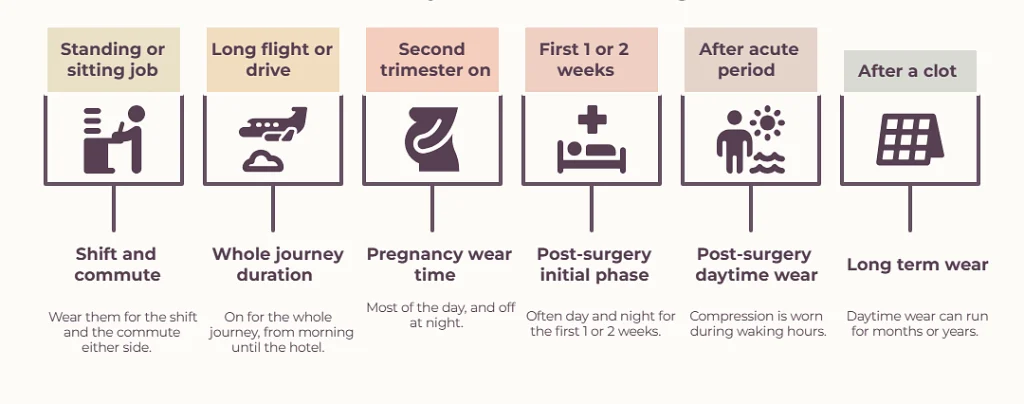
The up and down rule covers most people, but the reason behind the socks changes the edges of it.
A Standing Or Sitting Job
Nurses, hairdressers, warehouse staff, drivers and anyone at a desk for 9 hours wear them for the shift and the commute either side, and take them off when they get home and get the feet up. That is 10 to 12 hours. A 15 to 20 mmHg pair from a pharmacy is the usual level for this, and no prescription is needed for it.
A Long Flight Or Drive
On for the whole journey, from the morning of travel until the hotel, which on a long haul day can be 20 hours and is fine. A Cochrane review of 12 trials, which Cleveland Clinic cites on its compression stockings page, found a large drop in the symptomless clots that form on long flights among passengers who wore them. Below the knee is enough, and they go on before the airport, not on the plane.
Pregnancy
Most of the day, from the second trimester on, as the swelling arrives, and off at night the same as anyone else. The pair gets refitted as the legs change, which they will.
After Surgery Or A Clot
Whatever the discharge sheet says, which is often day and night for the first 1 or 2 weeks and then daytime only, and the University Hospitals Birmingham leaflet is plain that once the acute period is over, compression is worn during waking hours. After a clot the daytime wear can run for months or years to keep the leg from the long term swelling that follows a DVT.
Varicose Veins Or Venous Insufficiency
From getting up to lying down, every day, for life. This is the group the socks were invented for and the one where skipping days shows fastest, because the swelling comes back within a day of stopping.
Sport
During the run and for a few hours after, or after only. The evidence here is for less soreness the next day, not for running faster, and the pair comes off once the legs feel normal. Swelling after a twisted ankle is a different thing and gets the ice and the 4 step check in the ankle piece on this site before anyone reaches for compression.
When The Answer Is Zero Hours
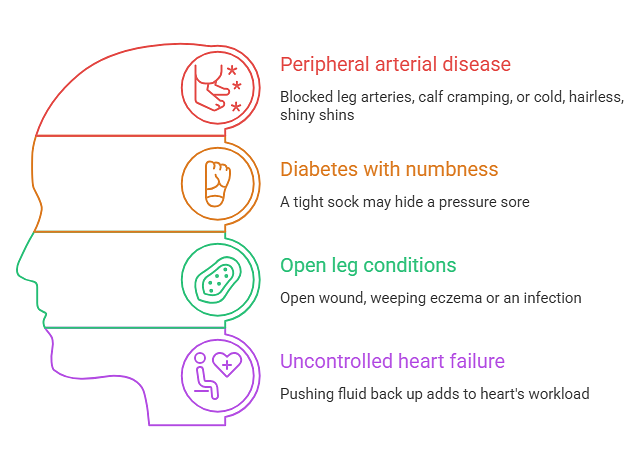
A few people should not wear them at all, or not without a doctor checking the circulation first, and the hours question does not apply to them. Squeezing a leg only helps when the arteries bringing blood down into it are open. When they are narrowed, the squeeze makes a bad supply worse.
- Peripheral arterial disease, or any history of blocked leg arteries, cramping in the calves on walking, or cold, hairless, shiny shins.
- Diabetes with numbness in the feet, because a sock that is too tight will not be felt, and a pressure sore can be days old before it is seen.
- An open wound, weeping eczema or an infection on the leg, which needs dressing before anything goes over it.
- Heart failure that is not yet controlled, since pushing fluid back up out of the legs adds to what the heart has to handle.
For the first 2, a doctor or vascular nurse will usually do a quick test called an ankle brachial index, a blood pressure cuff at the ankle compared with one at the arm, and the result decides whether compression is safe and at what strength. It takes 10 minutes and it is the test to ask for before buying a 20 to 30 mmHg pair for a parent in their seventies.
The Pair Wears Out Before It Looks Worn
A sock that goes on every morning and through the wash every night keeps its squeeze for about 6 months, and after that the elastic lets go slowly enough that the owner does not notice. The sock still looks fine but it has stopped pressing. MedlinePlus puts the replacement at every 3 to 6 months and the manufacturers say roughly the same, so the real wear time of a pair is about 180 days, and a pair from 2 years ago is doing nothing for the leg.
Two things stretch that out. Washing by hand or on a cool cycle and drying flat, never in a dryer, since heat is what kills the elastic. And owning 2 pairs and swapping them day about, so each one gets a day to recover its shape between wears and the whole set lasts closer to a year.
The daily wash matters. Sixteen hours against the skin leaves sweat, dead skin and whatever cream was on the legs in the fabric, and a sock worn 3 days running is the usual cause of the itch people blame on the compression. Wash it, dry it flat, and put it back on the nightstand for the morning.