


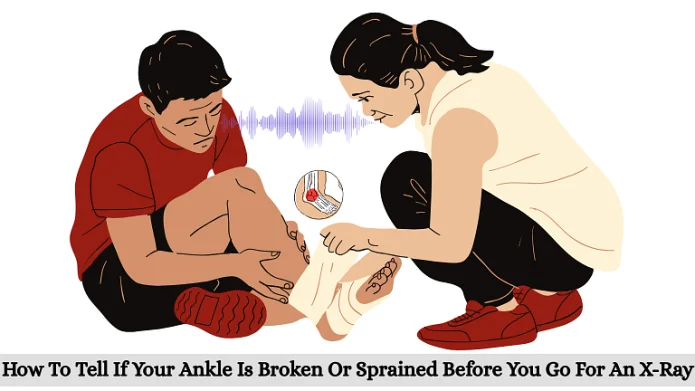
There is no way to be certain from home. Only an X-ray shows bone, and a bad sprain and a small break can look the same from the outside, swell the same, and hurt about the same for the first day. What can be done at home is the check that emergency departments themselves use to decide who needs an X-ray and who does not, and most of it can be run sitting on the edge of a bed with the sock off.
Can you take 4 steps on it?
That is the first question, and it is the one the doctor will ask before touching the ankle. The rest of this post goes through the full check, what the answers mean, what a sprain feels like compared to a break, the signs that mean going in tonight rather than waiting, and why a small number of breaks get missed even with the check done right.
The Check Emergency Doctors Use To Decide Who Gets An X-Ray
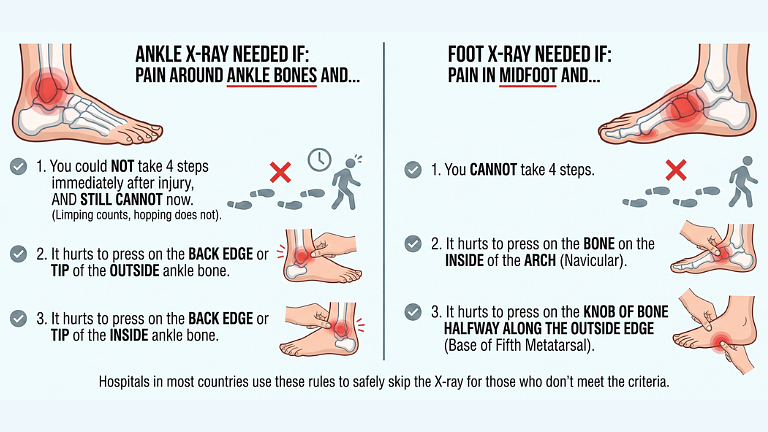
The check is called the Ottawa Ankle Rules. It was worked out at the Ottawa Civic Hospital in Canada in the early 1990s by a team led by Dr. Ian Stiell, because at the time almost everyone who came in with a twisted ankle was being X-rayed and only about 15 in 100 of those X-rays showed a break. The rules were written to pick out the people who could safely skip the X-ray, and hospitals in most countries use them today.
The rule says an ankle X-ray is needed if there is pain around the ankle bones and any one of the following is true.
- You could not take 4 steps on it straight after the injury, and still cannot now. Limping counts as a step. Hopping on the other foot does not.
- It hurts to press on the back edge or the tip of the outside ankle bone, the bump on the outside of the ankle, and the tender spot is on the bone itself.
- It hurts to press on the back edge or the tip of the inside ankle bone, the bump on the inside.
There is a second part for the middle of the foot, and an X-ray of the foot is needed if there is pain in the midfoot and either you cannot take the 4 steps, or it hurts to press on the bone on the inside of the arch, called the navicular, or on the knob of bone halfway along the outside edge of the foot, which is the base of the fifth metatarsal.
How To Press In The Right Place
Use one finger, not the whole hand. On the outside ankle bone, run the finger along the back edge of the bump, from about 2 inches above it down to the very tip, pressing firmly as you go. Then do the same on the inside bump. Soft tissue in front of and below the bump will probably be sore after a sprain, and that is not what the rule is asking about. The rule is only positive if the pain is on the bone itself, on its back edge or its tip, not in the soft swollen area in front of it. That distinction is the whole reason the test works, because sprained ligaments sit in front of and below the ankle bones, and breaks happen in the bones.
How Good The Check Is
A review published in the BMJ in 2003 pooled 27 studies covering more than 15,000 patients and found the rules picked up about 98 in 100 ankle breaks. The 1995 validation study in Annals of Emergency Medicine found a lower figure, around 95 in 100, and also found that a doctor’s gut feeling alone caught only 69 in 100, which is why hospitals adopted the rule. So if every part of the check is negative, meaning the 4 steps can be taken and none of the bone points are tender, the chance of a break is somewhere around 1 or 2 in 100. Low, but not zero, and the last section of this post is about that 1 or 2.
What A Sprain Feels Like Compared To A Break
Most of the things people are told to look for do not separate the two. Swelling comes with both. Bruising comes with both, and after a bad sprain the bruise can spread down to the toes within 2 days and look far worse than a small break would. A pop or a snap at the moment of injury comes with both too, because a tearing ligament makes a sound. So the usual list of symptoms does not settle it, and that is why the pressing test above exists.
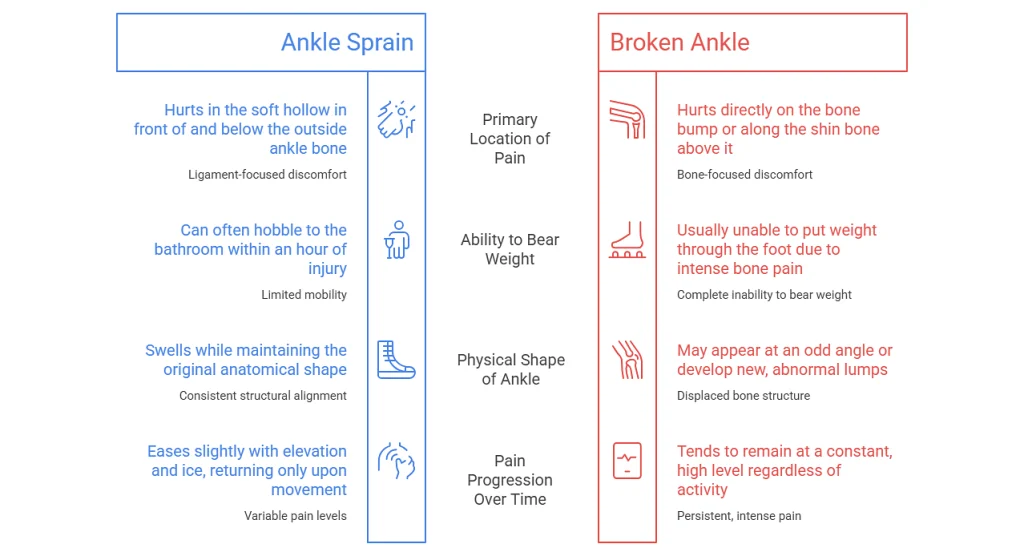
The things that do point one way or the other are where it hurts, whether weight can go through it, the shape of the ankle, and how it feels an hour later.
Where It Hurts
A sprain hurts in front of and just below the outside ankle bone, in the soft hollow, because that is where the ligament that gets torn most often sits. A break hurts on the bone, on the bump itself or along the shin bone above it. Press both spots and notice which one makes you pull the foot away.
Whether Weight Can Go Through It
Many people with a sprain can hobble to the bathroom within an hour, badly, but they can do it. A person with a break usually cannot, and if they try, the pain is in the bone and not in the joint. This is why the 4 steps question carries so much weight in the rule.
The Shape Of The Ankle
A sprain swells but the ankle keeps its shape. A displaced break, where the bone ends have moved, changes the shape, so the foot sits at an odd angle or there is a lump where there was not one before. Mayo Clinic lists an ankle that looks out of place among the symptoms of a broken ankle, and that one is not a sprain.
How It Feels An Hour Later
Sprain pain usually eases a little once the foot is up and iced, and comes back when it is moved. Break pain tends to stay at the same level whatever you do with it, and it is often worse at night.
None of these 4 are proof on their own. They shift the odds, and they are what the doctor is weighing alongside the pressing test.
Signs That Mean Going In Tonight, Not Tomorrow
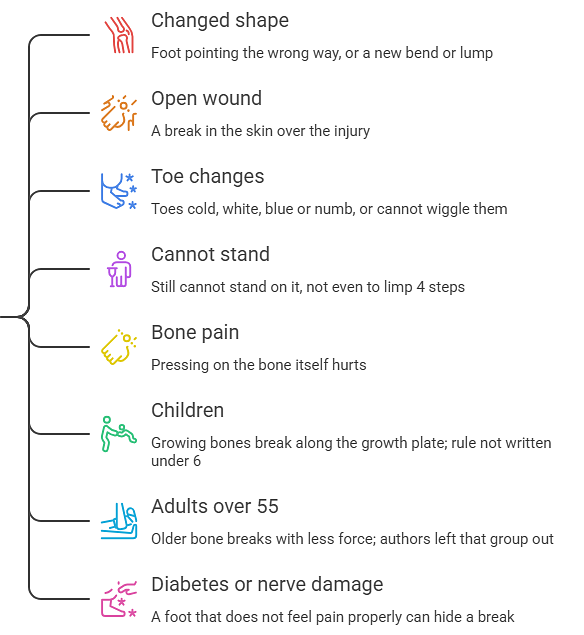
Some things take the pressing test off the table altogether, because they mean the ankle needs to be seen whatever the rule says. If any one of these is true, the question is not whether to get an X-ray but how to get to one.
- The foot is pointing the wrong way, or there is a bend or a lump in the ankle that was not there this morning.
- There is a break in the skin over the injury, even a small one, because a broken bone under an open wound is an emergency.
- The toes are cold, white, blue or numb, or you cannot wiggle them, which can mean the blood supply or a nerve is caught.
- You could not stand on it at all at the time and still cannot now, not even to limp 4 steps.
- Pressing on the bone points in the test above hurts, on the bone itself.
Two groups should go in on a lower bar than everyone else. Children, because growing bones break along the growth plate in a way that looks like a sprain and the rule was not written for anyone under 6, and adults over 55, because older bone breaks with less force and the rule’s authors left that group out as well. The same goes for anyone with diabetes or nerve damage in the feet, since a foot that does not feel pain properly can hide a break for days.
If the ankle has changed shape, if there is a wound over it, if the toes have gone cold or numb, or if 4 steps are impossible, go tonight. Everything else in this post is for the person whose ankle has none of those.
What To Do Tonight If The Check Points To A Sprain
If the 4 steps can be taken, none of the bone points are tender, the ankle has kept its shape and the toes are warm and pink, the odds are heavily on a sprain, and a sprain is treated at home for the first 2 days.
Get the foot up above the level of the hip, on 2 pillows on the sofa, and keep it there as much as the evening allows. Ice wrapped in a towel for 15 to 20 minutes at a time, then off for at least an hour, and never straight on the skin. A compression bandage, firm but not tight, taken off at night. Weight on it only as far as it allows without sharp pain, because a little walking in the first days helps a sprain heal faster than complete rest, and the American Academy of Orthopaedic Surgeons says the same on its sprained ankle page. Ibuprofen or acetaminophen for the pain if there is no reason you cannot take them.
The 48 Hour Recheck
The pressing test has a known weak point, which is that a very swollen ankle is sore everywhere for the first few hours, and a tender bone can be hard to pick out from tender skin on the night of the injury. So the check is done again after 2 days, when the swelling has come down.
If at 48 hours the 4 steps are still not possible, or pressing on the bone points still hurts on the bone, that is an X-ray, even though the first night looked like a sprain. A sprain is usually clearly better by the second morning, not healed, but better. An ankle that is the same or worse on day 3 needs a look.
The other thing that comes out at 48 hours is where the bruise has settled. A bruise that stays around the outside ankle fits a sprain. A bruise that has come up on the inside of the ankle as well, or along the shin above the bump, means both sides took damage, and that pattern is more often seen with a break or a bad high sprain, and either way it needs the X-ray.
Why Some Breaks Still Get Missed
The rule catches around 98 in 100 breaks when it is done properly, and the 2 it misses are mostly of one kind. They are small flake fractures, where a ligament pulls a chip of bone off the end of the ankle bone instead of tearing itself. These are called avulsion fractures. They hurt in roughly the same place as a sprain, they let most people take the 4 steps, and in many cases the treatment is the same as for a bad sprain anyway, a boot or a brace and a few weeks off running, so a missed one is usually not a disaster. The X-ray mostly matters for how long the brace stays on.
The second group that gets missed is the midfoot. The ankle rule only covers the ankle and the middle of the foot, not the toes and not the heel, and a twisting injury can break the base of the fifth metatarsal, the knob halfway along the outside of the foot, while the ankle itself is fine. That is why the foot part of the rule exists, and why the knob is one of the bone points to press. Injuries to the front of the foot sit outside the rule altogether, which is the case with turf toe, the big toe joint sprain covered here, where the ankle rule has nothing to say and the toe is judged on its own.
The third reason is timing. The rule was built for injuries seen within 10 days, and an ankle that has been limped on for 2 weeks and is still swollen is past the point where the rule applies, so it is X-rayed on the history alone. The same goes for a sprain that keeps rolling over in the months afterward, because an ankle that gives way on flat ground has a ligament that did not heal and a doctor will want pictures of the joint even though nothing is broken.
So the home check does what it was designed to do, which is tell the person with the sore, swollen, fully weight bearing ankle that the X-ray can wait and the ice can start. It was never meant to replace the X-ray for the person who cannot walk on it, so if that is you, go and get the picture taken.