


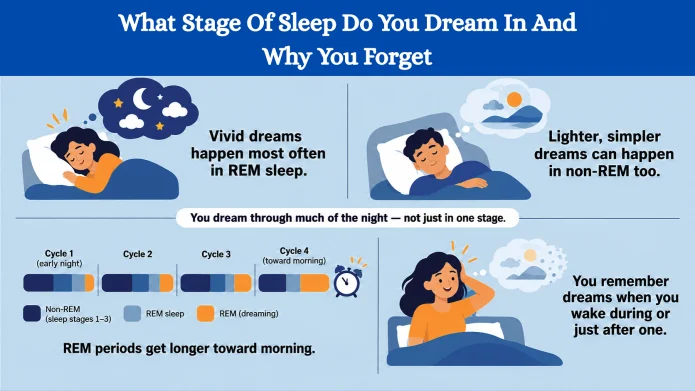
Try this before reading the rest. Tomorrow, set the alarm 20 minutes earlier than usual, and when it goes off, lie still for a moment before you reach for the phone. There is a fair chance a dream will be sitting right there, clear enough to tell someone about. Then do the same thing the next day with the alarm 20 minutes later than usual, and notice how often there is nothing at all. Those two mornings show the main point. You dream through much of the night, in more than one stage, and the dreams you remember are the ones the alarm, or the bladder, or the dog interrupted.
You Dream In REM Sleep, And In The Other Stages Too
For about 50 years the answer was simple. People dream in REM sleep, the stage where the eyes dart under the lids, the big muscles go slack, and the brain’s electrical activity looks almost like being awake. Wake someone from REM and roughly 8 times out of 10 they will describe a dream. Wake them from the deeper, slower stages and they mostly said no, so dreaming and REM were treated as the same thing.
That was only half right. Later studies that woke people from non-REM sleep and asked more carefully found dreams there as well, in something like 4 or 5 awakenings out of 10. The non-REM ones are usually shorter, plainer and more like a thought than a film a sense of being at work, a half-formed conversation, a single image. The REM ones are the long, strange, vivid stories with a plot that falls apart when you try to retell it.
So the stage you dream in is REM for the vivid dreams and every stage for some kind of dreaming. A sleep lab in Wisconsin showed this directly a few years ago. The researchers wired volunteers with 256 EEG electrodes, woke them hundreds of times across the night, and found a patch at the back of the brain, over the visual and parietal areas, that went quieter in slow waves whenever a person was dreaming, no matter which sleep stage the chart said they were in. They could tell from that one region whether a sleeper would report a dream before asking.
When REM Sleep Happens Across The Night
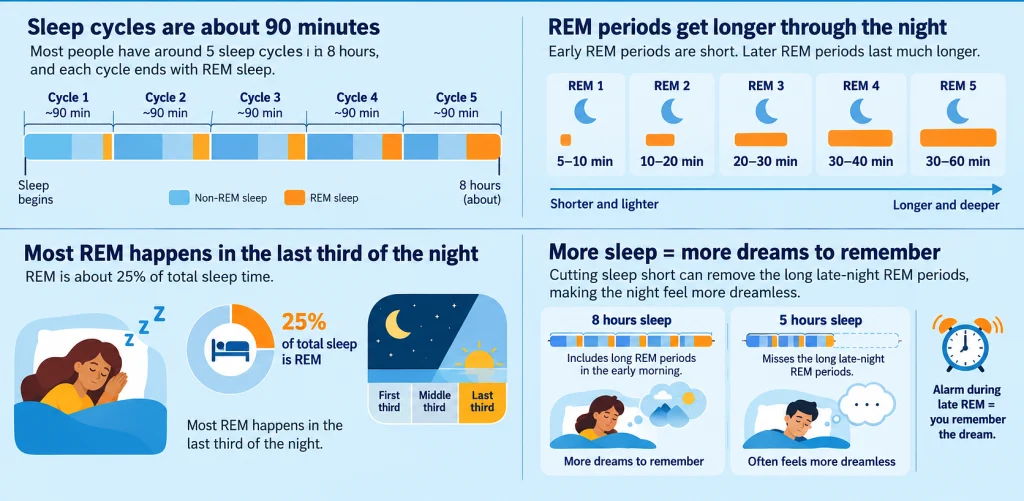
REM doesn’t arrive all at once. Sleep runs in cycles of about 90 minutes, and each cycle ends with a stretch of REM.
- The first REM period of the night comes around 90 minutes after you fall asleep and lasts only 5 or 10 minutes.
- Each cycle after that, the REM stretch gets longer and the deep sleep gets shorter.
- By the last cycle before morning, REM can run 30 to 60 minutes straight.
- Across a full night, REM adds up to about a quarter of your sleep, and most of it is packed into the last third.
That schedule explains the alarm experiment. The last 2 hours of sleep hold the longest REM periods, so an alarm that lands inside one wakes you mid-dream, with the whole thing still playing. An alarm that lands after the REM period has ended, when the brain has slid back into light non-REM, wakes you to a blank.
It also explains why a short night feels dreamless. Cut sleep from 8 hours to 5 and you haven’t lost 3 hours of dreaming spread evenly. You’ve lost almost all the REM, because the long REM periods are at the end you cut off.
Why Most Dreams Are Forgotten Within Minutes
The dream you remember at 7 a.m. is probably the fourth or fifth of the night. The others are gone and were never going to be kept.
During REM, the brain runs low on noradrenaline, the chemical that helps lock an experience into memory while you’re awake. The hippocampus, which files new memories, is also partly cut off from the outer cortex during sleep, so what’s happening in the dream doesn’t get written to long-term storage the way the morning commute does. A dream only gets saved if you wake up while it’s still running, or within a minute or two of it ending, and then only if you hold it in mind long enough for the awake brain to file it. Roll over and go back to sleep and it’s gone.
- Waking up to noise or a phone screen, which fills working memory with something else before the dream is stored.
- Getting up fast. The brain needs a short, quiet window to transfer the dream.
- Alcohol in the evening, which suppresses REM in the first half of the night and then produces a crowded, intense REM rebound in the second half. People remember vivid, odd dreams after drinking for that reason, and don’t remember the night’s earlier ones at all.
- Antidepressants in the SSRI family and some blood pressure drugs, which cut REM time or change how vivid it is.
Why Some People Remember Dreams Every Morning And Others Almost Never
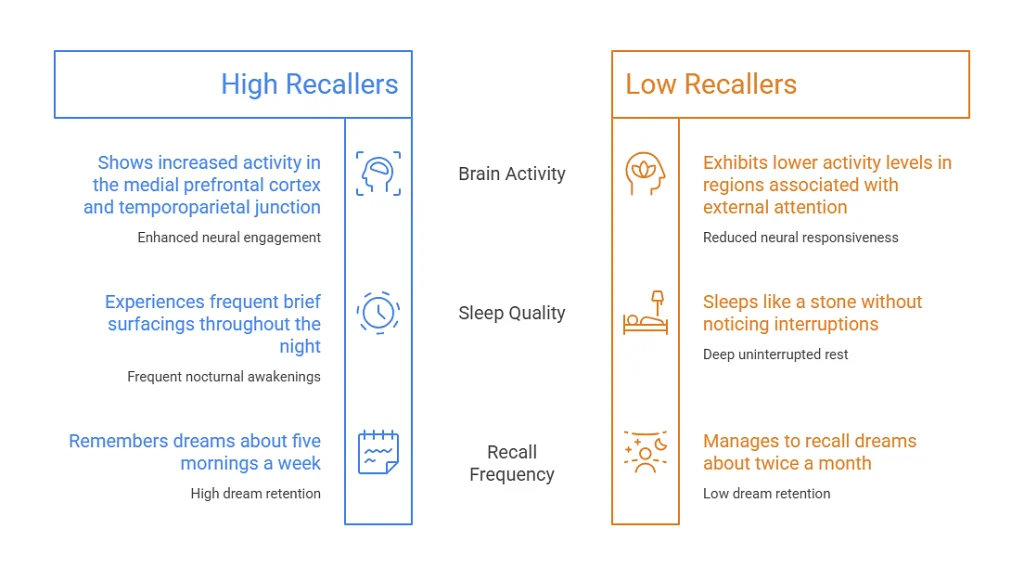
Ask around and you’ll find people who say they never dream. They do. They don’t wake up at the right moment, or they don’t wake up at all.
A research team in Lyon split volunteers into high recallers, who remembered dreams about 5 mornings a week, and low recallers, who managed about 2 a month, and put both groups through brain scans asleep and awake. The high recallers had more activity in two regions, the medial prefrontal cortex and a spot behind the ear called the temporoparietal junction, which handles attention to the outside world. Earlier work from the same lab had found the high recallers spent about twice as long awake during the night. Those were brief surfacing’s, not long enough to notice, but long enough for a dream to get filed.
So remembering dreams is largely a matter of waking up more, and lightly, not of dreaming more. The person who sleeps like a stone and never recalls a dream is the better sleeper, and the person who remembers 3 dreams a night may want to ask why they’re surfacing so often.
A few other patterns hold up across studies:
- Recall drops with age. Teenagers and people in their 20s remember the most, and recall declines steadily from middle age on, partly because deep sleep and REM both shrink.
- Women report slightly higher recall than men on average, though the gap is small.
- People who are interested in their dreams remember more of them, which sounds circular and isn’t. Paying attention in the first minute after waking is the whole trick.
How To Remember More Dreams If You Want To
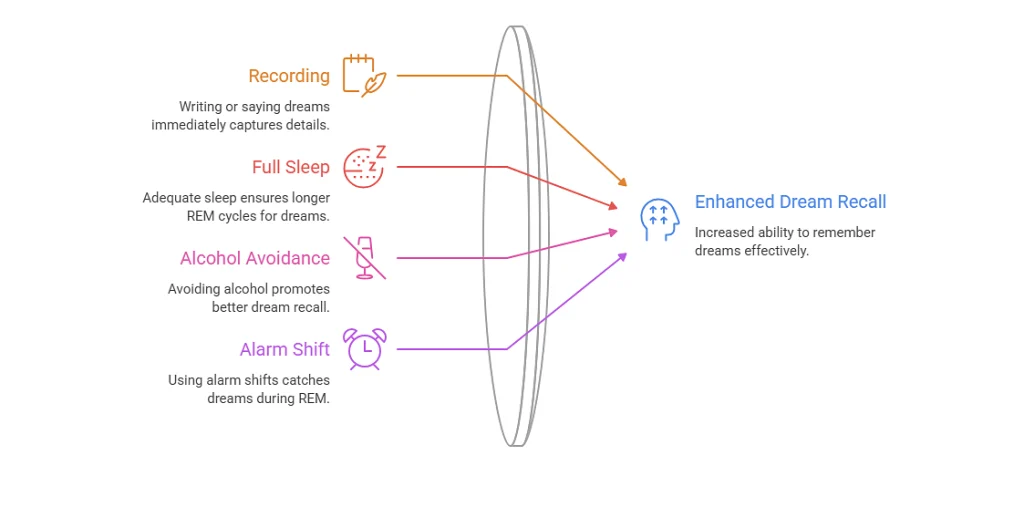
Some people would rather not. For anyone who does:
- Keep the first minute still. Don’t move, don’t check the time, replay what’s there before it goes.
- Say it or write it before anything else. A notebook by the bed, or a voice memo, beats a phone with notifications on it.
- Sleep a full night. The long REM periods are in the last 2 hours, and they’re the first thing lost to a short night.
- Skip the nightcap. Alcohol trades the early dreams for a rough second half.
- Try the alarm shift once or twice. Landing an alarm inside a late REM period is the most reliable way to catch a dream in progress.
Dreams that come with a scream, a thrashing fight against the mattress, or a partner saying you acted out what you were dreaming are a different matter. REM normally paralyzes the big muscles so you can’t act anything out, and when that paralysis fails, a doctor should hear about it, because REM sleep behavior disorder needs catching early.