


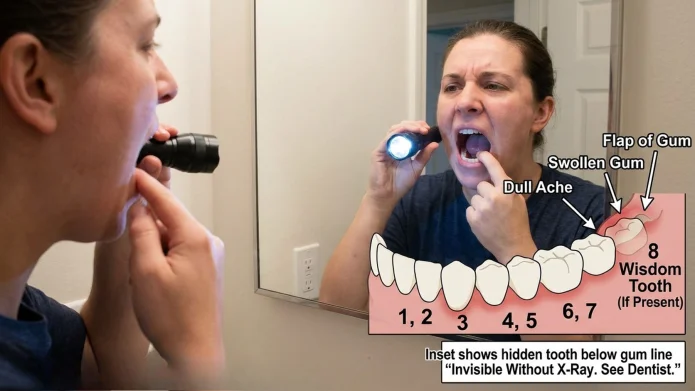
People search for this for all sorts of reasons. Some don’t have dental insurance and want to know whether a dull ache at the back of the jaw needs a visit. Some are between dentists after a move. Others are in their twenties, have never had a wisdom tooth pulled and have started to wonder if they ever had any to begin with.
You can tell a fair amount on your own with a mirror, a flashlight and a little counting, as long as the tooth has broken through the gum. What a home check can’t do is see a wisdom tooth that’s still buried in the bone. Keep that limit in mind while you count.
Wisdom Teeth Sit In Your Mouth
Wisdom teeth are the third molars. They’re the last teeth at the very back of each row, one in each corner of the mouth, so most people have four at most. They usually show up between the ages of 17 and 21, a good ten years after the other molars came in, though some take until 25 or later.
A full adult mouth has 32 teeth when all four wisdom teeth are in, and 28 without any. That difference of four is the basis for the simplest home check.
How To Count Your Teeth To Find A Wisdom Tooth
Counting all 32 is fiddly, and it’s easy to lose your place. It’s much easier to count one corner at a time, starting from the middle.
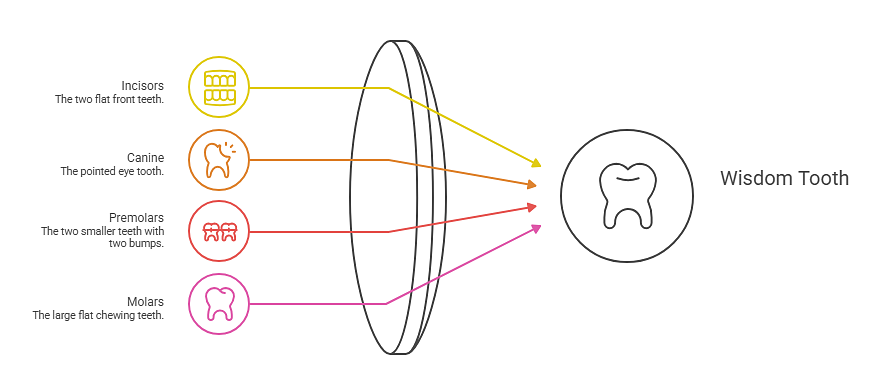
In each quarter of your mouth, a wisdom tooth would be the eighth tooth counting back from the center. The order goes like this:
- Teeth 1 and 2: the two flat front teeth, called incisors.
- Tooth 3: the pointed canine, or eye tooth.
- Teeth 4 and 5: the two premolars, which are smaller and have two bumps on top.
- Teeth 6 and 7: the first and second molars, the large flat chewing teeth.
- Tooth 8: the wisdom tooth, if it’s there.
Checking The Lower Teeth
Stand in good light in front of a mirror and pull your cheek back with a clean finger. A phone flashlight helps a lot. Start at the gap between your two lower front teeth and count backward along one side. If you reach eight, you’ve found a wisdom tooth. If the row stops at seven, there either isn’t one or it hasn’t broken through.
Then run your tongue behind the last tooth you can see. A smooth, firm ridge of gum usually means nothing has come up there. A small hard bump, or a flap of gum sitting over something, can mean a wisdom tooth is part of the way through.
Checking The Upper Teeth
The upper wisdom teeth are harder to see, since they sit high up and tucked toward the cheek. Tilting your head back and opening only halfway tends to give a better view than opening wide, because opening wide tightens the cheek over them. Count back from the middle the same way.
When The Count Can Mislead
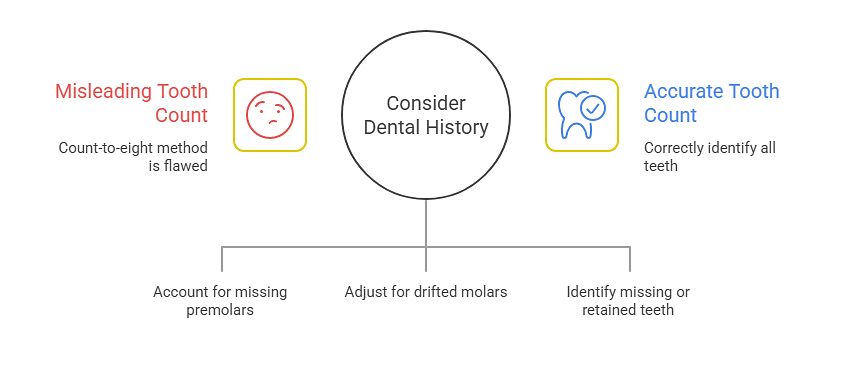
The count-to-eight method assumes everything in front is where it should be, and that isn’t always true. You could easily get the wrong answer if:
- You had premolars taken out for braces, which is common. Your wisdom tooth would then be the seventh tooth back.
- A molar was pulled years ago and the teeth behind it have drifted forward.
- A baby tooth never fell out, or an adult tooth never formed in that spot.
Signs A Wisdom Tooth
Plenty of people find out they have wisdom teeth because they feel them arriving. The signs tend to come and go over weeks or months rather than all at once:
- A dull ache or pressure at the very back of the jaw, behind the last molar.
- Tender, puffy or red gum in that corner.
- A tooth tip you can feel with your tongue that wasn’t there before.
- Soreness when chewing on that side.
- An ache that spreads toward the ear or the side of the head.
None of these prove it’s a wisdom tooth, since a cavity in a second molar can feel almost identical. But an ache that sits right at the back, in someone in their late teens or twenties, is very often a wisdom tooth on its way.
Signs A Wisdom Tooth Might Be Stuck Under The Gum
Sometimes a wisdom tooth gets partway up and stops because there isn’t enough room behind the other molars. Dentists call this impacted. A large review of 49 studies, covering more than 83,000 people, put the share of impacted wisdom teeth at about 24%, with lower ones more likely to get stuck than upper ones.
A partly erupted tooth often leaves a flap of gum over the top of it. Food and bacteria get trapped underneath, and the gum can become infected. That’s called pericoronitis, and it’s usually the clearest sign from the outside that a wisdom tooth is there and having trouble.
- Swollen, red gum around the back tooth that hurts to touch.
- A bad taste or bad breath that doesn’t go away with brushing.
- Pus coming from the gum flap.
- Difficulty opening your mouth fully.
- Swelling in the cheek or jaw, sometimes with a fever.
Swelling that spreads into the cheek or neck, trouble swallowing or a fever needs a dentist or urgent care the same day. An infection there can spread.
Why Some People Never Get Wisdom Teeth
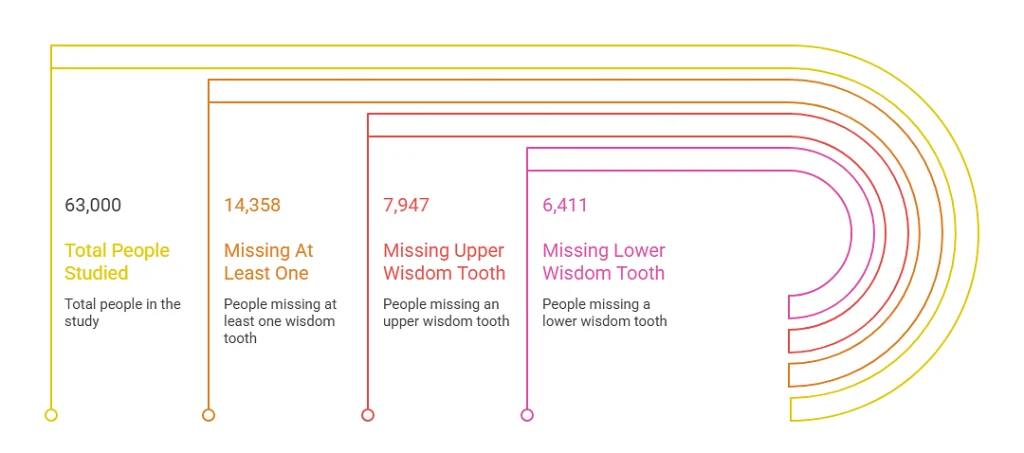
If the count stops at seven in every corner and you’re well into your twenties, it’s entirely possible you were never going to get any. Missing wisdom teeth are far more common than people think.
This is what turned up when researchers pooled studies from around the world:
- About 22.6% of people are missing at least one wisdom tooth. That figure came from a review of 92 studies covering more than 63,000 people.
- Women were around 14% more likely than men to be missing one.
- Upper wisdom teeth were missing more often than lower ones.
- The rates varied a lot from one population to another, from very low in some groups to more than half in others.
So roughly one person in five will have fewer than four, and some will have none at all. It tends to run in families, so asking a parent or sibling whether they ever had theirs taken out can give you a hint.
What A Home Check Can’t Tell You
A wisdom tooth that hasn’t broken through can sit fully hidden in the jawbone, and there’s no way to see or feel it from inside the mouth. A smooth gum at the back could mean there’s no tooth, or it could mean there’s one lying sideways underneath.
The things a dentist would want to know before deciding anything are all invisible without an X-ray:
- Whether a buried tooth is there at all.
- Which way it’s facing, since one lying flat against the next molar can damage it.
- How close the roots sit to the nerve that runs through the lower jaw.
- Whether there’s a cyst or decay forming around it.
That’s why dentists usually take a panoramic X-ray, the wide one that shows the whole jaw in a single picture, around the late teens. It takes a few seconds and uses a low dose of radiation.
When To See A Dentist About Your Wisdom Teeth
You don’t need an appointment because you’ve counted to eight. A wisdom tooth that came in straight, has room and can be brushed properly may never cause a problem. It’s sensible to book a visit if:
- The back of your jaw has ached on and off for more than a week or two.
- The gum over a back tooth keeps getting swollen or sore.
- You notice a bad taste or smell from one corner that won’t clear.
- You can’t reach the back tooth well enough to brush it.
- You’re planning braces or other dental work.
Cost puts a lot of people off, but dental schools and community health centers often offer exams and X-rays at a lower price. A home check will usually tell you whether a wisdom tooth has come through. Only an X-ray will tell you what’s going on underneath.