


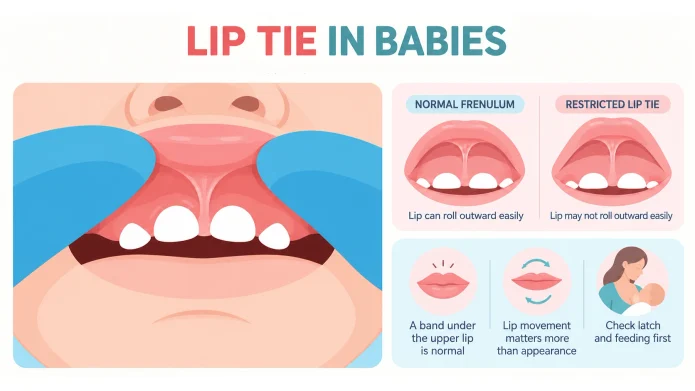
It usually starts with a photo. Feeding hurts, the baby clicks and fusses at the breast, somebody in a parenting group says to check under the lip, and there it is a band of pink tissue running from the lip down to the gum. Post the picture and a dozen people will tell you it’s a lip tie and give you the name of a dentist with a laser.
The trouble is that the same picture could be taken in almost any newborn’s mouth.
A Band Under The Upper Lip Is Normal In Newborns
Every baby is born with an upper lip frenulum, and in about half of them it reaches all the way down to the gum. That’s what a team at Stanford found when they looked under the lips of 100 healthy newborns. All 100 had one. Fifty-three had the low, thick kind that some providers score as a grade 3 or 4 “lip tie.”
When two examiners scored the same babies, they often came up with different grades. The same examiner sometimes changed the grade on a second look. So the scoring chart that gets passed around online doesn’t measure much at all, and the authors said plainly that cutting the tissue based on how it looks can’t be supported.
What does matter is whether the lip can move. A frenulum that looks dramatic in a photo can still let the lip roll out normally during a feed, and that’s the only test that counts.
What US Doctors Have Said About Cutting It
Ear, nose and throat surgeons sat down as a panel in 2020 and tried to agree on what a lip tie even is. They agreed it’s poorly defined. They agreed the upper lip frenulum is normal in an infant, that its link to breastfeeding problems is unclear, and that in some communities it’s being diagnosed far more than it should be. What they couldn’t agree on was that cutting it helps a baby feed.
Four years later the American Academy of Pediatrics came out with its own report. It found no evidence that releasing a lip tie improves breastfeeding, and only limited support for cutting anything other than a clear tongue tie at the front of the tongue. Its advice was to get a full feeding assessment from a lactation professional before any procedure.
So two separate groups of specialists, one surgical and one pediatric, looked at the same question and neither could find good proof that the lip is the problem. That’s a fair amount of caution from the people who would be doing the cutting.
What Usually Causes The Pain, The Clicking And The Fussing
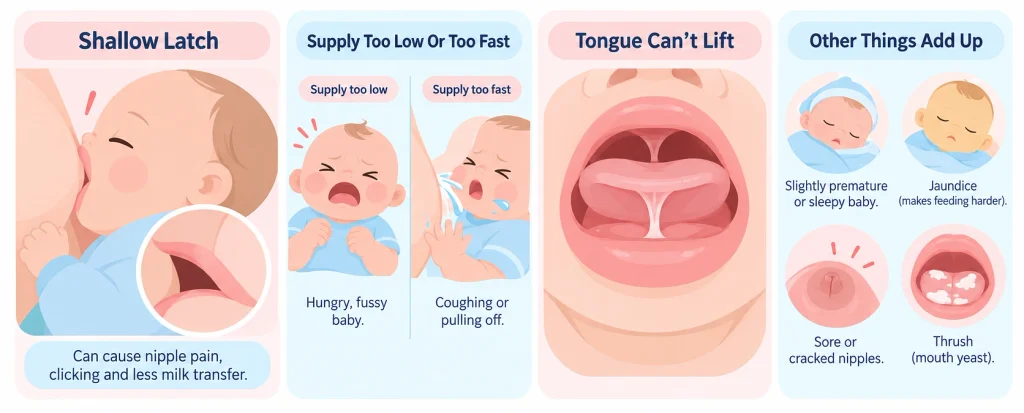
If the lip isn’t to blame, something else is. A good lactation consultant tends to go down this list, roughly in this order.
A Shallow Latch
A baby who takes in only the nipple, instead of a wide mouthful of breast, pinches the nipple against the hard palate. That hurts, it makes a clicking sound as the seal breaks, and less milk gets out. The upper lip often gets tucked under in a shallow latch, which looks a lot like a “tied” lip in the moment. A change in hold, with the baby coming in chin first and the head tipped back slightly, fixes this more often than anything else.
Supply Running Too Low Or Too Fast
A low supply means a hungry baby who feeds constantly and still fusses. An oversupply with a fast letdown does nearly the opposite the baby gulps, coughs, pulls off, swallows air and gets gassy. Both look like a baby who “can’t feed properly,” and neither has anything to do with the lip.
A Tongue That Can’t Lift
A tight band under the tongue is a different story. If the tongue can’t lift or reach past the lower gum, it can’t do its job during a feed. This is where the evidence for a release is stronger, especially when the tie is near the tip. When something in the mouth is truly restricted, it’s the tongue far more often than the lip.
The Smaller Things That Add Up
- A baby born a few weeks early, who tires before finishing.
- Jaundice, which makes babies sleepy at the breast.
- Nipples that were damaged in the first days and still hurt after the latch gets better.
- Thrush, which burns and leaves white patches inside the baby’s cheeks.
Checking Whether The Lip Is Part Of It
You can do the first check yourself during a feed. Once your baby is latched, look at the top lip. If it’s curled under, slide a fingertip along it and gently roll it outward. If the lip flips out easily and stays there, the frenulum isn’t holding it back, and that tells you more than any photo.
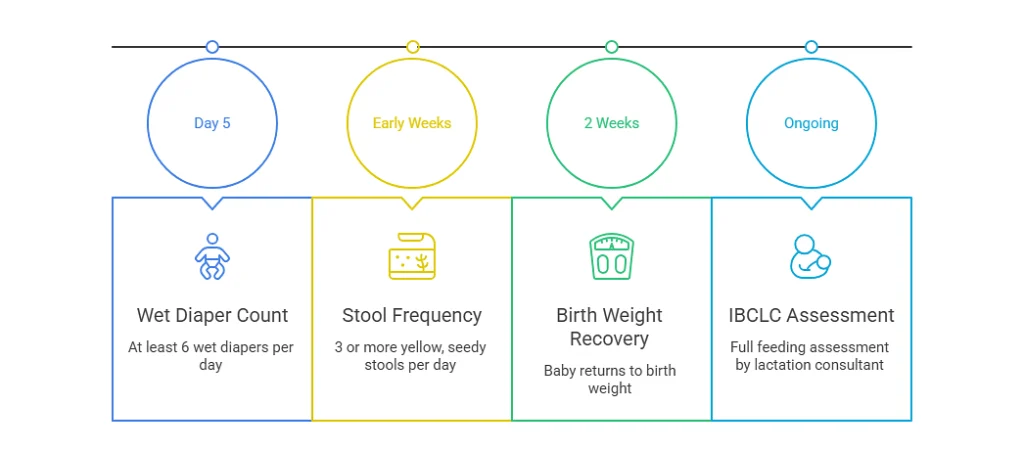
Next, look at the numbers that show whether feeding is working:
- At least 6 wet diapers a day by around day 5.
- 3 or more yellow, seedy stools a day in the early weeks.
- Back to birth weight by about 2 weeks old.
If those are on track, your baby is getting milk, even if the feeds still feel awkward or sore. If they’re not, call your pediatrician.
The step both doctors’ groups recommend is a full feeding assessment by an International Board Certified Lactation Consultant, or IBCLC. A good one will watch a whole feed, weigh the baby before and after to see how much milk went in, check the position and latch, and look at the tongue as well as the lip. Many families find the problem gets solved in that session without anyone mentioning a laser.
When A Release Is Even On The Table
There are babies whose upper lip truly won’t turn out, even with gentle help, and whose feeding is still a struggle after the latch, hold and supply have all been worked on. For them, a pediatrician, pediatric ENT or pediatric dentist might bring up a release.
It’s quick, done with small scissors or a laser, but it’s still a procedure on a newborn. Bleeding, a few days of refusing to feed, and scar tissue can all happen. Some clinics send families home with stretching exercises to do several times a day for weeks, which babies tend to hate and which haven’t been shown to help.
So if someone recommends it, ask them straight out:
- What exactly is restricted, and how is it affecting the feed?
- Has a lactation consultant watched a full feed first?
- Is it the lip, the tongue or both?
- What should change after the release, and how soon?
- What aftercare do you expect us to do, and what can go wrong?
A provider who diagnoses a lip tie from a photo, or seems to find one in every baby, is a good reason to get a second opinion.
Will It Cause A Gap In The Front Teeth?
This gets used as a reason to cut early, so it helps to know the panel’s answer releasing the lip in infancy won’t prevent a gap between the front baby teeth. The frenulum usually thins and moves higher as the face grows, and many gaps close by themselves once the canine teeth come in. If a gap is still there after the permanent front teeth arrive, around age 8, an orthodontist can decide then whether anything needs doing.
Get the latch looked at first, by someone who watches your baby feed rather than someone who looks at a photo. The lip can wait.