

Most turf toe in Britain these days doesn’t happen in an American football stadium. It happens on the 3G pitch behind the leisure centre on a Thursday night, in a five-a-side game, when somebody plants the front of their foot, a defender lands on their heel and the big toe gets bent back much further than it was ever meant to go. More often than not, the player limps off, puts some ice on it and turns up again the following week, which tends to be the start of the trouble.
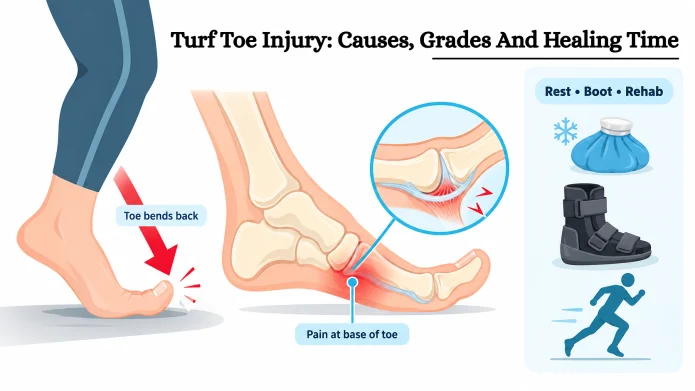
Turf toe is a sprain of the joint at the base of the big toe. The tissue underneath the joint gets stretched or torn when the toe is forced upwards while the body’s weight is coming down through it. It can be anything from a sore toe for a fortnight to an injury that keeps someone out for most of a season.
Why It’s Called Turf Toe When Grass Pitches Get It Too
The name goes back to 1976. West Virginia University had laid artificial turf, and the team doctors, Bowers and Martin, started seeing the same big toe injury again and again. They counted 27 cases and put it down to the hard new surface along with the soft, flexible shoes the players were wearing on it.
That explanation was partly right. A firm artificial surface grips the boot, so the foot stays where it is while the rest of the body keeps travelling forwards, and a bendy shoe gives the toe nothing to stop it folding back. Put the two together and the risk goes up.
Grass doesn’t let anyone off, though. When researchers went through NFL turf toe injuries between 2011 and 2014, they found 29 on artificial turf and 29 on natural grass. So the name has stuck around long after the surface stopped being the whole story.
What Gets Damaged Under The Big Toe
The joint involved is where the big toe meets the foot. Doctors call it the first metatarsophalangeal joint, which most of them shorten to the first MTP joint. It does far more work than people give it credit for, taking roughly half your body weight on each ordinary step and several times your body weight when you sprint or jump.
Under the joint, there’s a thick pad of tissue called the plantar plate. It’s only around 2 centimetres long, but it’s the thing that stops the toe from bending upwards too far. Next to it, tucked inside the tendons, sit two pea-sized bones called the sesamoids, which help the tendons pull and soak up some of the force.
In turf toe, the plantar plate and the joint capsule around it take the strain. They might only be stretched, they might be partly torn, or they might be torn all the way through. In the worse injuries, one of the sesamoids can crack or get dragged out of its usual spot as well.
How The Toe Gets Forced Back In The First Place
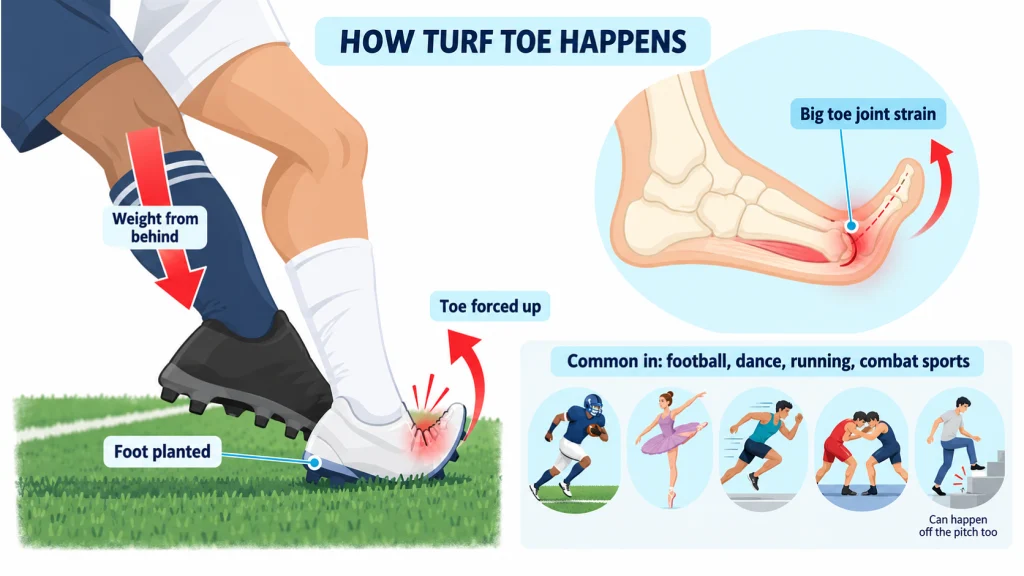
The common thread is a foot pinned to the ground with the heel up, then extra weight landing on it from behind. On a pitch, that’s usually another player falling across the back of the leg, but it doesn’t always need a collision. A hard push-off at the wrong angle can manage it on its own.
The people who turn up with turf toe in a sports injury clinic tend to come from a fairly predictable list:
- Footballers and rugby players, especially on 3G and 4G pitches.
- Dancers, ballet in particular, since so much of the work is done up on the balls of the feet.
- Wrestlers and martial artists, whose toes take weight in some odd positions.
- Runners and sprinters pushing off hard from the blocks or on hills.
Then there are the ones who weren’t playing anything. A trip on the stairs or catching the toe on a kerb can produce a milder version of the same sprain, and those cases often get brushed off for longer because people don’t connect them with a sports injury.
Telling Turf Toe Apart From A Stubbed Toe
A stubbed toe usually hurts at the end of the toe and eases within a day. Turf toe hurts at the base of the big toe, where it joins the foot, and it tends to get worse over the first few hours rather than better.
You’d normally expect swelling around the joint, and sometimes bruising will come through on the underside of the foot a day or two later. Bending the toe upwards will hurt, and so will pushing off when you walk. Some people find they start walking on the outside edge of the foot without thinking about it, to keep weight off the front.
What The GP Or Physio Will Do
They’ll press around the joint to find exactly where it’s sore and move the toe gently to see how far it’ll go before it hurts. One of the more useful checks involves holding the foot still and moving the big toe up and down to see if the joint feels loose. A toe that slides further than it should suggests the plantar plate has torn right through.
An X-ray will usually be arranged to check for a broken sesamoid or a flake of bone pulled off with the ligament. If the injury looks moderate or severe, you may be referred for an MRI scan, because that’s the only way to see the plantar plate properly.
How Long Each Grade Of Turf Toe Takes To Heal
Turf toe is sorted into three grades, and the grade will shape almost everything that comes after, from the type of footwear to the time off.
The tissue has been stretched but not torn. It’s tender and a little swollen, and most people can still walk without much of a limp. Athletes tend to miss a couple of weeks at least.
Part of the plantar plate has torn. Swelling and bruising are more obvious, the toe won’t bend as far and walking will be uncomfortable for a while. Getting back to full sport can take anything from a few weeks to around three months.
The plantar plate has torn completely and the joint can feel unstable. Swelling is heavy, putting weight through the toe hurts a lot, and a sesamoid may be broken or pulled back towards the heel. This is the grade that sometimes ends in surgery, and a return to high-level sport can take six months or longer.
What Recovery Looks Like When Surgery Isn’t Needed
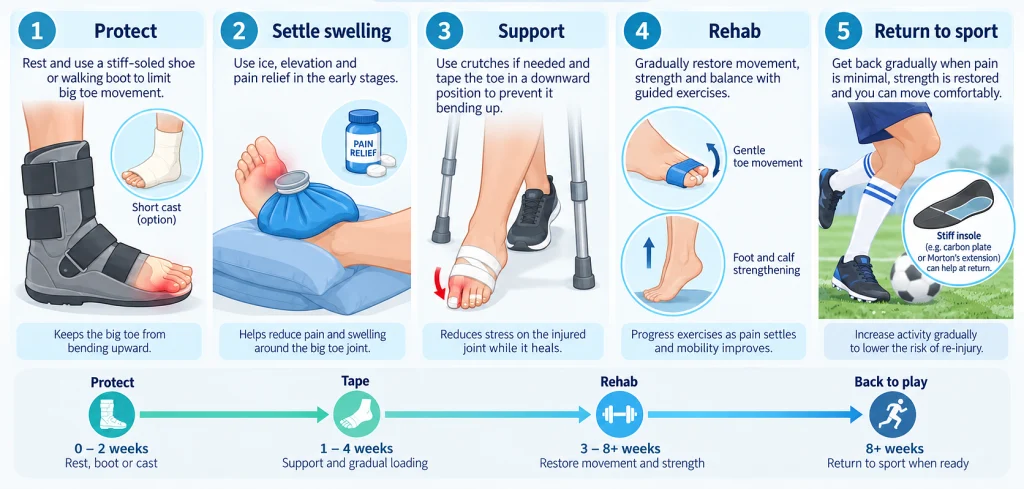
Most turf toe heals without an operation, including a good share of grade 2 injuries. The early weeks are about stopping the toe from bending so the torn tissue has a chance to knit back together, and that usually means:
- A stiff-soled shoe, a walking boot or, for worse cases, a short cast.
- Ice and keeping the foot up for the first few days.
- Paracetamol or ibuprofen for the pain, if they’re safe for you to take.
- Crutches for a short while if walking is too sore.
Taping tends to come in later, after the swelling has gone down, because strapping a swollen toe can restrict the blood flow. When it’s used, the toe is strapped pointing slightly downwards so it can’t flick back up into the painful position.
Once the pain has settled, a physio will start you on gentle movement to stop the joint from stiffening up, and then work on strength in the foot and calf. The usual sign that someone’s ready to go back to sport is being able to run and push off without pain, with the big toe bending upwards comfortably to somewhere around 50 or 60 degrees.
A lot of players go back in a stiffer boot, or with a carbon fibre plate or a Morton’s extension in the shoe. A Morton’s extension is a firm insert that runs under the big toe and stops it bending too far, and it’s common to keep one in for the rest of the season.
The Cases That End Up Needing An Operation
Surgery is mostly kept for grade 3 injuries where the joint won’t settle on its own. A foot and ankle surgeon would usually be thinking about an operation if the plantar plate has torn and the joint is clearly unstable, if a sesamoid has broken, split or been pulled out of place, if there’s a loose fragment of bone or cartilage in the joint, if the big toe has started drifting sideways, or if several months of proper non-surgical treatment haven’t helped.
The operation repairs the plantar plate and deals with any damage to the sesamoids. The results in athletes have generally been encouraging. In one group of 15 athletes who had surgery for grade 3 turf toe, the average return to sport was around 16 weeks, and pain levels were low when they were checked again a couple of years later.
Why Playing Through It Can Cost You Later
This is where the Thursday night habit of strapping it up and carrying on causes the most damage.
A long-term follow-up of turf toe patients found that nearly half of them still had some pain or stiffness in the big toe around five years after the injury. Over time, a damaged joint can wear down and turn arthritic, a condition called hallux rigidus, which simply means a stiff big toe. Once that sets in, it can make walking uncomfortable, never mind running, and the risk seems to be higher in people who went back too soon.
Giving the joint its full recovery time, sticking with the stiffer footwear and doing the physio exercises will give it the best chance of staying healthy for years.
When A Sore Big Toe Should Be Looked At
A mild knock that’s clearly improving after a day or two can usually be looked after at home with rest, ice and a firm pair of shoes. It’s sensible to see your GP or a physio, or to go to a minor injuries unit, if:
- The toe is badly swollen or bruised underneath.
- You can’t walk normally or push off on that foot.
- The pain isn’t easing after a few days.
- The toe looks bent out of line or feels loose.
- The joint clicks, pops or locks when you move it.
Turf toe that’s spotted early and given proper time will, in most cases, let people get back to their football, rugby or dancing. The injuries that cause trouble years later are usually the ones that got strapped up and played on.