

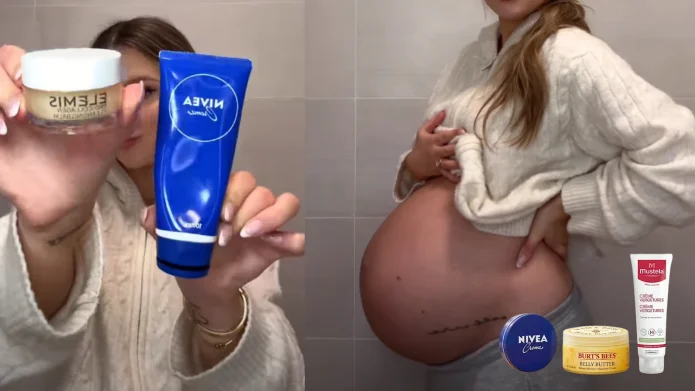
The blue NIVEA tin has been sitting in bathroom cabinets since 1911, and most pregnant women reach for it long before they think to check what is inside.
For the everyday NIVEA basics like NIVEA Creme, body lotions and the newer sunscreens, there is no ingredient that pregnancy guidance tells you to avoid. Mustela is the brand built and tested specifically for pregnancy, while Burt’s Bees sits in between, with a “natural” label that does not always mean better studied.
What NIVEA Itself Says About Using Its Products During Pregnancy
The company says its safety evaluation accounts for the fact that most cosmetics are used by women of childbearing age, including pregnant women, so it considers every product it sells safe for that group as well.
That statement means NIVEA’s safety assessments were written with you in mind. It does not mean every NIVEA product was tested on pregnant women, which is a separate thing and one that matters later when Mustela comes in.
Which NIVEA Products Are Fine To Keep Using While Pregnant
NIVEA Creme And NIVEA Soft
NIVEA Creme is a thick, old-fashioned moisturizer built on mineral oil, wax, glycerin, panthenol and lanolin alcohol. None of these appears on any list of ingredients pregnant women are told to avoid, and one ingredient-analysis database shows no pregnancy flags for it, though it does point out that the formula contains fragrance, which can bother sensitive or reactive skin.
That fragrance note matters more than people expect. Pregnancy hormones often make skin react to products it tolerated for years, so if your face or belly suddenly itches after NIVEA Creme, the perfume or the lanolin alcohol is the likely cause, not a safety issue for the baby.
A heavy, plain moisturizer is actually what doctors suggest for pregnancy skin. ACOG, the American College of Obstetricians and Gynecologists, recommends a heavy moisturizer during pregnancy to keep skin soft, and NIVEA Creme fits that description at a low price.
NIVEA Sunscreens
Sunscreen is the one product you should not drop during pregnancy, because hormone changes make dark patches on the face (melasma) more likely, and sun makes them worse.
The concern most women hear about is oxybenzone. ACOG advises pregnant women to avoid sunscreens that contain oxybenzone, and the current NIVEA SUN lotions sold in the UK and Europe are made without oxybenzone, octinoxate and octocrylene.
Formulas change by country, so if you bought your NIVEA sunscreen in the US, Asia or the Middle East, turn the bottle over and look for “oxybenzone” or “benzophenone-3” before you trust the European claim.
The NIVEA Products You Should Ask Your Doctor About First
Luminous630 With Thiamidol
This is the line that causes the most confusion, because NIVEA markets it for pregnancy marks. The Luminous630 body oil serum is sold to reduce stretch marks caused by pregnancy, hormonal changes and weight changes, and the face range targets dark spots from pregnancy too.
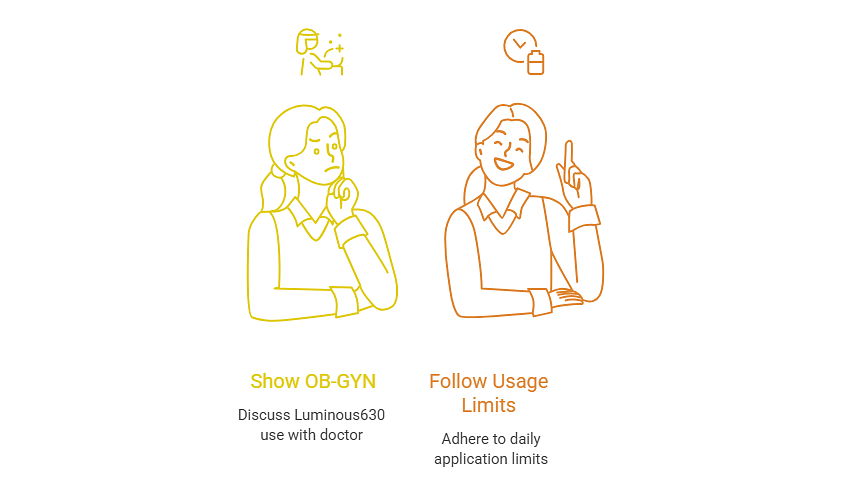
Its active ingredient, Thiamidol, works by slowing melanin production. Beiersdorf’s own labels put limits on how much you should use:
- Body: only 1 Luminous630 product on the body per day.
- Face: no more than 4 applications a day in total, counting every Thiamidol product you use.
Pharmacy sources do not agree on pregnancy use. One pharmacist quoting the brand says the range can be used during pregnancy and breastfeeding, with the 4-a-day limit as the only restriction, while another pharmacy listing for the same ingredient says there is not enough data on Thiamidol during pregnancy and suggests a medical opinion first.
So this is the one NIVEA product family to show your OB-GYN or midwife before using. It is not known to be harmful, but it is a newer active ingredient with less outside research behind it, and many pregnancy dark spots fade on their own a few months after birth anyway.
Whitening And “Extra White” Lines Sold In Asia
These lines are not sold in the US or UK, but if you live in South Asia or the Gulf they are on every shelf. They often pair chemical sunscreen filters with licorice extract for brightening, and conservative pregnancy guides list several of them as products to skip until after delivery. Plain NIVEA Creme or a mineral sunscreen is the simpler choice for these months.
How Burt’s Bees Compares On Pregnancy Safety
The Mama Bee Belly Butter
Burt’s Bees used to have a clear pregnancy product. The Mama Bee Belly Butter was a fragrance-free, 99% natural formula made with cocoa, shea and jojoba butters, sold without phthalates, parabens, petrolatum or SLS.
The catch is finding it. Superdrug lists it as no longer available online, and Macy’s shows it as currently unavailable. What remains is mostly old stock from third-party sellers, so check the expiry date if you buy one.
The Renewal Range With Bakuchiol
Burt’s Bees now pushes its Renewal anti-aging line, sold as a retinol alternative. Pregnant women usually pick it because retinol is off limits, but that reasoning has a gap.
Bakuchiol is widely seen as lower risk than retinol in pregnancy, but no clinical studies have tested it on pregnant women. The Renewal serum also lists natural fragrance along with eugenol, geraniol, limonene and linalool, which are common skin allergens.
Here the “natural” brand carries less pregnancy evidence than NIVEA’s basic tin. That does not make Burt’s Bees unsafe, it simply shows that a plant label tells you where an ingredient came from, not how well it has been studied in pregnancy.
How Mustela Compares On Pregnancy Safety
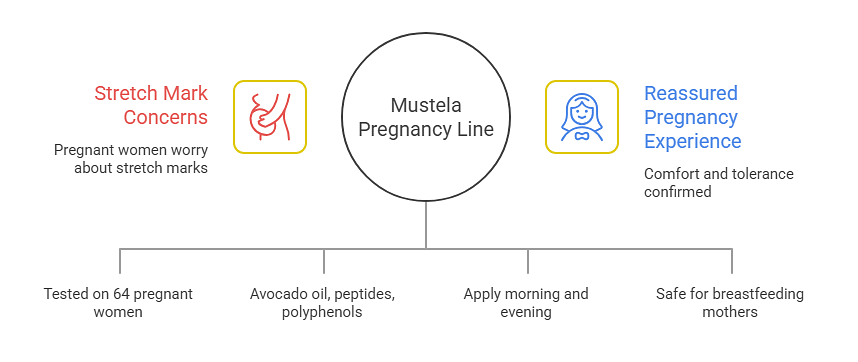
Mustela is a French baby-care brand, and it is the only one of the three with a full pregnancy line on shelves right now. Its best-known product is the Stretch Marks Cream.
What sets it apart:
- Tested on pregnant women: its efficacy was clinically tested by 64 pregnant women.
- Main ingredients: avocado oil, patented avocado peptides, and a passion fruit and witch hazel polyphenol complex.
- When to start: from the first month of pregnancy until after birth, on the abdomen, hips, thighs and breasts, morning and evening.
- Breastfeeding: described as compatible with breastfeeding, as long as normal hygiene rules are followed, which in practice means wiping the nipple area before a feed.
Be realistic about what that testing means. A test on 64 women checks comfort and how the cream performs, so it reassures you on tolerance, but no cream has strong proof that it prevents stretch marks, because genetics and how fast you gain weight matter most.
So Is Mustela Safer Than NIVEA, Or Just Made For Pregnancy?
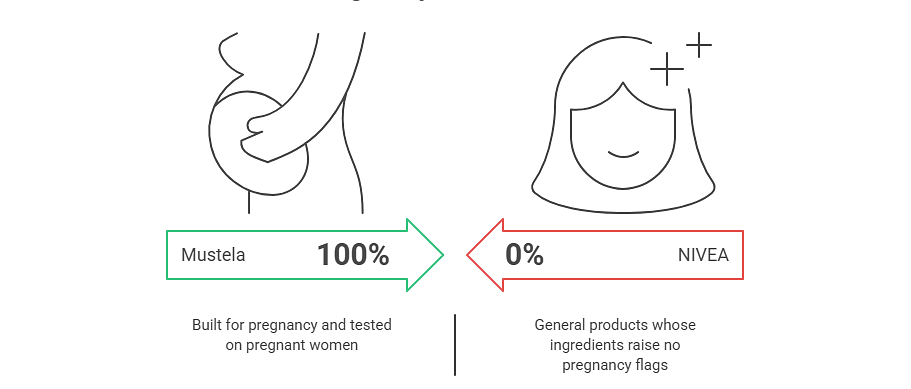
Mustela is the most pregnancy-focused choice, but that is not the same as NIVEA being risky.
- NIVEA basics are general products whose ingredients raise no pregnancy flags, assessed with pregnant users in mind, but not tested on them.
- Mustela Maternity is built for pregnancy and tested on pregnant women, with a higher price to match.
- Burt’s Bees has lost its dedicated pregnancy product in many stores, and its newer active line uses an ingredient without pregnancy studies.
If your skin is calm and you like NIVEA, there is no safety reason to replace it. If your skin has become sensitive, or you want one product made for the belly, Mustela is the stronger pick of the three.
How To Combine NIVEA, Mustela And Burt’s Bees In One Routine
You do not have to choose one brand. Each one does a different job well, and mixing them can keep costs down.
A Simple Daily Split
- Belly, hips, thighs and breasts: Mustela Stretch Marks Cream, twice a day.
- Hands, elbows, heels and dry patches: NIVEA Creme, since a little goes a long way.
- Face in the morning: an oxybenzone-free NIVEA SUN lotion or a mineral sunscreen.
- Lips: a Burt’s Bees lip balm, which is cheap and easy to carry.
What Not To Double Up
- Do not use Mustela and a Luminous630 body product on the same area, because you would be stacking 2 stretch-mark treatments with no added benefit.
- Do not layer several fragranced products if your skin has started to react, start by removing the most perfumed one.
- Patch-test anything new on the inner arm for 24 hours, even products you used before pregnancy.
The Ingredients To Check On Any Label In The Store
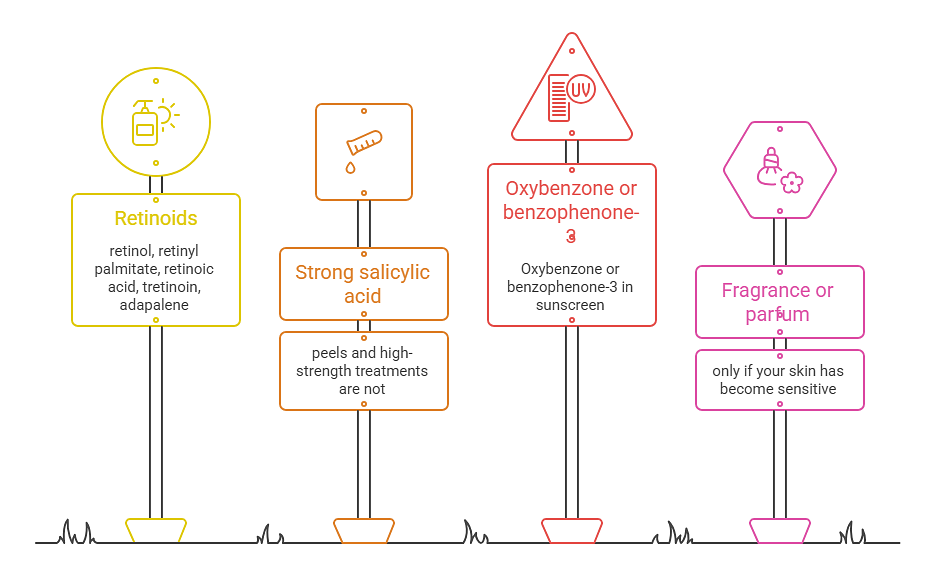
Whatever brand you pick up, these are the names to look for on the back of the pack:
- Retinoids: retinol, retinyl palmitate, retinoic acid, tretinoin, adapalene. Medical guidance says to avoid products with retinoids, hydroquinone, formaldehyde or phthalates during pregnancy.
- Strong salicylic acid: a face wash is fine, but ACOG considers topical products with 2% or less salicylic acid safe, while peels and high-strength treatments are not.
- Oxybenzone or benzophenone-3 in sunscreen.
- Fragrance or parfum, only if your skin has become sensitive.
ACOG also lists glycolic acid, azelaic acid, benzoyl peroxide and topical salicylic acid as safe options for acne during pregnancy, which helps if breakouts are the reason you were looking at products in the first place.
When A Skin Problem Means Calling Your Doctor, Not Changing Creams
Some skin symptoms in pregnancy have nothing to do with the products you use.
- Intense itching on the palms and soles, especially at night in the third trimester, can be a sign of a liver condition called intrahepatic cholestasis of pregnancy, and it needs a blood test, not a new moisturizer.
- A rash spreading from stretch marks across the belly and thighs should be seen by your doctor.
- Burning, swelling or hives after any product means stop using it and call your provider.
Your skin and your pregnancy are your own, and a 2-minute question at your next appointment will settle any product this article cannot. Take the jar or a photo of the ingredient list with you.

