


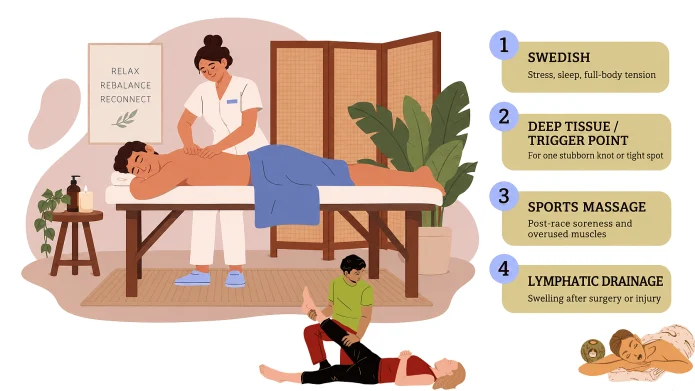
Stress: Swedish. A knot that’s been there since march deep tissue or trigger point, in a 30 minute slot on that one spot. Legs 2 days after a race: sports massage, and after, not before. Swelling after surgery lymphatic drainage from someone trained in it, not a spa.
Those four lines are most of the answer. The rest is why, and the why is what stops the wrong booking next time. A massage style is 3 things stacked together a set of hand techniques, a depth of pressure, and a goal. Spas sell the first, people choose on the second, and the goal is the only one that should decide it.
Swedish Massage, For Stress, Sleep And Feeling Tight Everywhere
Long strokes with oil, kneading, some light tapping, pressure that stays comfortable the whole way through. The point is to settle the nervous system and get blood moving through the muscles. Nothing gets dug out.
Book this when the problem is you, not one part of you: you’re wound up, sleeping badly, stiff all over with nothing in particular to point at. It’s also the right first massage for someone who’s never had one, since the therapist learns how your body responds before anyone leans in. Sixty minutes runs $60 to $120 across most of the US.
A frozen pain shoulder, a knot under the shoulder blade, a hamstring that’s been nagging since the fall league: Swedish will leave all of those exactly as it found them. Relaxed, and still there.
Deep Tissue Massage, For The Same Knot Coming Back In The Same Place
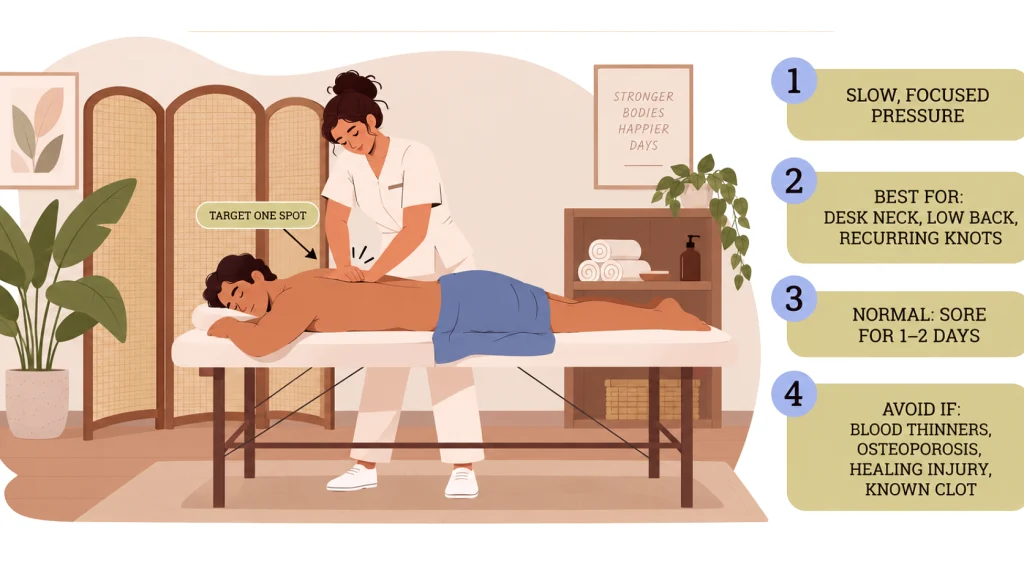
Deep tissue works the lower layers of muscle and the sheath of connective tissue around them. The therapist uses fingers, knuckles, sometimes a forearm, moves slowly, and will often sit on one spot with steady pressure until it gives. Slowly is the word that matters, and most spas skip it. Fast and hard is not deep tissue. Fast and hard is a bruise with an invoice.
It fits the desk neck, the low back that’s been tight for years, the knots that return to the same address every month. You’ll feel it for a day or two afterward, the way you feel a hard gym session, and that’s normal. Clenching your jaw and holding your breath on the table is not normal, it means the pressure is past useful, and the therapist would rather hear “less” than lose you as a client.
Some people should stay away from deep pressure completely, and spa menus leave this out:
- Anyone on blood thinners, where deep work can cause bleeding into the muscle.
- Anyone with osteoporosis.
- Anyone with an injury still healing, where the tissue hasn’t knitted.
- Anyone with a known clot or a history of one in that limb.
The serious injuries from massage that make it into the medical literature are rare, and they are nearly all vigorous pressure on someone from that list.
Sports Massage, For Soreness From Doing The Same Thing Too Many Times
Sports massage borrows from everything, some Swedish, some deep, some assisted stretching, and points all of it at the muscles you’ve been overusing. The difference from the other two is that it’s targeted. A runner’s session is calves, hamstrings, hips. A swimmer’s is shoulders and back. A nurse on 12 hour shifts has as much claim to it as a marathoner, because the overuse is the ticket, not the sport.
On the evidence, this is the best supported use on the whole list, though not for what people assume. When researchers pooled the trials on delayed onset muscle soreness, the stiffness that lands 1 to 3 days after a hard effort, massage reduced the soreness and brought strength back a little quicker. It didn’t make anyone faster or stronger on the day. So the timing is after the hard session, never the morning of it. A firm massage the day before a race is a well known way to turn up with heavy legs.
Trigger Point Work And Myofascial Release, For One Spot That Sends Pain Somewhere Else
A trigger point is a tight band in a muscle that hurts in a different place when it’s pressed. The classic one is a spot at the top of the shoulder that shoots up the side of the head and gets treated as a headache for years. Another sits in the glute and runs down the back of the leg, and gets called sciatica when it isn’t. The therapist finds the spot, holds pressure on it for 30 to 90 seconds until the referred pain fades, moves to the next one. Not relaxing. Very effective for tension headaches, jaw pain, and that one spot under the shoulder blade.
Myofascial release is the slower cousin. No oil, so the hands can grip, and a sustained stretch on the fascia, the thin web around every muscle, held for minutes rather than seconds. Plantar fasciitis, IT band pain, and the kind of tightness that wanders from one muscle to the next respond to this when kneading does nothing.
Both are usually booked as a 30 minute session on one region, and both are more often found at a physical therapy practice or a sports clinic than at a day spa.
Hot Stone And Aromatherapy, For Relaxation And Nothing More
Hot stone is Swedish with heated basalt stones laid along the back and used in the therapist’s hands. The heat loosens muscle, so lighter pressure reaches further, and that makes it a decent choice for someone who can’t tolerate deep work but still wants the tightness touched. Aromatherapy is Swedish with essential oils mixed into the carrier oil. Neither treats an injury. Hot stone at $85 to $160 is the priciest way to relax on this page, and that’s fine when relaxing is the whole point.
Thai Massage And Shiatsu, For Stiff Hips, Tight Backs And Poor Flexibility
Thai massage is done on a mat on the floor, in loose clothes, with no oil at all. The therapist pulls you into stretches, presses along the body with palms and thumbs and sometimes feet, and takes your joints through their range for you. It’s nearer to being put through a yoga class than to being rubbed, and people with stiff hips and a tight back often get more lasting movement from it than from any oil massage. It is not gentle. A joint replacement or a disc problem needs to be mentioned before you lie down, and some therapists will decline.
Shiatsu is the Japanese version without the acrobatics: finger pressure along similar lines, clothed, little stretching. For people who want firm pressure without being folded.
Lymphatic Drainage, For Swelling After Surgery, Not For Detox
So light it barely registers as touch. The therapist stretches the skin gently in the direction lymph fluid drains, and the job is real: swelling after surgery, lymphedema after breast cancer treatment, a limb that’s puffed up after an injury. Properly trained therapists are usually found through a hospital or a certified lymphedema clinic, and the $100 to $150 price reflects the training.
Detox, slimming, flushing toxins none of that. A healthy lymph system is already draining itself, and nothing done with the hands changes what the liver and kidneys clear.
Prenatal Massage, For Back And Hip Pain In The Second And Third Trimesters
Swedish, adapted. Side lying with a stack of pillows or a table with a belly cutout, light to moderate pressure, and a therapist trained to keep off certain points on the ankles and the abdomen. It helps the low back, hip and sciatic-type pain that shows up from the second trimester on, and it helps sleep. Most therapists won’t book the first trimester as a precaution. A general massage license doesn’t include prenatal training, so ask for the certificate.
What The Research Can Back Up
Less than the brochures claim.
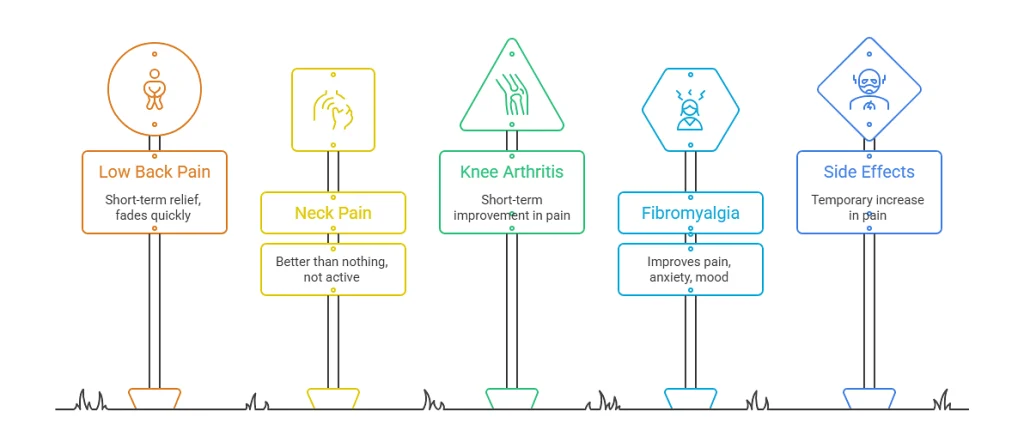
- Low back pain. The Cochrane review pooled 25 trials and 3,096 people. Massage eased pain and improved function in the short term, and the gain faded over months. The reviewers rated the studies low quality and said so plainly.
- Neck pain. Beats doing nothing. Doesn’t beat exercise or other active treatment. One trial found 60 minute sessions several times a week outperformed shorter or fewer ones.
- Knee arthritis. Eight weeks of Swedish improved pain and function in a trial of 68 adults.
- Fibromyalgia. Five weeks or more improved pain, anxiety and mood. Not sleep.
- Side effects. The usual one is more pain for a day or two, reported by somewhere between 1 in 60 and 1 in 4 people across the back pain trials.
Expect to feel better for days, not months. For stress and sleep, days is all anyone was asking for. For a pain that keeps returning, massage is a tool, and whoever finds the cause still has to be someone else.
How To Book So The Hour Is Not Wasted
- Describe the problem, not the style. “My right shoulder blade, it’s been 2 months” gets a better session than “deep tissue please”.
- Say “less” the second it’s too much. Bracing defeats the point.
- For one spot, 30 minutes on it beats 60 minutes on everything.
- For stress, book late in the day. For soreness, book after the training.
- Drink water afterward because you’ll be thirsty. It doesn’t flush anything.
A sore spot that’s lasted more than a few weeks, or one that comes with numbness, weakness, or pain that wakes you at night, is a doctor’s appointment first and a massage second.