


Use up and down arrow keys to resize the meta box pane.
Last winter I spent about three weeks with a sore spot just left of my spinal thoracic pain, right between the shoulder blades. It hurt when I turned to reverse the car and it hurt when I sneezed. My first thought, at 1 am, was my heart. My second was my lungs. It was neither. It was a stiff rib joint from too many evenings hunched over a laptop on the sofa, and a physio sorted it in two visits.
I’m telling you that because it’s the usual story. Most pain in the middle of the back comes from the back. But that bit of the body sits right behind the heart, the lungs, the gullet and the gallbladder, so it pays to know what spine pain feels like and what doesn’t fit. That’s what this page is for.
Why The Middle Of The Back Picks Up Pain From Other Organs
The middle section of your spine is called the thoracic spine. It’s twelve bones, with a rib joined to each side of every one. Over the top sit the muscles that hold your shoulder blades in place. Any of those can get sore.
The tricky part is wiring. The nerves from your heart, gallbladder, food pipe and the lining of your lungs plug into the spinal cord at the same levels as the nerves from your mid back. When one of those organs is unhappy, your brain sometimes can’t tell where the signal came from and reads it as back pain. Doctors call this referred pain. It’s the reason a heart attack can feel like a knot between the shoulder blades, and a gallbladder attack often shows up under the right one.
What Pain From The Spine Or Back Muscles Feels Like
Back pain that really is back pain tends to behave in a few ways. If most of these sound like you, it’s very likely coming from the spine, the rib joints or the muscles:
- It gets better or worse when you twist, reach, bend or turn your head.
- It’s worse after you’ve been sitting, driving or looking down at your phone for a long time, and eases when you get up and move.
- You can find a sore spot by pressing on the spine or just next to it.
- It feels dull and achy, or stiff and tight, with the odd sharp catch on one movement.
- A deep breath or a cough gives a jab at one exact point.
- You can think of what set it off: lifting something, a new chair, a long drive, sleeping funny.
If moving changes the pain, the back is almost always the cause.
Quick Checks That Help You Tell The Difference At Home
These aren’t a diagnosis. They’re the first questions a doctor or physio would ask you anyway.
| Try this | Sounds like the back | Doesn’t sound like the back |
|---|---|---|
| Twist slowly to each side | The pain shifts, catches or eases | Nothing changes at all |
| Press on and beside your spine | You find one tender spot you can make hurt again | No sore spot anywhere |
| Breathe in deeply | A sharp stab at one point, also worse when you twist | You feel short of breath or tight across the chest |
| Stand up or change position | It feels noticeably different | It’s exactly the same however you sit or lie |
| Think back to your last meal | No link to food | It started after eating, especially something fatty |
| Think about effort | Linked to sitting, posture or lifting | It comes on when you walk uphill or hurry |
Keep an eye on the right-hand column. Pain that doesn’t move with you, comes on with effort, or turns up with sweating or breathlessness needs a doctor, not a stretch.
The Most Common Back Causes Of Pain Between The Shoulder Blades
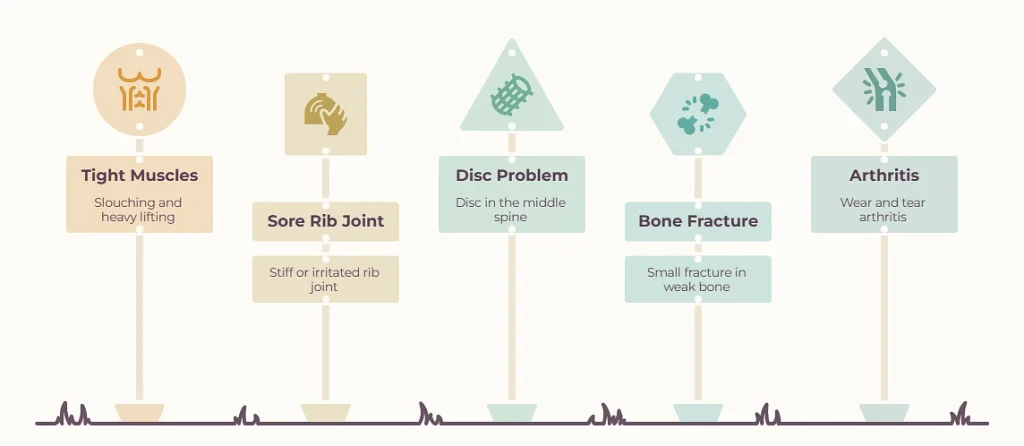
Tight Or Strained Muscles
This is the big one. Slouching over a screen, long drives, carrying a toddler on one hip, or lifting something heavy in a hurry can all leave the muscles round the shoulder blades sore and knotted. It normally clears up in 2 to 6 weeks if you keep moving.
A Sore Rib Joint
Each rib meets the spine at two small joints. If one gets stiff or irritated, you get sharp pain in one spot that’s worse when you breathe in, cough or twist, and sometimes spreads round the side along the rib. This was mine. It’s scary and almost always harmless.
A Disc In The Middle Of The Spine
Much less common than in the neck or lower back, because the ribs keep the middle spine fairly still. When it does happen, the pain can wrap round the chest or tummy in a band, a bit like a tight belt.
A Small Fracture In A Weak Bone
If your bones are thin (osteoporosis), one of the spine bones can partly squash down after a minor fall, a big cough or lifting a shopping bag. The pain is sudden and right on the spine. This needs an X-ray, especially if you’re over 60, have broken a bone before, or have been on steroid tablets for a long time.
Wear And Tear Arthritis
Worn joints in the spine bring stiffness and aching, usually worst first thing in the morning and better once you’re up and about.
When Pain Between The Shoulder Blades Is Coming From Somewhere Else
| Where it might be from | What usually gives it away |
|---|---|
| Heart | Ache or pressure between the shoulder blades with breathlessness, sweating, feeling sick, or chest discomfort, often when you exert yourself. Women and people with diabetes are more likely to get it in the back. |
| Aorta, the main blood vessel | Sudden, very severe pain that feels like tearing or ripping. Rare, and an emergency. |
| Gallbladder | Pain under the right shoulder blade after rich or fatty food, often with pain in the upper right of the tummy. |
| Lungs | Sharp pain on breathing with a cough, a temperature or breathlessness. |
| Food pipe or stomach | Burning pain linked to meals or lying flat, like bad heartburn. |
| Shingles | Burning or tingling in a strip on one side, followed by a blistering rash a few days later. |
Warning Signs That Mean You Should Get Help Today
Call 999 (or 911) straight away if the pain comes with:
- Pain, pressure or tightness in your chest.
- Sudden breathlessness, sweating, feeling sick or faint.
- A sudden, severe, tearing pain.
- Coughing up blood.
See a GP the same day, or go to urgent care, if you have:
- A temperature along with the back pain.
- Pain after a fall, or you know you have weak bones.
- Weakness, numbness or pins and needles in your legs, or you’re struggling to walk.
- Any change in controlling your bladder or bowels.
- Pain that’s there all the time, wakes you at night and doesn’t ease when you shift position.
- Weight loss you can’t explain, or you’ve had cancer before.
Doctors take new pain in the middle of the back a bit more seriously than lower back pain, especially in people over 50 or under 20. So if it hasn’t started to settle after a few weeks, get it looked at.
What Usually Helps When It Is Your Back
If your pain fits the back pattern and none of the warning signs apply, the fixes are pretty ordinary:
- Keep moving. Lying in bed makes a stiff back stiffer.
- Use heat on tight muscles, like a hot water bottle or a warm shower, for 15 to 20 minutes.
- Take simple painkillers or rub on an anti-inflammatory gel, if they’re safe for you.
- Do gentle moves through the day: roll your shoulders, squeeze your shoulder blades together, and twist slowly while sitting.
- Get up from your desk every 30 to 45 minutes, and lift your screen so you’re not looking down at it.
- See a physio if it’s no better after 4 to 6 weeks, or sooner if it’s stopping you sleeping or working.
My rib joint felt like the end of the world for about four days. A few gentle twists, a hot water bottle and a laptop stand later, I’d mostly forgotten it was there.
This is general information, not medical advice. If you’re not sure about pain in your back or chest, or any of the warning signs above apply, speak to a doctor straight away.
References
- NHS, Back pain: https://www.nhs.uk/conditions/back-pain/
- NHS, Heart attack symptoms: https://www.nhs.uk/conditions/heart-attack/symptoms/
- NICE Clinical Knowledge Summaries, Back pain: https://cks.nice.org.uk/topics/back-pain-low-without-radiculopathy/
- Royal Osteoporosis Society, Spinal fractures: https://theros.org.uk/information-and-support/osteoporosis/spinal-fractures/