



Four mornings a week for 7 months. That was my record before I paid for a trainer, and I was proud of it, and I looked almost exactly the same as the day I started. Same jeans, same shoulders, same number on the scale give or take a kilo. When I finally booked 6 sessions with a coach at the gym, she asked me 4 questions in the first 10 minutes, wrote 2 numbers on a card, and had the whole problem diagnosed before I had finished warming up. I had been doing the same weights, in the same order, for 7 months. Not one of them had gone up since about week 5.
That is the thing about consistency. It is necessary and it is not enough, and the reasons people put in the hours and see nothing are so predictable that a decent trainer works through them in the first fortnight and has usually found yours by the third week. Here are those reasons, in roughly the order a trainer checks them, so you can run the check yourself.
The Weights Have Not Gone Up Since The First Month
This is the one, for most people, and it was mine. Muscle grows because it is asked to do something it could not do last time. If the dumbbells you press today are the ones you pressed in March, your body finished adapting to them in April and has been coasting since. Effort is not the same as progress. You can sweat, ache and leave tired every single session and still be giving the muscle no reason to change.
A trainer’s first question is always “what did you lift last week?”, and if you cannot answer it with a number, that is the diagnosis. The fix is a notebook or a phone app and a rule every exercise, every session, either the weight goes up, or the reps go up, or the sets go up. Small, 1 rep or 1 kg or 2.5 kg on a bar, but every week. This is called progressive overload and it is the entire mechanism. Everything else on this page is a reason it is not happening.
You Are Eating Back Everything You Burn
Second question, and the one people least want to hear. A 45 minute weights session burns somewhere between 200 and 350 calories, which is a large muffin. If the reward for training is a bigger lunch, a protein shake with 400 calories in it and a “well, I went to the gym” pudding, the maths cancels out by teatime.
The other side of the same problem is not eating enough protein to build anything. The number most coaches use is around 1.6 grams of protein per kilo of body weight per day, so a 75 kg person is aiming at 120 grams, which is more than most people eat without trying. 3 eggs, a chicken breast, a tin of tuna and a yoghurt gets you there. Toast and pasta does not.
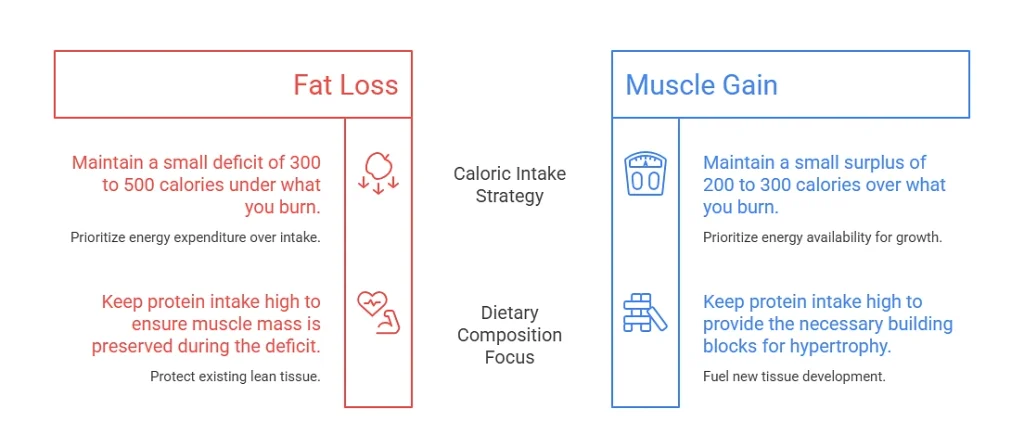
- To lose fat: a small deficit, 300 to 500 calories under what you burn, and protein kept high so the muscle stays.
- To gain muscle: a small surplus, 200 to 300 over, and protein high for the same reason.
- To do both at once from a standing start: possible in the first year, but only with protein at that number and the weights limit going up.
Track a normal week honestly, with an app, including the weekend. Most people find their “roughly 1,800 a day” is 2,400 by Sunday night.
You Sleep 6 Hours And Call It Fine
Muscle is built in bed, not in the gym. The session creates the damage; the repair happens over the next 48 hours, mostly during deep sleep, when growth hormone does most of its work. Under about 7 hours, repair slows, appetite hormones shift towards sugar, and the next session is weaker, so the weights do not go up, which takes us back to the first problem.
Trainers ask about sleep by week 2 because a client who is training hard on 6 hours is a client who will plateau and then get injured. If you are consistent in the gym and inconsistent in bed, the bed wins.
The Reps Are Half The Length They Should Be
Watch anyone who has trained alone for a year and you will see it the squat that stops 15 cm above parallel, the bench press that bounces off the chest, the lat pulldown that never quite reaches the collarbone. Each rep counts in the head and does about 60% of the work. A trainer sees this in the first session and fixes it in the second, usually by taking 20% off the bar, which is the part people hate.
Full range, controlled on the way down, a pause at the bottom, and the weight you can actually do that with. Filming one set of each lift on your phone shows you what a trainer would see, and it is humbling, and it works.
You Do Too Much Of Too Many Things
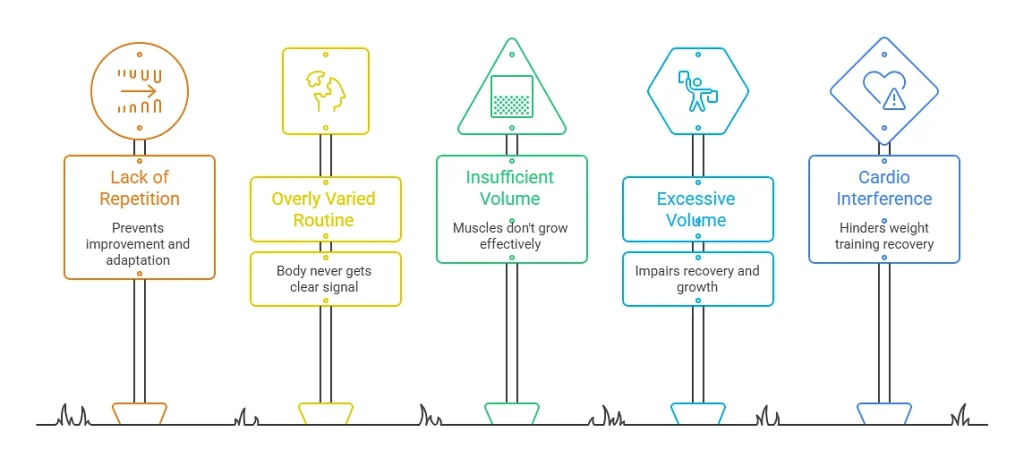
The other failure of the self trained is the opposite of doing the same thing for 7 months doing something different every week. A new programme from a video every Monday, a HIIT class on Tuesday, a leg day when there is time, and a run to make up for the missed session. Nothing gets repeated often enough to improve at, and the body never gets a clear signal about what it is supposed to become.
- The same 5 or 6 big lifts, squat, hinge, push, pull, carry, in the same rotation, for 8 to 12 weeks before anything changes.
- Each muscle worked 2 times a week rather than once, which the research keeps finding beats the bodybuilder split for anyone who is not already large.
- Somewhere between 10 and 20 hard sets per muscle per week. Under 10 and it will not grow. Over 20 and most people cannot recover from it.
- Cardio kept separate and modest, 2 sessions of 20 to 30 minutes, so that it does not eat the recovery the weights need.
A trainer writes this down for you in week 1 and then refuses to change it in week 3 when you get bored, which is most of what you are paying for.
You Are Measuring The Wrong Thing
The bathroom scale is a poor judge of a weights programme. Muscle is denser than fat, a new lifter can gain 2 kg of one and lose 2 kg of the other, and the scale reports nothing happened. Meanwhile the jeans fit differently and the bench press has gone from 40 kg to 60 kg, which is the change that matters.
- Photos, same light, same time of day, every 4 weeks. They show what the mirror hides because the mirror is looked at daily.
- A tape measure at the waist, chest and upper arm, every 4 weeks.
- The training log, which shows whether the weights are going up, which is the only number that predicts the rest.
- The scale once a week at most, in the morning, and averaged over the month.
If the log is going up and the tape is changing, the programme works, whatever the scale says.
What The First 3 Weeks With A Trainer Actually Look Like
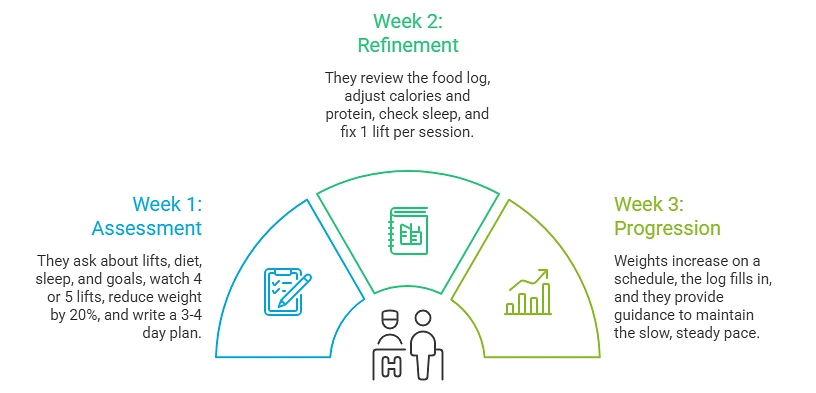
For anyone deciding whether to pay for one, this is what the money buys, and it is less mystical than the marketing suggests.
- Week 1: they ask what you lift, what you eat, how you sleep, and what you want. They watch you do 4 or 5 lifts and take 20% off most of them. They write a plan that fits 3 or 4 days a week and does not change for 2 months.
- Week 2: they check the food log, find the 600 calories you forgot about, push protein up, and ask again about sleep. They fix 1 lift a session.
- Week 3: the weights start moving up on a schedule, the log is filling in, and the first thing they say is “this is going to look slow for another month, keep going”.
The value is not the exercises. The exercises are on the internet for nothing. The value is somebody noticing in week 3 what took me 7 months to notice on my own, and being annoyed enough on my behalf to make me fix it.
How To Run The Check On Yourself
If a trainer is not in the budget, the same 3 week audit costs nothing.
- Write down every lift and every weight for the next 2 weeks. If the numbers are the same as last month, that is the problem, and the fix is adding 1 rep or 2.5 kg every session from now on.
- Track food honestly for 7 days including the weekend, and count the protein.
- Count the hours in bed for the same 7 days.
- Film 1 set of each of your main lifts and watch it back looking for depth and control.
- Pick 1 programme and commit to 8 weeks of it without changing anything.
Most people find their answer in the first 2 items. I found mine in the first. 7 months of consistent effort had built a very reliable habit and no muscle, and a card with 2 numbers on it, my bench and my squat from March, fixed it inside a month.
This is written for information and from experience, not as medical or professional training advice. Anyone with an injury, a heart condition or a long gap from exercise should check with a doctor before starting or changing a programme.