


Key Takeaways
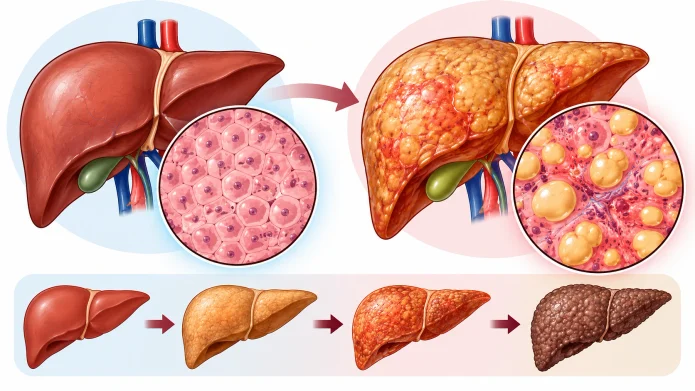
- MASH liver stands for metabolic dysfunction-associated steatohepatitis. It is fatty liver that has gone on to inflame and scar, and it used to go by the name NASH.
- It rarely causes symptoms, so most people only hear the word after a routine blood test comes back with a liver enzyme flag.
- Caught early it can go back, and for the first time there are 2 approved drugs for the people it will not go back for.
MASH is 4 letters that most people first see on a scan result or hear in a 10 minute appointment, and the letters do not help much on their own. Metabolic, dysfunction-associated, steato, hepatitis.
Take them in reverse. Hepatitis is an inflamed liver, and it has nothing to do with the hepatitis viruses here. Steato is fat, from the Greek.
Dysfunction-associated and metabolic together mean the fat got there because of how the body is handling sugar, blood fats and blood pressure, and not because of drink. So the whole thing reads as fat in the liver that has started an inflammation, caused by a metabolic problem.
A normal liver has some fat in it. Doctors start using the word steatotic once fat makes up more than about 5% of it, and at that point the report will say MASLD, which is the umbrella term. Roughly a third of adults have that much fat in the liver, and the majority of them stay there for life without ever getting inflamed. MASH is the group that did get inflamed.
Fat on its own does not hurt the liver. The inflammation does, because inflammation is what leaves scar tissue behind.
The Same Disease Has Been Called NASH Since The 1980s
If your older paperwork says NASH, nothing has changed inside you. The liver societies, the AASLD in the US among them, sat down a few years ago and agreed to retire nonalcoholic fatty liver disease and nonalcoholic steatohepatitis, partly because patients hated the word fatty and partly because naming a disease after the thing it is not (alcohol) told doctors nothing about what it is. NAFLD became MASLD and NASH became MASH, and the biopsy that diagnoses it did not move an inch.
Fat First, Then Inflammation, Then Scar
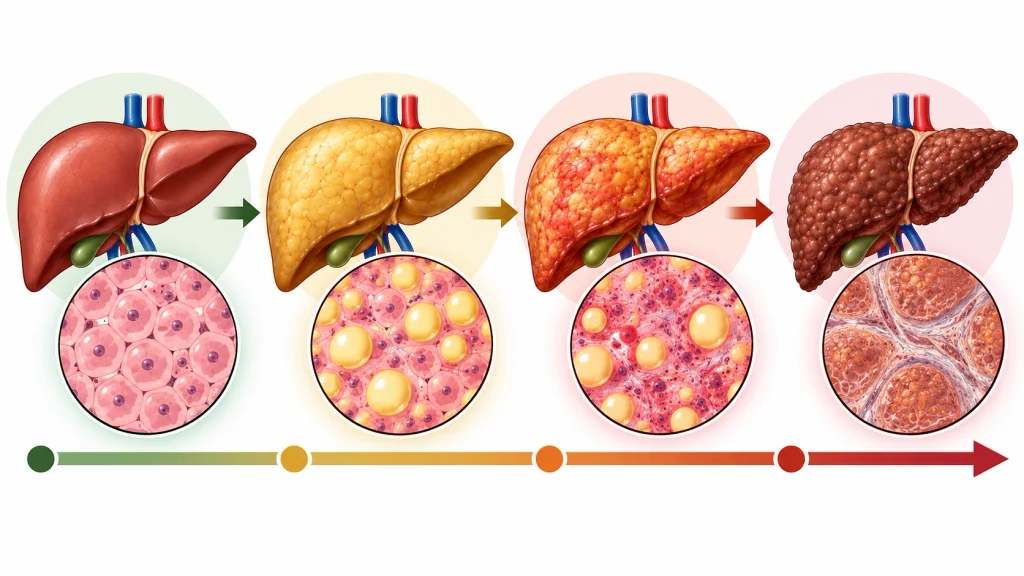
Where you are on the ladder matters more than the name does, and the ladder has 4 rungs.
- Simple fatty liver, which is the fat with little or no inflammation, and most people never leave this rung.
- MASH, where the fat has set off inflammation, liver cells are being injured, and the first scar tissue is forming.
- Fibrosis, which is the scar building up, and this gets graded F1, F2 or F3 depending on how much there is.
- Cirrhosis, graded F4, where scar has replaced so much working liver that it cannot do its job, and liver failure and liver cancer both become real risks from here.
The grade is the number to look for on your report, because an F1 and an F3 both come under MASH and get handled completely differently. Ask for the F number if it is not written down, and write it somewhere you will find it again.
There is one detail about the liver that explains why any of this is treatable, and I did not know it until I went reading. The liver regrows. It is the only internal organ that rebuilds its own mass to any real degree after damage, which is how living donors can give away more than half of theirs and be fine a few months later. So an inflamed liver at F1 or F2, once the inflammation is turned off, can quietly rebuild working tissue where the injury was. What it cannot do is rebuild through dense scar, and that is the whole reason cirrhosis is treated as the line. Everything above that line has a way back, and the way back gets narrower each rung down.
The American Liver Foundation puts the number of American adults with MASH somewhere between 1.5% and 6.5%, which sounds vague until you turn it into people, and then it is 9 to 15 million, and they expect it to become the leading reason for a liver transplant in the country. Alcohol used to hold that spot.
Weight And Diabetes Are The Big Two Drivers
Carrying extra weight around the middle is the biggest driver, and insulin resistance runs a close second. Insulin resistance means the cells have stopped answering insulin the way they should, so sugar and fat keep circulating in the blood and the liver ends up storing what does not get used. Prediabetes and type 2 diabetes are that same problem further down the road. High triglycerides, high cholesterol and high blood pressure each add weight to it, and so does a job where you sit for 9 hours.
I want to be careful with the weight part, though, because lean people get MASH as well and the doctors are honest that they do not fully know why one fatty liver inflames and the next one sits there for 30 years. A review in Frontiers in Cell and Developmental Biology puts the overlap between MASH and the other metabolic conditions at 50% to 80%, and the same paper spends most of its pages on how the inflamed liver spills its trouble into the heart, the kidneys and the muscles. The part that surprised me is that people with this disease mostly die of heart disease, and the liver comes second. I had assumed a liver disease would end in the liver.
If you have type 2 diabetes you are in the group this matters most for. A review on MASH and diabetes published this year says around 7 in 10 people with type 2 diabetes have fat in the liver already, and a fair number have crossed into MASH without a single symptom to show for it.
Why A Blood Test Finds It Before You Do
Early MASH gives you nothing to feel. The liver has no pain nerves inside it, only in the capsule around it, so it can be inflamed for years while you feel completely normal, and the dull ache under the right ribs that Cleveland Clinic lists only arrives once the organ has swollen enough to stretch that capsule. Tiredness, muscle weakness and losing weight without trying come in around the same time. Swelling in the belly or legs and yellowed eyes are cirrhosis signs, and by the time those show the easy window has usually closed.
So how does anyone catch it at F1? By accident, most of the time. A blood panel ordered for something else comes back with ALT and AST flagged, those are 2 liver enzymes, your doctor looks twice at them, an ultrasound follows, and the ultrasound shows an enlarged liver with fat in it. If the doctor is being thorough the next step is a FibroScan, which is an ultrasound type scan that measures how stiff the liver is, and stiffness stands in for scar. A biopsy, a needle taking a tiny piece of liver, is still the only way to confirm MASH beyond doubt, but most people are never sent for one now.
I paid for that blood panel and the ALT came back flagged and the note said probably nothing, why is no one worried about it? That is the reader who should be reading this. A raised ALT on a routine panel is, for most people, the first and only warning the disease gives, and it deserves a repeat test rather than a shrug. If it is still up on the repeat, that is the moment to ask 3 things in the room. Whether you need a FibroScan. What your fibrosis stage is, or how they would find out. And whether your sugar and cholesterol should be run again now, because those results decide the plan more than the liver ones do.
Losing 7% To 10% Of Body Weight Is Still The Main Treatment
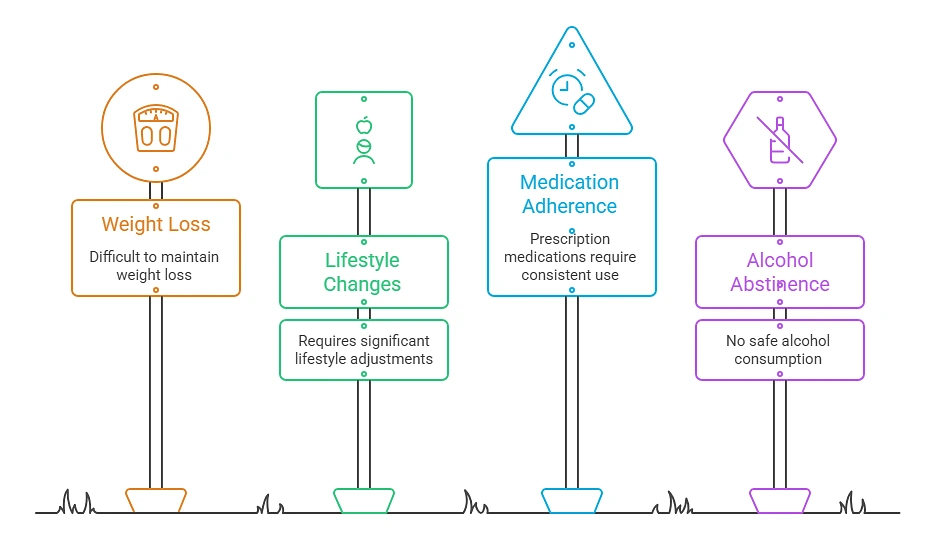
For anyone at F1 or F2 the treatment with the most evidence behind it is weight loss, and the amount is more specific than people expect. Around 5% of body weight taken off cuts the fat in the liver. Somewhere between 7% and 10% is where the inflammation settles and early fibrosis can start going backwards. For a 220 pound person that is 15 to 22 pounds, and it has to stay off, which is the hard half.
Johns Hopkins lists the rest and none of it will surprise you. Bring the cholesterol and triglycerides down, get the diabetes under control if you have it, go easy on over the counter painkillers that pass through the liver, and stop drinking. Their page is blunt on the last one. No amount of alcohol is known to be fully safe once you have MASH, which is a stricter rule than the one for simple fatty liver, and I think a lot of people with an F1 are still being told the odd glass is fine. Vitamin E gets prescribed for some people who do not have diabetes or heart disease. Coffee keeps turning up as protective in the studies, 2 or 3 cups a day, though no doctor is going to write that on a prescription pad.
For most people that is the treatment. For people at F2 or F3 who cannot get the weight off, or whose scan is worse each year regardless, there is now a prescription conversation, and until 2 years ago there was not.
Rezdiffra And Wegovy Are The 2 Approved Drugs
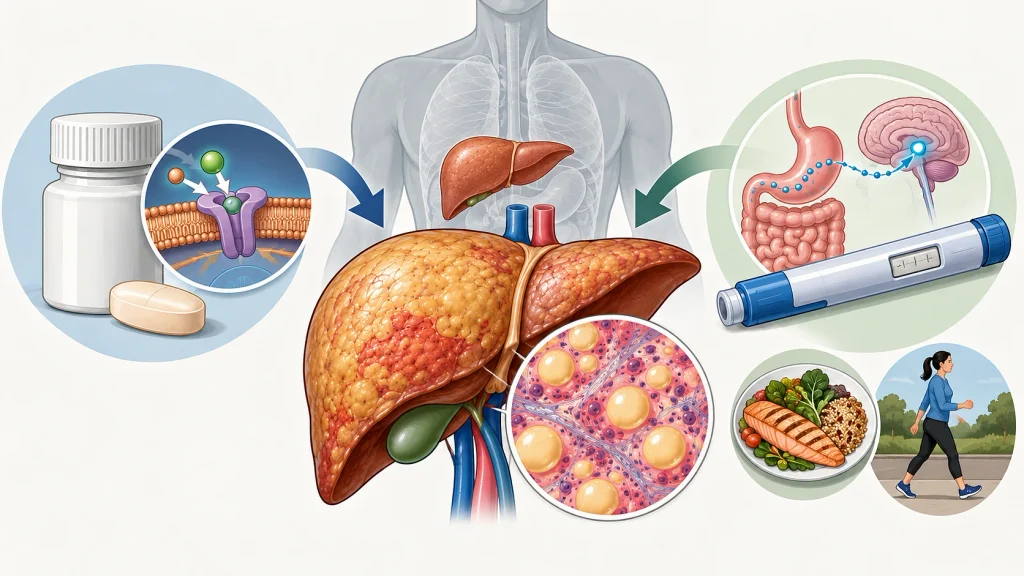
Rezdiffra (Resmetirom):
Rezdiffra was the first drug ever approved for this disease. The FDA cleared it in the spring of 2024 for adults with MASH at F2 or F3, and it is a once a day tablet. It works on a thyroid hormone receptor that lives mostly in the liver, and switching that receptor on makes the liver burn its fat instead of storing it. It is not approved for anyone who already has cirrhosis. The approval was an accelerated one, meaning the FDA granted it on early trial results and the company still owes the long term proof, and Public Citizen, a consumer watchdog, has it on their do not use list for that reason. I would not call that settled either way.
Wegovy (Semaglutide):
The second one you already know from the weight loss ads. Last August the FDA gave Wegovy the same accelerated approval for MASH at F2 to F3, which made it the first GLP-1 drug approved for a liver disease. In the ESSENCE trial that got it there, about 63% of people on the weekly injection had their steatohepatitis resolve against 34% on the placebo, and 37% saw their fibrosis improve against 22%. It has to be taken with a reduced calorie diet and more activity, it is not for cirrhosis, and the second half of that trial does not report until the end of the decade. The UK regulator approved both drugs over the summer, and we post those approvals as they come through on our news page.
Both trials ran the drug on top of the diet. Neither company tested it as a replacement for losing the weight, so that part of the plan does not go away with a prescription, and the number your doctor will be watching between now and the next scan is still the F number.

