


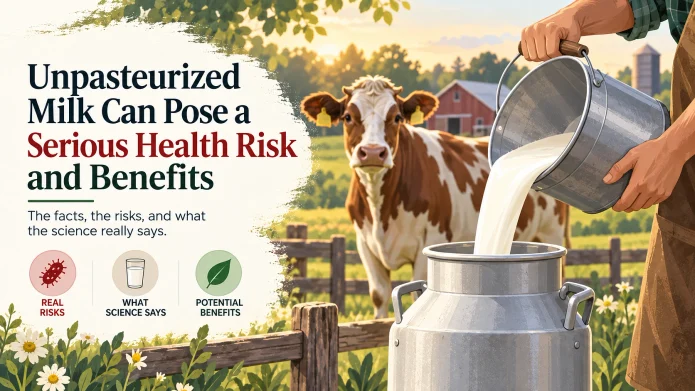
Key Takeaways
- Pasteurization kills the germs in milk and changes nothing that matters nutritionally.
- Raw milk picks up E. coli, Campylobacter, Listeria and Salmonella between udder and bottle, clean farm or not.
- It causes several hundred times more illness per serving than pasteurized milk.
- Children under 5, pregnant women, over 65s and the immunosuppressed carry the worst of that risk.
- Live H5N1 bird flu has been found in raw milk and raw milk cheese since 2024.
- The lactose, probiotic and enzyme claims fail testing; the allergy finding is real but points to gently heated milk, not raw.
Raw milk is milk that has not been heated. That is the whole definition, and it is worth holding on to, because most of the argument around it is conducted as if the heating were some industrial insult and the raw product were a different, older, purer thing. It is the same milk. One jug has been to 72 degrees for 15 seconds and the other has not, and everything that follows comes down to what that quarter of a minute does.
I want to say early that I am not neutral. I have worked in food microbiology for a long time and I have seen what E. coli O157 does to a 3 year old’s kidneys, and I do not think I am obliged to pretend that the 2 sides of this argument carry equal weight. They do not. But the people who drink raw milk are not fools, they have usually read more about it than their doctor has, and they deserve the actual reasons rather than a poster. So here are the actual reasons, with the bacteria named, and the one benefit claim that is not nonsense given its due.
What Happens To Milk At 72 Degrees
Almost nothing, nutritionally. The proteins are still there. The whey proteins unfold a bit, which changes how the milk froths and how it sets into cheese and does nothing to what we digest from it. Calcium, phosphorus, and magnesium do not care about heat. Vitamins A and D are added afterwards in the US whatever happens. A few B vitamins drop by around a tenth, thiamine and B12 mostly, and vitamin C drops by more, but milk has so little vitamin C that this is like worrying about the iron in a lettuce. Raw milk and pasteurized milk are the same food on a nutrition label. I have never seen a serious dietitian dispute that, and I have looked.
What does change is the living content. The heat kills the bacteria and viruses that were in the milk, whether they got there from the cow’s blood, the cow’s udder, the cow’s backside, or the person milking her. It also knocks out 2 enzymes, one that turns milk rancid within days and one, alkaline phosphatase, that we test for in the lab to prove the heating happened. And it partly denatures lactoferrin and the immunoglobulins, which is the part raw milk advocates mind about, and which I will come back to because it is the interesting bit.
Small dairies often use the older method, 63 degrees for 30 minutes, which they call gentle or low temperature pasteurization. It works. It kills the same organisms. If you want milk that has been treated as little as the law allows, that is the product, and it is legal in every state.
What Is In Raw Milk
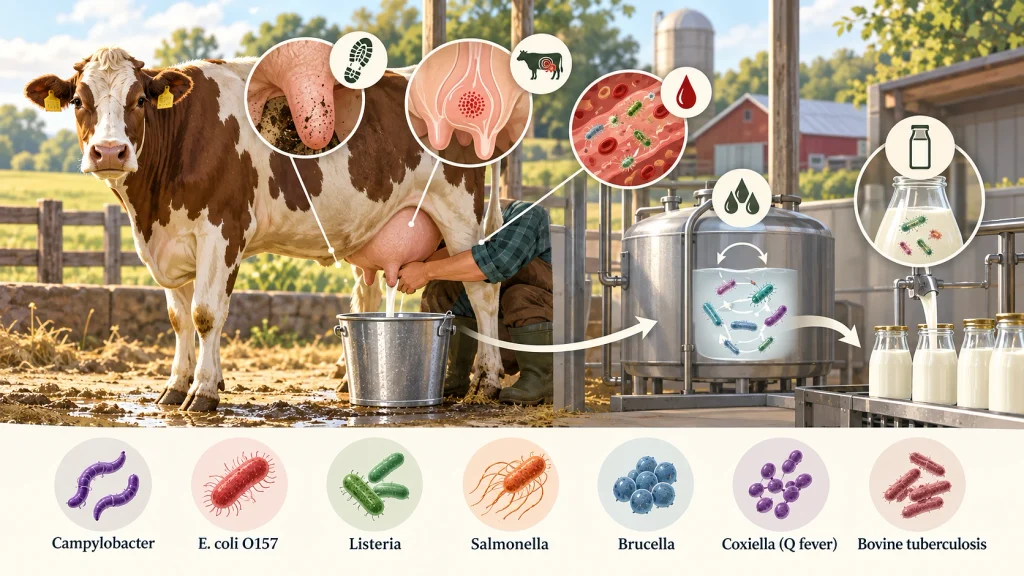
A healthy udder produces milk that is nearly sterile. It is the 30 centimetres between the udder and the bottle where the trouble happens. Teat smooth skin. Faeces, because a cow produces a great deal of it and it ends up on the udder no matter how careful the milker is. Mastitis, an udder infection that is common, often invisible, and pours bacteria straight into the milk. The bulk tank, which is shared across the whole herd, so one cow’s problem becomes everybody’s bottle. And, for a few organisms, the cow’s own bloodstream.
The ones that matter, because these are the ones that come back on the plates after an outbreak:
- Campylobacter, which is the commonest. A week of fever and bloody diarrhoea, and in about 1 in every 1,000 cases a delayed paralysis called Guillain-Barré syndrome that can put a previously healthy adult on a ventilator.
- E. coli O157 and its relatives. This is the one that hurts children. Something like 15% of young children who catch it go on to haemolytic uraemic syndrome, in which the toxin wrecks red blood cells and shuts the kidneys down. Some recover. Some are on dialysis at 20.
- Listeria, which a healthy adult barely notices and which in pregnancy crosses the placenta and kills the baby.
- Salmonella, ordinary food poisoning but with a shared bulk tank behind it, so 40 people at once.
- Brucella, Coxiella (Q fever), and bovine tuberculosis, the diseases our great grandparents got from milk and that pasteurization largely ended, and that reappear wherever raw milk is sold. I have seen 1 Brucella case from a herd share. The man was ill for months and thought he had cancer.
The CDC’s count for 1998 to 2018 was 202 outbreaks traced to raw milk, with a couple of thousand confirmed illnesses and over 200 hospital admissions, and confirmed cases are always a fraction of real ones. The comparison people quote from Emerging Infectious Diseases in 2017 is that raw dairy, less than 4% of what Americans drink, causes several hundred times more illness per serving than pasteurized dairy. I think the exact multiplier is 840. It does not much matter whether it is 840 or 400. It is not a slightly riskier drink. It is a different category of risk altogether.
Who It Hurts Most
Children under 5. Pregnant women. Anyone over 65. Anyone on chemotherapy, on a biologic drug for arthritis or Crohn’s, after a transplant, or with HIV. Those 4 groups are where the deaths and the dialysis come from, and raw milk is very often marketed straight at the first 2 of them as a natural food for growing families. I find that hard to be calm about and I am not going to try.
The Bird Flu Problem
This is new, and if you are drinking raw milk in 2026 and have not thought about it, please do.
In the spring of 2024 H5N1 avian influenza turned up in dairy cows, which nobody in the field expected, and it has since moved through herds across most of the dairy states. Infected cows shed virus into their milk at very high concentrations. Live, infectious virus has been recovered from raw milk. Cats on affected farms drank it and died of brain inflammation. A California raw milk producer had bottles pulled from shops in late 2024 after the virus was found in retail product. And the aged raw milk cheese that everybody assumed was safe because of the 60 day rule turned out, in Cornell’s testing for the FDA, to still carry live virus past 60 days.
Pasteurization kills it, completely, at temperatures well below the standard, and the FDA has tested hundreds of pasteurized products without finding a live particle. Raw milk gets no such protection. So far there is no confirmed human case from drinking it, and the CDC rates the public risk as low. I would not want to be the first case, and the advice to doctors from the CDC has stayed the same through 2 administrations: pasteurized only.
The Benefit Claims
I have read them all. Most fall over quickly. One does not.
Lactose intolerance. Raw milk has the same lactose and no lactase. A small Stanford crossover trial in 2014 gave lactose intolerant adults raw milk, pasteurized milk, and soy milk in turn and measured breath hydrogen and symptoms, and the 2 milks were indistinguishable. People who feel better on raw milk are usually drinking less of it, or with food.
Probiotics. The bacteria in raw milk are whatever was in the tank. Not named strains, not a known dose, and sharing the jug with everything in the list above. Kefir made from pasteurized milk does the job properly.
Enzymes. Lipase and lactoperoxidase are proteins. The stomach digests them. They do not arrive in the gut alive and do not do anything there.
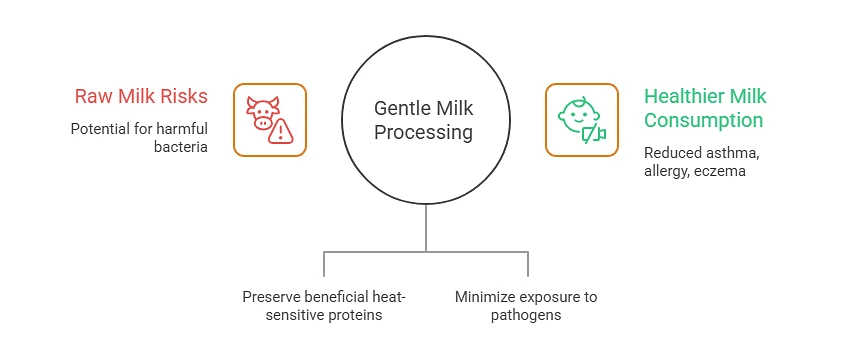
Asthma and allergy. Here is the one that is real. 3 big European cohort studies, PARSIFAL, GABRIELA, and PASTURE, found that farm children who drank unprocessed farm milk had less asthma, hay fever, and eczema, the finding held after allowing for the other things farm children are exposed to, and it weakened when families boiled the milk at home. The likely explanation involves the heat sensitive whey proteins and possibly the fat. This is a genuine, repeated, published effect, and I would be lying if I said otherwise. What the researchers who found it recommend is not raw milk. It is milk processed more gently than the supermarket standard, which several of them are now developing, because the same farm children in the same studies were also exposed to Campylobacter and E. coli, and the authors say so in their own papers. There will never be a randomised trial of raw milk in infants. No ethics committee would pass it.
The Law
Interstate sale has been banned by the FDA since 1987. Within states it varies from open retail sale in about 13 to a full ban in a handful, with most of the rest allowing farm gate sales or herd shares. Sales have risen sharply since 2022, and the current Secretary of Health and Human Services has spoken in favour of raw milk, which has changed nothing in the federal rule or the CDC guidance and a great deal in how often I get asked about it.
If You Are Going To Drink It Anyway
Some people will, and telling them not to for a fifth time achieves nothing, so:
- Not if you are pregnant, not for a child under 5, not for anyone over 65 or on any drug that suppresses the immune system. Those are the lines I would not cross for anyone.
- From a herd that tests for H5N1 and Brucella, and ask to see the results, not to be told they exist.
- Kept cold from the udder to your fridge and drunk within 2 days.
- Knowing that none of that removes the E. coli on the teat, because nothing does except heat.
The farm behind the worst outbreak I have worked on was clean. Well run, small, family owned, and the family drank the milk every day and had never been ill. That is the thing nobody expects and the thing I most want understood. A raw milk outbreak does not need a dirty farm. It needs a cow.
This is written for information by a food microbiologist and is not medical advice. Bloody diarrhoea in a child, a fever in pregnancy, or weakness or confusion after any dairy related illness needs same day medical attention.