


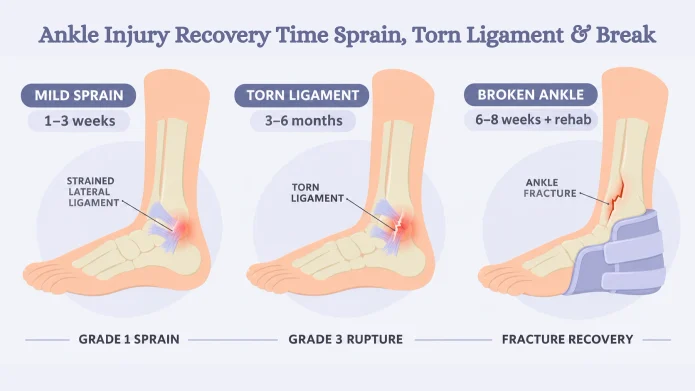
The X-ray comes back clean and the doctor says sprain, and most people hear that as two weeks. Sometimes it is. A ligament that only got stretched settles down fast and gets forgotten about. But a clean X-ray can also be sitting on top of a ligament that tore all the way through, and that ankle will need closer to half a year before it can be trusted again. The word sprain covers both of those situations, which is sort of the whole problem, and a broken bone follows a different schedule than either of them.
A Mild Sprain Needs One to Three Weeks, a Ligament Tear Can Need Six Months
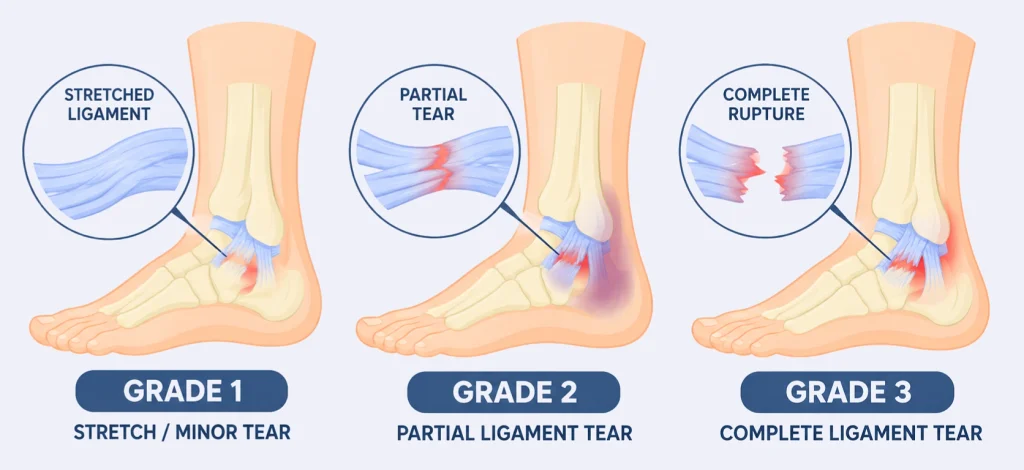
Nearly every ankle sprain happens on the outer side of the joint, where three small ligaments hold the ankle against the rolling-inward motion that causes the injury in the first place. One AAOS surgeon writing on OrthoInfo notes that “these ligaments will almost always heal on their own,” and the academy grades the damage from tiny fiber tears up to a complete rupture. Healing time follows the grade:
- Grade 1 is a stretched ligament with some microscopic tearing, and it needs 1 to 3 weeks. Most people are walking within a day or two.
- Grade 2 means the ligament partially tore. 4 to 6 weeks, usually with bruising and swelling you can see above and below the joint.
- Grade 3 is a complete rupture, and the ankle needs 3 to 6 months before it holds up under cutting, jumping or uneven ground.
Those windows move around. The physical therapists Healthline spoke to put even a mild sprain at three to five weeks, and two clinicians can look at the same ankle on the same day and grade it differently, so treat the ranges as rough planning numbers. The ligament in a grade 3 injury also keeps remodeling for up to a year after the injury, meaning the pain is gone months before the tissue has finished rebuilding.
A Completely Torn Ligament Can Hurt Less Than a Partial Tear
A grade 3 rupture sometimes hurts less than a grade 2 tear. Sounds backwards until you think about what tore. Once the ligament has separated all the way, the torn fibers are no longer being tugged with every step, so the pain can fade while the damage sits there at its worst. People walk around on ruptured ligaments for weeks because the fading pain reads like proof the injury was minor.
Then the instability shows up. EmergeOrtho, an orthopedic group out of North Carolina, points to research showing that one to two of every ten people with a severe sprain end up with chronic ankle instability, the giving-way ankle that rolls on a flat sidewalk for no reason, years after the original injury. Most of the people in that group have the same story behind them, a bad sprain that got walked off and never rehabilitated. If an ankle cannot take weight at all, feels loose, or stopped hurting suspiciously fast after a violent twist, get it examined.
A Broken Ankle Knits In Six to Eight Weeks, But The Clock Does Not Stop There
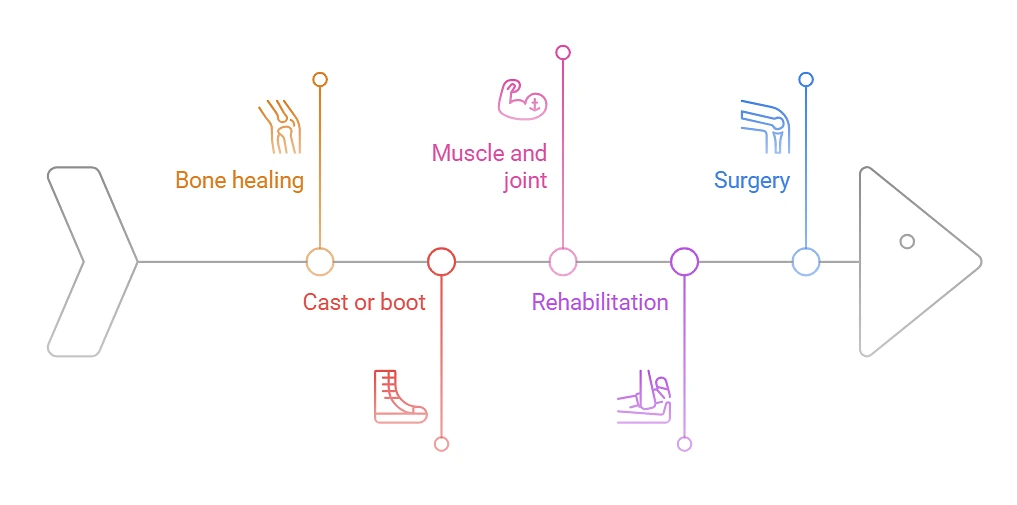
Bone behaves better than ligament, which surprises people. The NHS puts a broken ankle at six to eight weeks to heal, and bone comes back to its full strength instead of healing into a looser version of itself the way ligament does. The catch is everything around the bone. Four to eight of those weeks go by inside a cast or a boot, the calf muscle wastes visibly in that time, the joint comes out stiff, and walking normally again takes several more weeks of physiotherapy, so a return to running or contact sport usually lands somewhere around the three to six month mark. Surgery, when the bones have shifted and need plates and screws, adds its own healing on top of all that, and a lot of surgical patients are told to keep weight off the leg for six weeks or longer.
Even the six-week cast is being questioned now. A 2019 trial reported by HealthDay found that three weeks in a cast or brace healed simple ankle fractures just as well as the traditional six, and the brace group had slightly better ankle mobility at the one-year mark. Smokers heal slower than everyone else, since smoking measurably delays bone union and in extreme cases stops it altogether. A fracture is one of the more persuasive moments to quit.
The Cast Protects The Ankle And Puts The Calf at Risk
Weeks of sitting still in a boot or cast do one more thing, and it has nothing to do with the ankle. A lower leg that is not moving lets blood pool and clot in the deep veins of the calf, and a piece of that clot can break off and travel up to the lungs. A calf that turns hot and swollen and painful under the cast, or breathlessness that arrives out of nowhere, means go straight to an emergency room. Anyone riding out a fracture should know the warning signs of a pulmonary embolism before that moment comes. Hospitals take the threat seriously enough that their protocols avoid propping a patient’s knees up in bed after major surgery, because bent legs that stay still are exactly how blood clots in the legs get started.
Given the choice, plenty of orthopedic surgeons would rather manage a clean simple fracture than a grade 3 rupture, because bone comes back to full strength and ligament usually comes back a little loose. Either way, the rehab weeks after the pain stops are the ones that decide how the ankle behaves five years from now, and those are the weeks that get skipped.

