



The morning after an eye injection, a lot of people wake with an eye that feels as if there’s sand under the lid. It waters, it’s red, and looking at a bright window isn’t pleasant. Nearly all of that comes from the surface of the eye and has little to do with the needle, and it should be easing by the second day.
What you’re watching for is the direction things are moving in. An eye that’s sore tonight and a bit less sore tomorrow is healing. An eye that felt fine on day one and starts to ache on day three, or one that simply hurts more each time you check, needs to be seen by the clinic that day, even if it means a phone call you’d feel silly making.
Why The Eye Hurts On The First Night
During the injection itself most people feel pressure and not much else, because the eye has been numbed. The soreness arrives a few hours later, once the anesthetic drops wear off, and there are usually two or three ordinary reasons for it.
The Antiseptic
Before the needle goes anywhere near you, the eye and lids are washed with povidone-iodine, the yellow-brown liquid that stings. It’s there to kill the bacteria that live around the eye, and it does that job very well. It’s also rough on the eye’s surface. An ophthalmic nurse who spoke to the Macular Society for its piece on pain after eye injections called a reaction to the iodine the most common cause of discomfort afterwards. The American Society of Retina Specialists describes the result as a feeling that something is in your eye.
A scratch On The Surface
Less often, the clear front of the eye picks up a small scratch during the procedure, or from rubbing afterwards. You’ll know this one. It tends to come on sharply three to six hours after the appointment, and it’s worse when you blink or look from side to side. Miserable as it is, a scratch heals fast, and the Macular Society’s nurse put the limit for that kind of pain at 24 to 48 hours.
The Red Patch That Looks Worse Than It Is
A bright red blotch on the white of the eye, right where the needle went in, can be the most alarming thing in the mirror. It’s a small bruise under the clear skin of the eye. It doesn’t hurt much, it doesn’t affect your sight, and it fades by itself over a week or two.
What Helps In The First 48 Hours
Not a great deal is needed, which is good news when you can barely keep the eye open.
- Lubricating drops, and plenty of them. The nurse quoted above tells his patients to put drops in every hour on injection day until bedtime, to wash out what’s left of the iodine. The retina specialists’ society suggests sterile single-use vials, since a bottle that’s been open for weeks is the last thing you want near a fresh injection site.
- An ordinary painkiller such as acetaminophen, if you’d normally take one.
- Hands off. Rubbing is how a sore eye turns into a scratched one.
- Sunglasses, indoors too if the light bothers you.
Blurry vision for a few hours is expected, and so are a few floaters or dark specks drifting about for a day or so.
Rest the eye if you can. Nobody has ever regretted an early night after one of these.
How to Tell Ordinary Soreness From Trouble
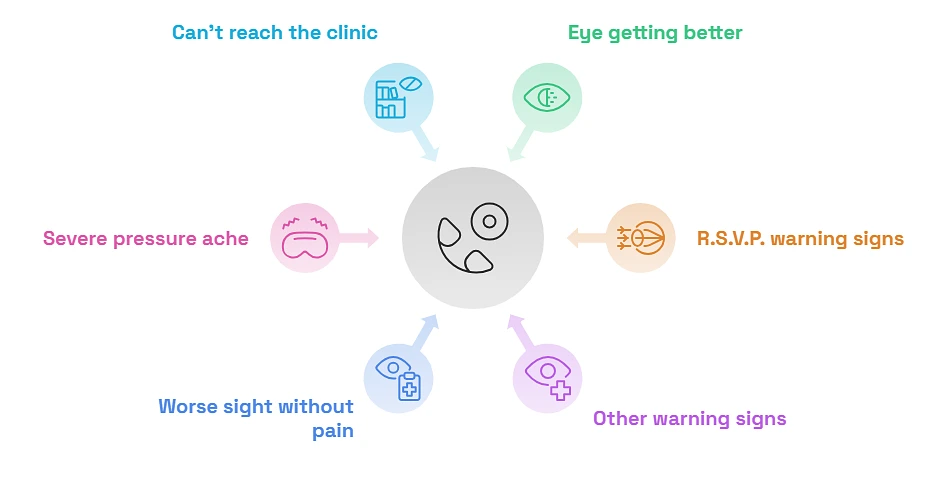
Ask yourself one question each morning: is the eye better than it was last night?
If the answer is yes, even slightly, you’re on the normal path. Hospital aftercare sheets generally allow 24 to 48 hours of mild discomfort and redness, and some mention a bruised feeling that hangs on a day or two longer.
If the answer is no, and especially if the eye was comfortable and has now started to hurt, call the clinic today.
One NHS hospital gives its injection patients a four-letter reminder, R.S.V.P., and it’s the easiest way we’ve found to remember the list:
- Redness that is spreading or deepening.
- Sensitivity to light that’s getting worse.
- Vision that is dropping or turning hazy.
- Pain that is building, or that a painkiller doesn’t touch.
The leaflet applies that list to anyone who has had an injection in the past two weeks. A swollen lid, any discharge, or a sudden shower of new floaters after the first day belong on it too.
Pain isn’t always part of the picture, and that catches people out. In a review of injection-related infections published in 2022, pain was present in about three-quarters of cases, whereas loss of vision was present in nearly all of them. If your sight is clearly worse and nothing hurts, that still counts.
There’s a separate problem worth knowing about as well. Occasionally the pressure inside the eye shoots up straight after the injection, and that produces a deep, severe ache within seconds to hours that painkillers won’t shift. It’s rare. It also shouldn’t wait until morning.
As for who to call, the number is on the aftercare sheet you were handed on the way out, and many clinics have an emergency line for exactly this. If you can’t find the sheet or nobody answers, go to an emergency room and tell them you’ve had an injection into the eye.
How Likely An Infection Really Is
The thing every one of those warning signs is pointing at is an infection inside the eye, which doctors call endophthalmitis. It’s the complication the iodine is there to prevent.
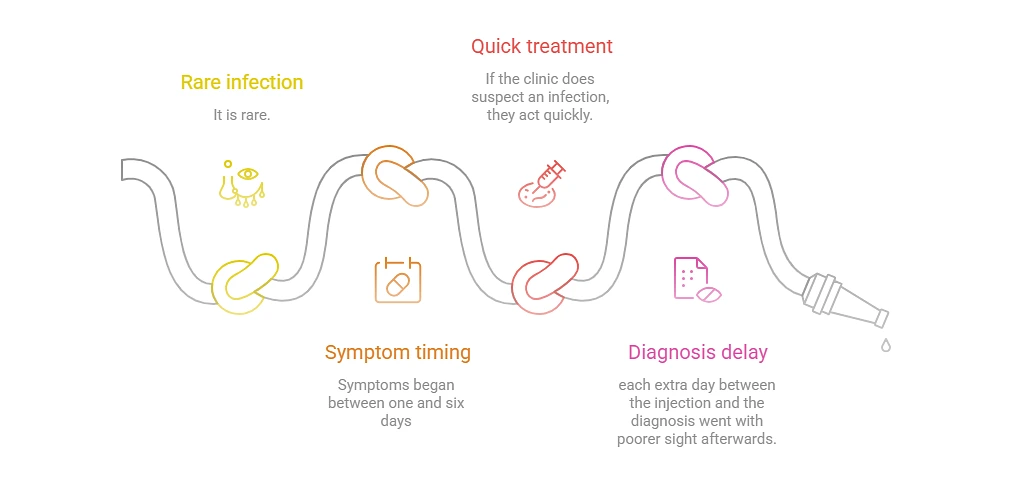
It is rare. A 2022 review of injection-related endophthalmitis put the reported rate for the common sight-saving drugs at between 0.016% and 0.083% of injections, and a large study presented to the American Society of Retina Specialists in 2023 worked it out at about one case in every 3,500 injections. Somebody having a course of eight injections a year for several years is still far more likely never to meet it than to meet it.
The timing is what makes it recognizable. Symptoms in that review began between one and six days after the injection, and patients turned up at the clinic on day three or four on average. That is exactly the window in which ordinary soreness ought to be finished.
If the clinic does suspect an infection, they act quickly. A small sample of fluid is taken from the eye and antibiotics are injected directly into it. Most people do well. In one series from Wills Eye Institute, the majority of patients treated for a presumed infection after an injection got their vision back to where it had been. The 2023 study added a sobering detail, though: each extra day between the injection and the diagnosis went with poorer sight afterwards.
That’s the whole case for making the phone call early. A false alarm costs you an afternoon.
What To Do if Every Injection Leaves You In Pain
Some people have a rough night after each appointment and start to dread the next one. It’s tempting to cancel. Please talk to the clinic before you do, because these injections are usually what’s holding your sight where it is, and the soreness can very often be reduced.
Tell whoever gives the injection what happened last time, in plain terms: how bad it was, how long it went on, what it felt like. The Macular Society’s advice to patients with regular pain is to raise it with their specialist, and a team has several things it can change. The eye can be rinsed more thoroughly once the injection is done. The numbing can be done differently. Some units will consider another antiseptic for people who react badly to iodine. If you’d like to go in informed, a paper written for Australian family doctors, Injections in the back of the eye: the why, the what and when to worry, is a readable summary of what else can cause pain.
Eye clinics aren’t the only places that send people home with a sheet of instructions that turns out to matter. We’ve written about why nurses avoid the knee gatch after a hysterectomy, and about the pulmonary embolism warning signs that runners tend to explain away.
Keep the aftercare sheet on the fridge until your next appointment. And if you’re squinting at this page with one sore eye, wondering whether it’s bad enough to bother anyone, it is bad enough, and the clinic would much rather hear from you.

