



Press 2 fingers into the top of the shoulder, halfway between the neck and the point of the shoulder, and slide them slowly along the muscle. In most people there is a spot where the muscle changes under the fingers, a tight cord running through the softer tissue around it, and somewhere on that cord a small firm lump about the size of a pea. Pressing it hurts more than pressing anywhere else nearby, and in a lot of people it sends an ache up into the base of the skull or across toward the shoulder blade. That lump is what everyone calls a knot. Physical therapists call it a trigger point, and the cord it sits on is a taut band.
It is not a tangle, and nothing in the muscle is tied. A small group of fibers has stayed contracted and will not let go, the blood supply to that patch drops, waste builds up, and the nerves there get touchy. Cleveland Clinic puts the share of people who get one at some point in their lives at about 85 percent, which makes it one of the most ordinary things that can go wrong with a body. Mayo Clinic says plainly on its page that the exact cause is not known.
A knot is a patch of muscle fibers stuck in contraction. The things that get it to let go at home are heat, slow pressure held on the spot, and then moving the muscle, in that order.
Where They Come From
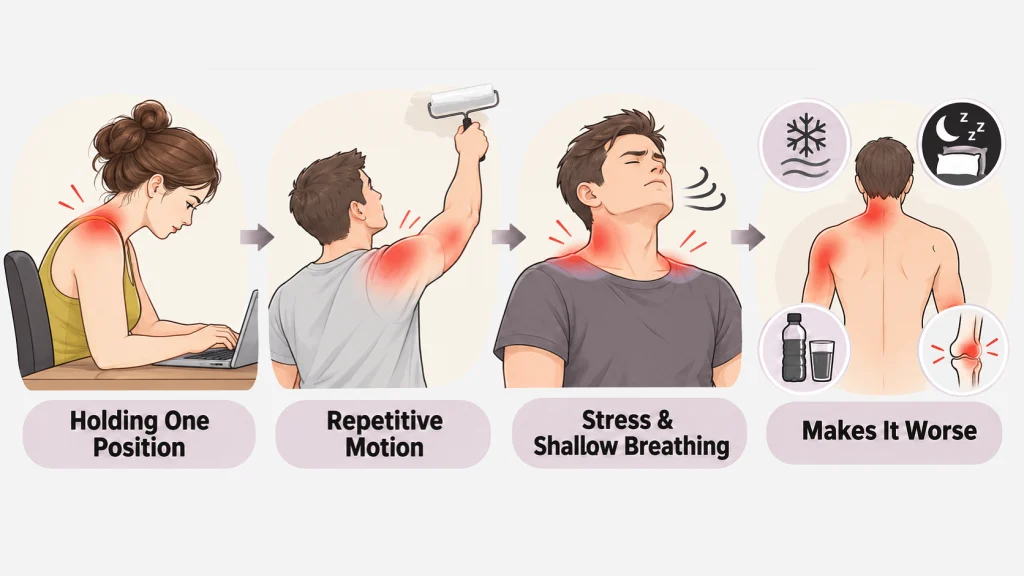
Since the exact cause is not settled, what the clinics list are the things that reliably bring one on, and most people can find their own in this list.
Holding One Position For Hours
A muscle that is held slightly tensed for a long stretch, rather than worked hard, is the most common start. The shoulders raised a little at a laptop, the head forward over a phone, the jaw set, the right leg on the gas pedal for 2 hours. The muscle never fully relaxes, blood flow through the held part drops, and a patch of fibers gets stuck. This is why desk workers and drivers get them in the neck and shoulders more than people who lift for a living.
Doing The Same Movement Over And Over
The other common start is the opposite, a muscle worked the same way many times, a new gym program, a weekend of painting a ceiling, hammering, a tennis serve. Cleveland Clinic lists repetitive motion and muscle injury alongside posture as the usual causes.
Stress And The Breath
Worry tightens the shoulders and the jaw without anyone deciding to tighten them, and shallow chest breathing uses the small muscles at the top of the ribs and the neck for a job the diaphragm should be doing. A week of bad news is enough to grow a knot at the base of the neck in someone who has never had one.
The Things That Make Any Of The Above Worse
- Cold, including an air conditioner blowing on one shoulder all day.
- Short or broken sleep, since the muscles do most of their repair at night.
- Not drinking enough through the day.
- An old injury that changed how a joint moves, so the muscles around it work harder than they should.
None of these 4 starts a knot on its own. They lower the bar for the first 3 causes.
The 5 Places They Favor And Where Each One Sends Its Pain

A knot hurts where it is, and it often hurts somewhere else as well, which is the part that confuses people. The pain it sends out follows a pattern that is the same from person to person, so the place that aches is a clue to where the knot is.
- The top of the shoulder, in the trapezius. Sends pain up the side of the neck and into the temple, and is behind a large share of what gets called a tension headache.
- The strip between the shoulder blade and the spine. A burning ache under the blade that feels like it is in the bone.
- The side of the neck, in the muscle that lifts the shoulder blade. Stiffness turning the head to check a blind spot, worst in the morning.
- Deep in the buttock, in the piriformis. Pain down the back of the thigh that gets mistaken for sciatica, and sometimes is sciatica, since the muscle sits over the nerve.
- The calf. A hard lump in the belly of the muscle that cramps at night and aches on stairs.
If the ache is in the head, the shoulder blade or the back of the thigh, the knot is usually not there. Press the 5 spots above and the sore one is the source.
How To Loosen One At Home
The order matters more than the tool. Warm the muscle, hold pressure on the spot, then move it. Doing the pressure cold, or stretching hard first, is how people make a knot angrier than they found it.
Heat For 15 Minutes First
A heat pack, a hot water bottle wrapped in a towel, or a shower with the water on the spot for a few minutes. Heat opens the small vessels in the patch of muscle that has been short of blood, and a warm knot gives under pressure where a cold one just hurts. The NHS lists heat among its plain ways to ease muscle pain, and it is the step most people skip.
Slow Pressure On The Spot, 30 To 90 Seconds
A tennis ball between the back and a wall for the shoulder blade, a lacrosse ball on the floor for the buttock, the thumbs for the top of the shoulder, a foam roller for the calf. Find the lump, lean into it until the pressure is strong but breathable, somewhere around a 6 out of 10, and hold still. Do not rub back and forth over it. Breathe out slowly, and after 30 to 90 seconds the lump usually softens under the ball, which can be felt. Two or 3 spots in a session is plenty, and the session is once a day, not 5 times.
Stretch After The Pressure, Not Before
Once the spot has let go a little, take the muscle gently to the end of its range and hold for 20 to 30 seconds. Ear toward the shoulder for the trapezius, the chin tucked and turned for the side of the neck, the ankle crossed over the knee and leaned into for the piriformis, the heel dropped off a step for the calf. A stretch pulled on a knot that has not been warmed and pressed first tends to make it grip harder.
Then Use The Muscle
Ten slow shoulder rolls, a walk around the block, 10 calf raises. Movement pumps blood through the patch that has been starved of it, and it is the part that keeps the knot from reforming by evening. A knot that is pressed and then left to sit still at the same desk in the same chair comes back by the afternoon, which is why the next section is about the desk.
Most knots that are a few days old ease over 2 or 3 of these sessions. One that has been there for months takes 2 or 3 weeks of the same routine, and it fades rather than vanishing in one go.
What Makes A Knot Worse
The instinct with a knot is to dig into it as hard as possible, and it is usually wrong.
- An elbow, a knuckle or a hard massage gun driven into the spot at full strength. The tissue bruises, the muscle guards against the pain by tightening further, and the next day the knot is bigger.
- Rolling the same spot every hour. Pressure once a day gives the tissue a chance to settle. Pressure 5 times a day keeps it inflamed.
- A foam roller across the lower back or the front of the neck. The lower back has no muscle bulk to protect the spine from the roller, and the front of the neck carries the arteries and the windpipe. Balls and rollers are for the shoulders, the hips, the thighs and the calves.
- Stretching hard into a cold, unpressed knot, which has already come up.
- Ice. It is for a fresh injury with swelling, and a knot is the opposite kind of problem, a patch short of blood that needs more flow, not less.
If a session leaves the area more sore the next morning than it was before, the pressure was too much or too long, and the next session is lighter.
When It Needs More Than A Tennis Ball
Most knots are a nuisance and go with the routine above. A few are a sign of something else or have been there long enough to need a professional’s hands, and the line between the 2 is fairly clear.
- Pain that has not changed after 2 weeks of daily heat, pressure and movement.
- Numbness, tingling or weakness in an arm or a leg, which points at a nerve rather than a muscle.
- A lump that is growing, hard and painless, or in a place that was never worked, since a knot is always tender and always in muscle.
- Pain that wakes you at night and does not ease with a change of position.
- Fever, redness or heat over the area.
For the first 2, a physical therapist is the usual next step. They find the knot the same way, with the fingers, and then have 3 things a home routine does not: dry needling, where a thin needle is put into the trigger point to make it twitch and release, a hands on release that goes deeper than a ball safely can, and a look at why the muscle is overworking in the first place. For a knot that keeps returning in the same spot, a doctor can inject a local anesthetic into it, which Cleveland Clinic describes as a short procedure done in the office. The last 3 signs on the list skip the therapist and go to a doctor.
Keeping The Same Knot From Coming Back
A knot that has been loosened grows back in the same place if the thing that made it is still there, and the thing that made it is nearly always a position held for too long. So what comes after the fix is about the hours at the desk.
The screen goes to eye height, so the head is not hanging forward on the neck muscles for 8 hours. A laptop on a desk puts the screen about 8 inches too low, and a stack of books or a $20 stand corrects it. The elbows rest at the sides rather than reaching forward, and the phone comes up to the face instead of the face going down to the phone.
Every 30 to 45 minutes, the position changes. Stand, roll the shoulders, walk to the kitchen and back. A timer on the phone does this better than willpower, and 2 minutes of movement does more for the shoulders than a 20 minute stretch at the end of the day.
Sleep decides a lot of it. A pillow that is too high or too low holds the neck bent for 7 hours, and side sleepers with a thin pillow wake with the same knot every morning. The pillow height for each position is in the sleeping positions post on this site, and for neck knots it is the first thing to change.
The last piece is strength. Muscles that are stronger than the job they do all day do not tense to hold a position, so 2 short sessions a week of rows, shoulder blade squeezes and glute work takes the load off the small muscles that keep knotting. A few weeks of a basic program, whether that is a class, a video or an online trainer writing it, usually does more for a recurring shoulder knot than another month of tennis balls.
Start with the pillow tonight and the screen height tomorrow morning, and keep the tennis ball for the days the shoulder is already sore.