



A calf that cramps at mile 20 and is still tender four days later gets written off as a strained muscle. Chest pain on the first run back after a long flight home from a race gets written off as a pulled intercostal. Breathlessness at a pace that felt easy last month gets written off as fatigue, or a cold, or overtraining. Each of those is usually exactly what the runner thinks it is. Once in a while it is a blood clot, and the training habit of pushing through is what turns a clot in the leg into a clot in the lung.
A pulmonary embolism is a blood clot that has traveled to the lungs. Its warning signs in an athlete are sudden shortness of breath, sharp chest pain that worsens on a deep breath, a heart rate that stays high for no reason, lightheadedness or fainting, and a cough with no cold behind it, often preceded by one swollen, warm, aching calf or arm.
Fit People Do Get Clots, And Being Fit Hides The Signs
For someone under 40, the chance of a venous clot in a given year is about 1 in 10,000, a figure Dr. Mary Cushman, a hematologist at the University of Vermont Medical Center, gave to American Heart Association News. Athletes aren’t more likely than anyone else to hit that number. The trouble is what happens around the edges of training: the flight home, the ankle in a boot, the hot marathon finished two liters down on fluid. Serena Williams, Chris Bosh, Zdeno Chára, Victor Wembanyama and Damian Lillard have all lost months to clots, and none of them was unfit.
An athlete’s body also muffles the alarm. Resting heart rates in the 40s and 50s mean a pulse of 90 at rest, which a doctor would read as unremarkable, is nearly double that person’s normal. A high pain tolerance turns a stabbing chest pain into something to run through. Claire Hull and Julia Harris, writing a patient page for the journal Circulation, point out that athletes present atypically for exactly these reasons: fitness, low body fat and a habit of ignoring pain.
Most Lung Clots Start In A Leg, So The First Sign Is Often Below The Knee
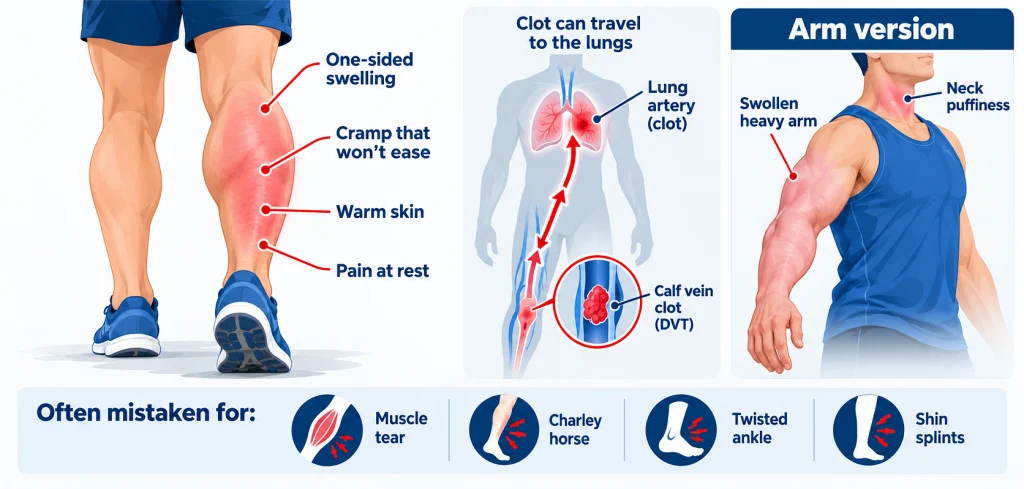
A pulmonary embolism rarely forms in the lung. A clot forms in a deep vein, usually in the calf or thigh, breaks loose, rides the bloodstream through the heart and lodges in a lung artery. Catching the leg clot is the chance to stop the lung clot. The CDC puts the signs of deep vein thrombosis as swelling, pain or tenderness, warmth, and redness or discoloration in the affected limb, and notes that about half of people with a deep vein clot have no symptoms at all.
In a runner the leg version has a particular look:
- Swelling in one calf only, with the other side normal.
- A cramp or charley horse feeling that doesn’t ease with ice, stretching or ibuprofen.
- Skin over the calf that is warmer than the other leg, sometimes pink or bluish.
- Pain that is there at rest, not only when running.
Rowers, swimmers, pitchers and weightlifters get the arm version. Repeated overhead motion can pinch the vein where it passes under the collarbone, a condition called effort thrombosis or Paget-Schroetter syndrome, and the sign is a swollen, heavy, discolored arm or an unexplained puffiness in the neck. Either way, the clot is mistaken for soft tissue damage. The National Blood Clot Alliance lists muscle tear, charley horse, twisted ankle and shin splints as the usual wrong guesses. A sore ankle after a trail fall can be a sprain or a fracture, and either one can also put the leg in a boot, which is itself a clot risk.
Five Signs Mean Stop Running And Go To The Emergency Room
When a clot reaches the lung, the picture changes from a sore leg to something that feels like a heart or breathing problem. The signs below come from the CDC, NHLBI and the Circulation page, and they usually arrive suddenly rather than building over weeks.
Breathlessness That Doesn’t Match The Effort
Shortness of breath at rest, climbing one flight of stairs, or at a pace that was conversational a week ago. Athletes feel this one first and explain it away longest.
Chest Or Side Pain That Sharpens On A Deep Breath
A stabbing pain, often to one side, worse when breathing in or coughing, sometimes radiating to the shoulder. It gets blamed on a pulled muscle, costochondritis or bronchitis.
A Pulse That Stays High
A racing or irregular heartbeat with no exertion to explain it. For a runner whose morning resting pulse is 48, a reading of 85 is a change, even though it sits inside the normal range on a chart.
Lightheadedness Or Passing Out
A large clot drops blood pressure. Feeling faint standing up, or actually fainting, is the sign that the clot is big.
A Cough From Nowhere
A new cough without a cold, sometimes bringing up blood-streaked mucus. The NHLBI lists pain when breathing and shortness of breath as the core pair and says to contact a provider right away.
Any of these alongside a swollen or painful limb, a recent long trip, a recent injury or surgery, or hormonal birth control is a reason to be seen the same day. Per the CDC figure quoted by the AHA, in about a quarter of pulmonary embolism cases the first symptom is sudden death, which is why the answer to “should I wait and see” is no.
The Risk Clusters Around Races, Injuries And Airports
Doctors sort clot risk into three groups: slow blood flow, damage to the vein wall, and blood that clots more easily than usual. Hard training touches all three at once, and a race weekend can stack them.
- Travel. Flights or drives over four to six hours raise risk slightly through immobility and, in the air, lower cabin pressure. A marathoner who runs on Sunday and flies home Sunday night combines a dehydrated, inflamed body with six hours in a seat.
- Dehydration. Sweat losses concentrate the blood. Thicker blood clots more readily, and the effect lasts into recovery.
- Injury and immobilization. A fracture, a cast, a walking boot or knee surgery all slow flow in the leg. Knee surgery in particular carries a higher clot rate.
- Estrogen-containing contraception. Young women using combined pills, patches or rings carry a higher baseline risk, which travel and dehydration then add to.
- Low resting heart rate and blood pressure. The very adaptations that make an endurance athlete efficient also let blood pool in the legs at rest.
- Height, body mass and genetics. Taller people have slightly more risk; a family history of clots or an inherited condition such as factor V Leiden raises it further.
Clotting factor VIII rises with exercise and stays elevated during recovery, though exercise also boosts the body’s clot-dissolving system, so the net effect of training alone is not harmful. The danger is the combination.
Hydration, Movement And Socks Cover Most Of The Prevention
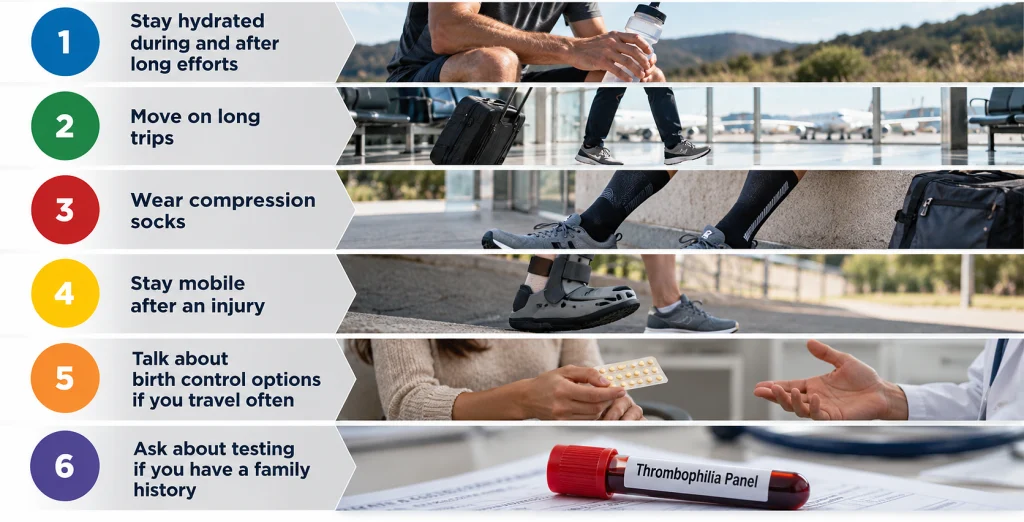
The advice from the Circulation authors and the AHA is low-tech:
- Drink to thirst during and after long efforts, and replace electrolytes as well as water; go easy on alcohol and caffeine on race night
- On any trip over four hours, stand and walk every one to two hours, flex the calves in the seat, and avoid crossing the legs
- Wear compression socks for long travel after a race or during recovery from an injury; how long to keep them on in a normal day is covered in a separate guide to compression socks
- After an injury, stay as mobile as the treating doctor allows, since light walking in a boot beats lying still
- Women on estrogen-based contraception who travel a lot for competition can raise estrogen-free options with their prescriber
- Anyone with a family history of clots can ask about testing before, not after, a long season of travel
If a clot is found, treatment is a blood thinner, for a few months after a clot with a clear cause and sometimes longer after one with none. Newer anticoagulants allow some athletes to pause dosing around contact play under supervision. Hull and Harris advise about a month off training after a deep vein clot and avoiding high-impact or contact sport while on blood thinners, with walking, swimming and gym conditioning as the way back.
A runner with a leg that won’t stop hurting, or a chest that hurts to breathe, needs a physician who sees active patients and will think of a clot early. A sports and injury specialist can tell a strain from a swollen vein in one visit, and for the five lung signs above, the right destination is the emergency room, with the race bib still in the bag if that’s where you are.