

Disclaimer: This is written for information and is not medical advice. Anyone with cancer, a photosensitive condition, epilepsy, or who is pregnant should ask a doctor before using a red light device.
There is a red light panel on the back of my bathroom door that cost $340, and I bought it for my hairline. It has been there 14 months.
That is about the most honest way I can open this, because the question everyone asks about red light therapy is “does it work?”, and the only honest answer is “for what?”. It does some things with decent evidence behind them, it does some things with weak evidence, and it is sold for a long list of things it has never been shown to do at all. The panels do not come with that list.
What is Red Light Therapy
The proper name is photobiomodulation, and the older one is low level laser therapy, and the idea is the same under both: shine red or near infrared light at the skin at a dose too low to heat it, and something useful happens in the cells underneath.
- Red light sits at about 630 to 660 nanometres. It goes a few millimetres into skin, which is why it is used for the face, the scalp and wounds.
- Near infrared sits at about 810 to 850 nanometres. It is invisible, it goes deeper, into muscle and joint, and most good panels put out both.
- There is no ultraviolet in it, so it does not tan, burn or age skin the way sunbeds do. That confusion comes up constantly.
The best supported explanation is that the light is absorbed by an enzyme in the mitochondria called cytochrome c oxidase, which nudges the cells into making a little more ATP, releases a bit of nitric oxide, and sets off a mild stress signal that the cell responds to by repairing itself. That is a real, measured mechanism in the lab, and it is also a mechanism, not a result. Cells doing slightly more of something in a dish is a long way from a wrinkle disappearing, and a lot of the marketing lives in that gap.
Dose matters more than most buyers realise. The effect follows what the researchers call a biphasic curve: too little light does nothing, the right amount helps, and more than that starts to cancel the benefit. So “longer is better” is wrong, and so is sitting 3 feet from a panel that was tested at 6 inches.
What Red Light Therapy Has Real Evidence For
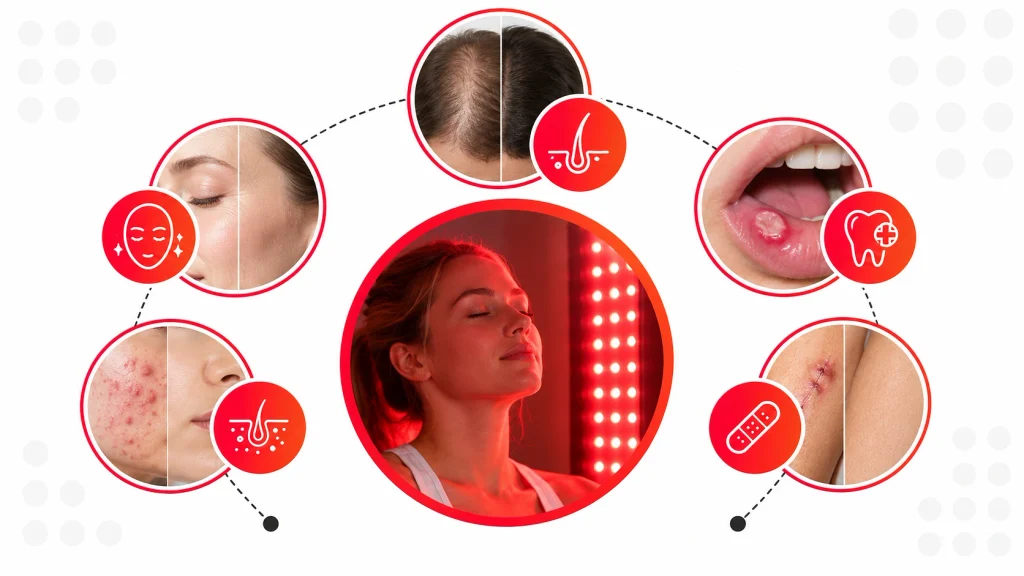
These are the uses where there are randomised trials, more than 1 of them, and the results mostly agree.
Hair Loss From Male And Female Pattern Baldness
This is the strongest consumer use and the reason my panel exists. Several randomised, sham controlled trials of helmets and combs at 650 nanometres have shown an increase in hair density over 16 to 26 weeks, on the order of 15 to 35 extra hairs per square centimetre against sham. The FDA has cleared a number of devices for exactly this. The gain is modest, it needs 3 sessions a week for months, and it stops when you stop. It also works on the hairs that are thinning, not on scalp that has been bald for 10 years. Mine has thickened a little at the temples. It has not come back where it was gone.
Mouth Ulcers From Chemotherapy And Radiotherapy
The single best evidence in the whole field, and the one nobody sells panels for. Oral mucositis, the painful mouth ulceration that comes with cancer treatment, is reduced in severity by photobiomodulation applied in the clinic, and this is in international oncology guidelines as a recommended treatment. It is a reminder that the science is real when the dose and the target are right.
Wound Healing
Diabetic foot ulcers, surgical wounds and burns close faster in a number of trials, and the effect is consistent enough that some hospital wound clinics use it routinely. This is skin depth work, red light, and the trials use clinic devices with known output.
Skin Ageing And Sun Damage
Trials of red and near infrared light on the face show improvements in fine lines, roughness and collagen density on biopsy after 8 to 12 weeks, 2 or 3 sessions a week. The changes are measurable and they are small, roughly what a good retinoid gives you, and they need to be kept up. The LED masks in the shops are a lower powered version of what those trials used, and the honest expectation is a mild improvement in texture rather than anything a friend would notice.
Acne
Red light on its own has a modest effect on inflammatory acne. Blue light kills the bacteria, red light calms the inflammation, and the combination devices have reasonable trial support for mild to moderate acne. Not for cystic acne, which needs a prescription.
What The Evidence Is Mixed Or Thin On
| Claimed use | What the trials say |
|---|---|
| Joint pain and osteoarthritis | Some positive trials, some null. Effects where found are small and short lived. Near infrared at higher doses does better than red. |
| Tendon injuries | Mixed. A few trials show faster recovery with rehab, others show nothing over rehab alone. |
| Muscle recovery after exercise | Several small trials in athletes show less soreness and slightly better performance the next day. Real but modest, and the trials are small and often industry funded. |
| Fat loss and body contouring | Weak. The trials measure circumference over a few weeks and the losses are centimetres that come back. It does not remove fat. |
| Depression and cognition | Early. A handful of small trials shining near infrared through the forehead show changes in mood and reaction time. Nowhere near enough to buy a device for. |
| Sleep | Almost nothing. The plausible effect is that red light in the evening does not suppress melatonin the way blue screens do, which is a reason to use a red bulb, not a panel. |
| Thyroid function | 1 small trial in Hashimoto’s showed reduced medication need. It has not been repeated. |
| Testosterone | Rat studies and 1 uncontrolled human report. The claim is everywhere online and the evidence is not. |
If a panel is being sold to you for anything in the bottom half of that table, the price is for the hope.
Side Effects And Who Should Not Use It
Red light is low risk. It is not no risk, and the risks that exist are mostly about how it is used rather than what it is.
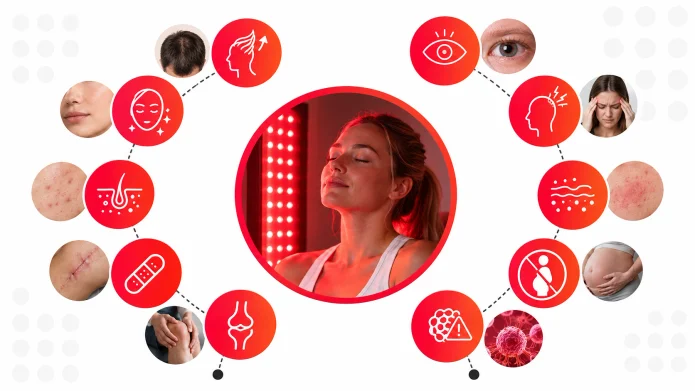
- Eyes. Near infrared is invisible, which means the blink reflex does not protect you. Every panel session needs the goggles that came with it, and if none came with it, buy some. Long term data on eye exposure at panel intensities does not exist, which is a reason for caution, not a reason for confidence.
- Photosensitising medicines. Doxycycline and other tetracyclines, isotretinoin, some diuretics, St John’s wort and several antipsychotics make skin react to light. Red light is far gentler than sun, but people on these drugs do report rashes and burning, and it is worth asking a pharmacist.
- Heat burns. A cheap panel with a poor heat sink, or a face pressed against it, can give a mild burn. Reddening that lasts more than an hour after a session means too close or too long.
- Headache, dizziness and tiredness after sessions are reported by a small number of users, usually in the first week, and usually settle with shorter sessions.
- Active cancer. Because the mechanism is “make cells more active”, the standard advice is not to shine it directly over a known tumour or a recently treated site unless an oncologist has said so.
- Pregnancy. No evidence of harm, and no evidence of safety either. The cautious position is to keep it off the abdomen.
- Flashing modes and epilepsy. Some masks and panels pulse. Anyone with photosensitive epilepsy should use the steady setting only.
How To Tell A Panel That Works From One That Does Not
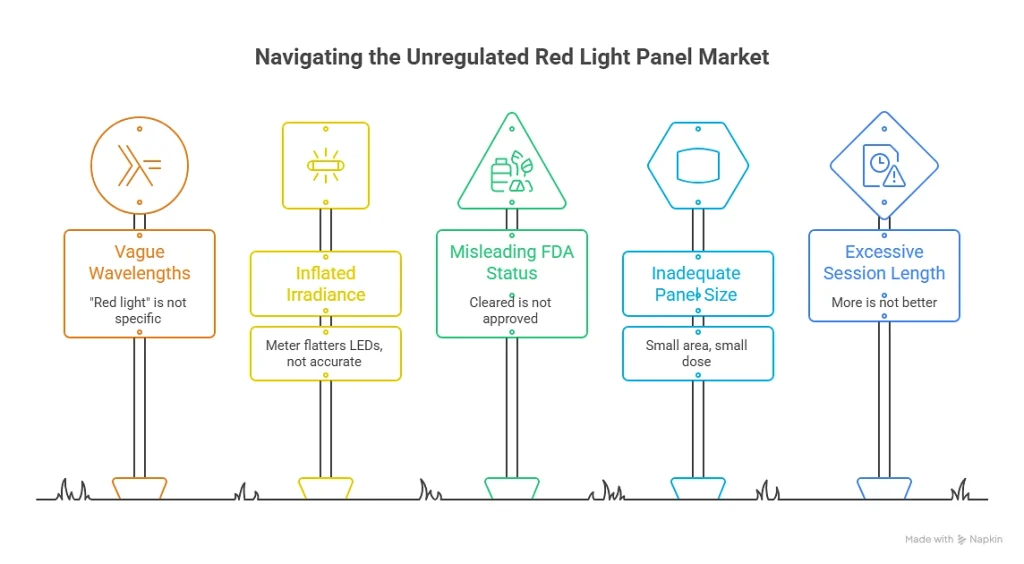
This is the part I wish I had read before I spent $340, because the market is mostly unregulated and the numbers on the box are often invented.
- Wavelengths should be stated exactly: 660 and 850 nanometres, or close to it. “Red light” with no number is a lamp.
- Irradiance is the power reaching the skin, in milliwatts per square centimetre, and it should be stated at a distance. Trials that worked used roughly 20 to 100 milliwatts per square centimetre at the skin. Panels that claim 200 or more at 6 inches are usually measuring with a meter that flatters LEDs, and independent tests have found some at a third of the advertised figure.
- FDA cleared is not FDA approved. Cleared means the device is similar enough to an earlier device to be sold. It says nothing about whether it works for the thing in the advert.
- A face mask at $150 to $400 delivers a small dose to a small area and suits the skin uses. A half body panel at $500 to $1,500 suits joints, muscle and the hair uses. A handheld wand at $60 suits almost nothing, because the area is too small to cover anything in a reasonable time.
- Sessions in the trials were 10 to 20 minutes, 3 to 5 times a week, at a fixed distance. More is not better and the research is clear on that.
What A Sensible Expectation Looks Like
Buy it for pattern hair loss, for facial skin texture, or for mild acne, use it the way the trials did for at least 3 months, and expect a small, real, reversible improvement. Do not buy it for fat, hormones, sleep or mood. Use the goggles every time. Ask a pharmacist if you are on any medicine that says “avoid sunlight” on the label. And if it is being sold as a cure for anything, it is being sold by someone who has not read the trials.
My panel is staying on the bathroom door. My temples are slightly better, my skin is possibly better, and my sleep is exactly the same, which is what the evidence said would happen before I ever bought it.