


The packet says “botanical”, it says “not for human consumption” in 6 point type on the back, and the woman who put it on my counter last month had been taking 3 spoons of it a day for a year and a half for the pain in her lower back.
She is 41, has never smoked, drinks anyplace or anytime event or gathering and she was in the pharmacy because she had run out for 2 days over a bank holiday and had felt, her words, like she had flu and a broken heart at the same time.
I get asked about kratom more now than in the 15 years before put together, nearly always by women, nearly always for pain or energy or nerves.
Shops call it a miracle leaf. Treatment centres call it heroin in a tea bag. We deserve better than either, and the better version needs some vocabulary, so this is a slightly technical read on purpose. If you are already taking it, you have earned the technical version.
What Kratom Is And What Is In The Leaf
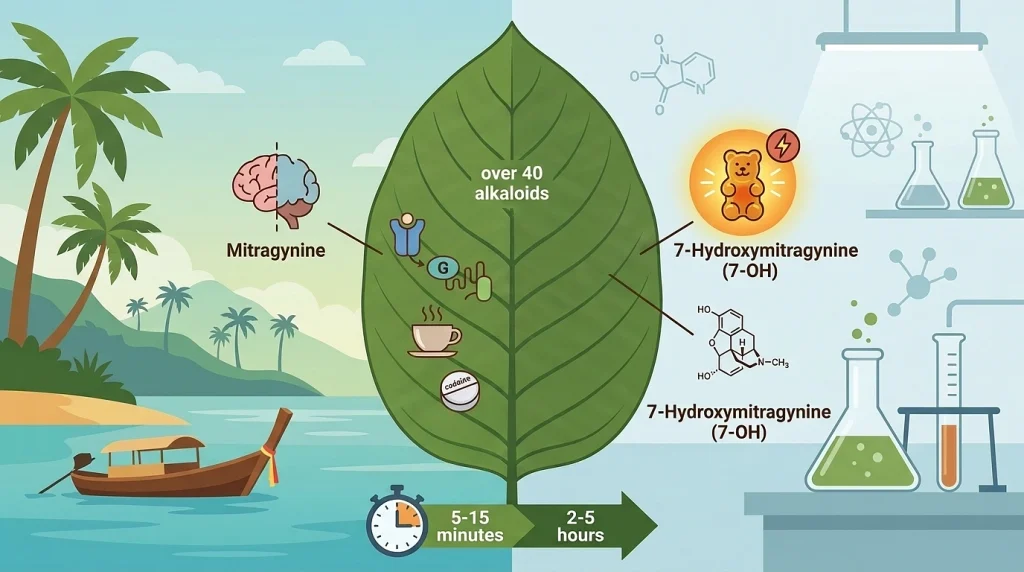
The dried leaf of Mitragyna speciosa, a tree in the coffee family from Thailand, Malaysia and Indonesia, where labourers have chewed it for at least a century. Over 40 alkaloids are in the leaf and 2 of them matter to us.
Mitragynine
Mitragynine is about two thirds of the alkaloid content and does most of the work at ordinary doses. It is a partial agonist at the mu-opioid receptor, so it sits on the same receptor as morphine, codeine and oxycodone and activates it less fully than they do. The detail every seller repeats is that mitragynine switches on the receptor’s G protein pathway without recruiting a second signalling protein, beta-arrestin, and in mice that pattern goes with less respiratory depression than morphine. In mice. Nobody has shown it in a controlled human study and I would not stake anyone’s life on a rodent. Mitragynine also acts on alpha-2 adrenergic receptors, which is the clonidine target, and on serotonin and dopamine receptors, and that is why a small amount feels like a strong coffee and a larger amount feels like a codeine tablet. One molecule, different receptors winning at different concentrations.
7-Hydroxymitragynine (7-OH)
Present in raw leaf at a fraction of a percent, and a much stronger mu-opioid agonist, more potent than morphine gram for gram in the animal data. In the leaf it hardly matters. Extracted and pressed into a gummy it becomes a different drug, and that is the thing that has changed the whole picture since about 2023, which I come back to below.
Onset by mouth is 5 to 15 minutes and it lasts 2 to 5 hours. The short duration is the reason so many of us end up on 3 or 4 doses a day without ever deciding to.
What Kratom Is Report To Help With
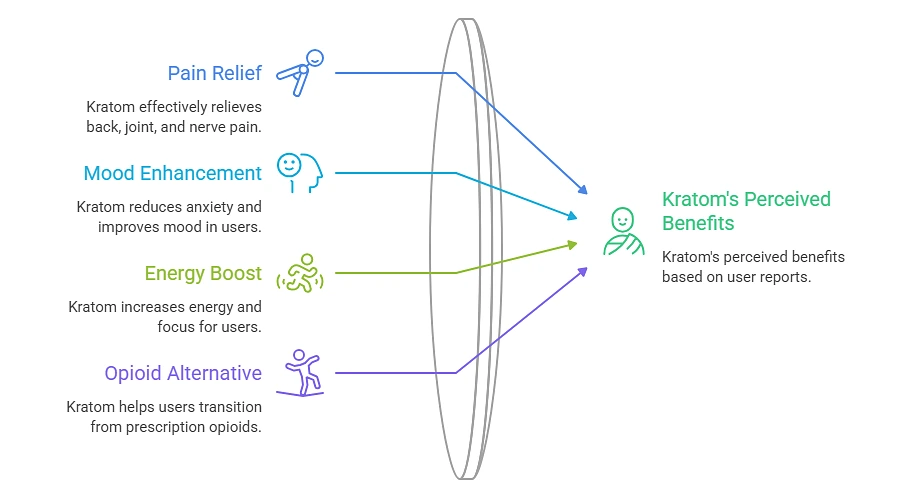
I am careful with the word benefit here. There is no completed randomised trial of anything. What we have is survey data, quite a lot of it, case reports, the pharmacology, and one small study where regular users took kratom or placebo and tolerated more pain. So everything below is what users say, at the volume they say it.
The Johns Hopkins group surveyed 2,798 regular users in 2020 and their reasons match what I hear across the counter almost word for word.
- Pain came first, named by more than 9 in 10, mostly back, joint and nerve pain, and most said it was doing at least as well as what they had tried before.
- Anxiety and low mood were named by about two thirds, which fits the serotonergic and opioid actions and fits the fact that every opioid ever made settles anxiety for 3 hours and worsens it over 3 months.
- Energy and focus came next, and that effect is real and adrenergic, which is exactly the problem, because the women asking me about tiredness have often not had their ferritin or thyroid checked in years, and a stimulant hides iron deficiency rather than treating it.
- Around 4 in 10 were using it to get off or stay off prescription opioids or heroin, and that is the one that makes me pause, because moving from oxycodone to kratom is not stopping opioids, it is switching to a weaker, cheaper, unregulated one. Sometimes that is an improvement. It is not a cure.
The strongest thing anyone can honestly say for kratom is that its main alkaloid seems, in animals, to depress breathing less than morphine, and that for some people it has been a bridge away from stronger opioids. Neither is a benefit in the way a doctor would use the word, and both assume a product that contains what the label says, which we cannot assume.
Side Effects Of Kratom For Women
The everyday effects are those of a weak opioid with a stimulant edge nausea, constipation, sweating, dry mouth, itching, dizziness, and with more of it sedation and vomiting. In women I see 2 extra patterns that rarely make the leaflets. Appetite loss and weight loss with daily use, which some women welcome and which, for anyone with a history of disordered eating, is not a side effect but a reason to keep going. And missed or irregular periods, which come up constantly in the forums and in a few case reports and have never been studied, though I find them entirely believable since opioids of every class suppress the hypothalamic hormones that run the cycle.
The serious harms, in the order I worry about them:
Dependence And Withdrawal
About 1 in 10 regular users in the Hopkins survey had withdrawal on stopping, and among daily users my own guess is well above that. Muscle aches, insomnia, sweating, running nose, diarrhoea, low mood, craving, for 3 to 7 days. My patient with the bad back had all of it and thought she was ill.
The risk factor is the pattern, not the dose. A few times a week, rarely. Every day for a month, commonly.
Liver Injury
Dozens of published cases now and an entry in the NIH LiverTox database. It presents as cholestatic hepatitis, so itching, dark urine, pale stools, jaundice, usually 2 to 8 weeks into daily use. I have seen 1. She thought the itching was the washing powder.
Seizures, Thyroid And Overdose
Seizures are reported at high doses and in combinations. There are a handful of reports of thyroid suppression with heavy use. And overdose, which needs its own paragraph. The CDC went through 27,338 overdose deaths from July 2016 to December 2017 and found kratom in 152, listed as a cause in 91, and in only 7 of those 91 was the only drug present. The others had fentanyl, heroin, benzodiazepines, alcohol or all four. So alone almost never kills. We are prescribed benzodiazepines and sedating antidepressants at roughly double the rate men are, and that is the combination I ask about first, every time.
Kratom Interactions With Common Medicines
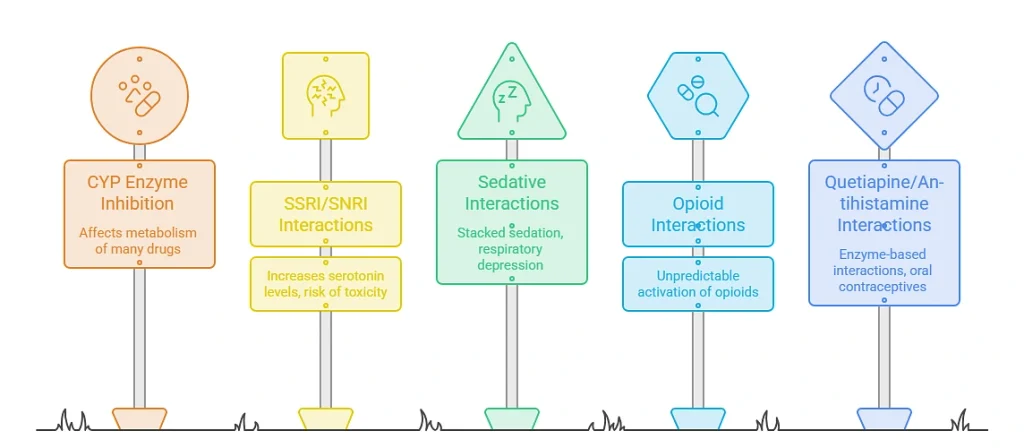
Mitragynine inhibits CYP2D6 and CYP3A4, which between them clear about half of what I dispense. There are no formal interaction studies, so this list is built from the enzyme data and the case reports, which is a warning on its own.
- SSRIs and SNRIs, particularly fluoxetine, paroxetine and venlafaxine, because kratom raises their levels and adds its own serotonergic push, and serotonin toxicity has been reported.
- Benzodiazepines, zolpidem, zopiclone, pregabalin and gabapentin, because of stacked sedation and respiratory depression, and because that is the combination in the death data.
- Tramadol and codeine, which are opioids themselves and need CYP2D6 to be activated, so the combination is unpredictable both ways.
- Quetiapine, which half the country seems to be taking for sleep, plus some antihistamines and some oral contraceptives, on the enzyme grounds alone.
Kratom In Pregnancy And Breastfeeding
If you read one paragraph of this, read this one. Daily through pregnancy has been followed by neonatal abstinence syndrome in the baby, the same withdrawal seen after maternal methadone or heroin: tremor, a high pitched cry, poor feeding, sometimes seizures, in the first days after birth. More than 20 such cases are published and there will be more. Mitragynine has been found in breast milk. If you are using it daily and find you are pregnant, do not stop dead, because abrupt opioid withdrawal in pregnancy carries its own risks, but tell your midwife or obstetrician that week and let them manage the taper. They will not be shocked. They have seen it before.
7-OH Products And The Legal Position In 2026
From about 2023 the shops began stocking tablets, gummies and shots labelled 7-OH, “enhanced” or “extract”, on the shelf next to leaf powder as though they were the same thing. They are concentrated mu-opioid agonists in the morphine potency range, sold without dosing or warnings to women who think they are buying a stronger tea.
- The FDA recommended in July 2025 that concentrated 7-OH go into Schedule I.
- On 1 July 2026 the DEA gave notice of intent to do that on a temporary basis, for products above 0.05% 7-OH by weight, together with 3 synthetic relatives, and leaf under that threshold is explicitly excluded.
- The earliest the order could take effect was 5 August 2026, and as I write in early September it has been announced but I have not seen it issued, so check the Federal Register rather than trusting this paragraph.
- Whole leaf stays legal federally, unapproved for any use, banned outright in around 9 states, and covered in a growing number of others by consumer protection acts with age limits and labelling rules.
What Is Safety Health
Nothing about kratom is safe in the sense of tested, standardised and monitored. What I can say is that the risk is not spread evenly across the ways we use it, and a woman who is going to use it regardless lowers hers most by avoiding a few specific things.
- Leaf, never extract. Anything labelled 7-OH, enhanced or shot is an opioid product.
- Not every day. The withdrawal data is clear that pattern matters more than quantity.
- Not with anything sedating, and wine counts.
- Not from a packet without a third party test for heavy metals and Salmonella, because the FDA has found both in commercial more than once.
- Not if pregnant, breastfeeding, epileptic or with any liver disease, and not as a way off opioids without telling someone who can help properly, because buprenorphine exists, works, and is not sold in a vape shop.
I am a pharmacist writing for information. This is not medical advice and it gives no dosing guidance on purpose. Withdrawal symptoms, jaundice, seizures or heavy drowsiness after taking medical attention.

