


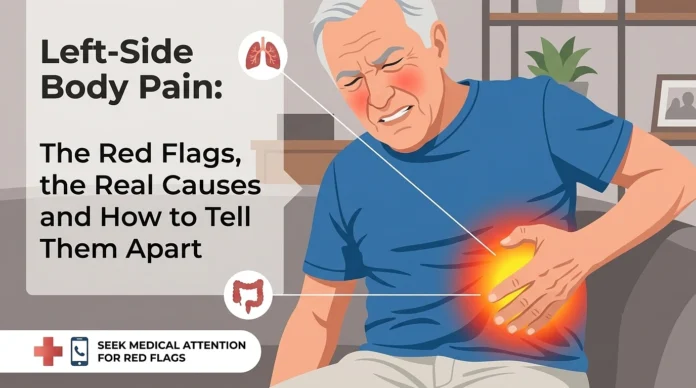
Here’s something most people don’t realise about pain your body is genuinely bad at telling you where it’s coming from. A pocket of trapped gas can imitate a heart attack. A problem in your chest can be felt low in your belly. The nerves that carry internal pain take crossed, shared pathways to your brain so “it hurts on my left side” is a starting clue, not a diagnosis.
That’s exactly why a generic symptom list often makes things worse. What actually helps is learning to read the pain relief the way a clinician does by how it behaves. But first, the part that can’t wait.
First The Signals That Mean “Get Help Now”
Before anything else, rule out an emergency. Call your local emergency number (such as 911) right away don’t drive yourself, don’t “wait and see” if your left-side pain comes with any of these:
- A squeezing, heavy, band-like pressure Behind the breastbone less a sharp stab, more like something clamping down that may spread up into the jaw, neck, or back. This is the classic heart-attack signal.
- The quiet version of a heart attack. Sudden cold sweat, unexplained deep exhaustion, nausea, or breathlessness without dramatic chest pain. This atypical pattern is especially common in women, older adults, and people with diabetes and it’s the one that gets dangerously dismissed as “just anxiety” or reflux.
- Stroke signs (F.A.S.T.) – A drooping face, one-sided weakness, slurred or jumbled speech, sudden confusion. Time matters enormously here.
- A rigid, board-like belly That’s agony to press on, or vomit that looks like coffee grounds, or black, tarry stools signs of internal bleeding.
If something feels seriously, suddenly wrong, treat it that way. Being checked and sent home is a good outcome. Waiting is not.
The Clinician’s Trick: Does Pressing On It Change Anything?

Say you’ve ruled out the emergencies. Now comes the single most useful question a doctor asks and you can ask it of yourself. It separates a mechanical problem (muscle, rib, nerve) from a visceral one (an internal organ):
- Press firmly on the exact spot that hurts. If that reproduces or sharpens the pain if there’s a clear “ow, right there” point it’s most likely musculoskeletal. Muscles and rib joints are tender to the touch. Organs, buried deep, usually aren’t.
- Take a sharp, deep breath, or twist your torso. If that triggers a stab, again think muscle, rib, or nerve. Internal-organ pain tends to ignore your breathing and movement entirely.
- Change position lie flat, lean forward. If the pain eases or shifts, it’s leaning mechanical or digestive. If it sits there unmoved, indifferent to everything you do, that’s more typical of an organ.
It’s not foolproof, and it never replaces a doctor. But it’s a far better starting point than guessing from a list.
Reading The Pain By How It Behaves

With that lens, most non-emergency left-side pain falls into a handful of recognisable patterns.
The sharp rib-cage jab. A needle-like, pinpoint pain near where a rib meets the breastbone, worse when you press it this is often costochondritis, inflammation of the rib cartilage. It can feel genuinely alarming, which is why it sends people to the ER. The reassuring tell: no fever, no breathlessness, no blood-pressure changes just a sore, pressable spot.
The positional fire. There’s a sharp bend in your colon tucked right under the left ribs called the splenic flexure, and it’s a notorious gas trap. Air caught there pushes upward and can genuinely mimic cardiac pressure. The giveaway is movement: if the pain shifts when you lie down or eases after a bowel movement, it’s digestive, not your heart. A burning that climbs upward after meals is usually acid reflux instead.
The burning band. When someone over fifty gets a deep, burning, hypersensitive strip of pain wrapping around one side with no obvious cause and nothing to press on clinicians start watching for shingles. The catch: that nerve pain can arrive days before the tell-tale rash, so catching it early genuinely matters for treatment.
The slow lower-left burn. Down in the lower-left belly sits the part of the colon where diverticulitis tends to flare. Unlike a fleeting gas twinge, this one is a slow burner a steady ache that worsens over a day or two, often with a low-grade fever and tenderness to the touch. It doesn’t tend to resolve on its own, and it’s worth getting seen.
What to Bring to Your Doctor (This Part Really Helps)
If you take one practical thing from this, make it this: don’t walk in and say “my left side hurts.” Walk in with a pattern. Before your appointment, jot down:
- The exact sensation – Sharp and pinpoint? Heavy and compressing? Burning? A deep, dull throb?
- The mechanical response – Does pressing on it, coughing, twisting, or a deep breath change it?
- The timing – Does it wake you at night? Show up reliably after meals? Ease after the bathroom?
- The companions – Any fever, chills, change in stool colour, or a patch of skin that feels oddly burning or sensitive?
Those four answers do more to guide a diagnosis than any amount of “it just hurts.” You’re handing your clinician the clues instead of making them dig.
So: left-side pain is usually something ordinary but because the same patch of real estate can also flag a heart, lung, or abdominal emergency, the smart move is always to clear the red flags first, then read the behaviour, and get seen whenever something feels severe, sudden, or simply wrong.
This article is general information only and is not a substitute for professional medical advice, diagnosis, or treatment. If you’re experiencing severe, sudden, or worrying pain, contact a healthcare professional or your local emergency services immediately.
Trusted sources for further reading:
- Cleveland Clinic — Left-Side Chest Pain: Causes (my.clevelandclinic.org)
- Cleveland Clinic — Left-Side Abdominal Pain (my.clevelandclinic.org)

