


If you have ever felt a sharp, shooting pain radiating from your lower back all the way down one leg, you already know how relentless sciatica can be.
It is not merely “back pain.” It disrupts how you sit, how you sleep, and how confidently you take your next step. The frustrating part is that staying still often makes it worse not better.
The good news is that for the majority of sufferers, deliberate, well-chosen movement is one of the most powerful tools available.
What Is Sciatica?
The sciatic nerve is the largest nerve in the human body. It originates from nerve roots spanning L4 to S3 in the lumbar and sacral spine, travels through the buttock, and runs the full length of each leg.
When this nerve becomes compressed or irritated by a herniated disc, a tight piriformis muscle, or spinal stenosis the result is the distinctive radiating pain, numbness, or tingling that defines sciatica.
The condition is far more common than most people realize. A review titled “Sciatica: a review of history, epidemiology, pathogenesis, and the role of epidural steroid injection in management“ published in the British Journal of Anaesthesia (ScienceDirect, 2007) reports that the lifetime incidence of sciatica ranges from 13% to 40%, with an annual incidence of new episodes between 1% and 5%.
How These Exercises Actually Work
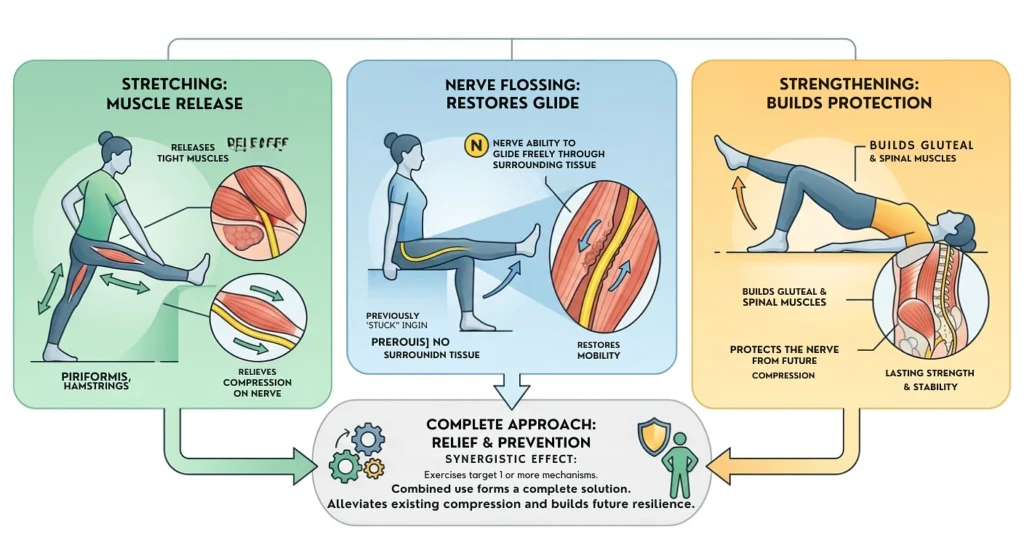
Stretches release the muscles compressing the nerve mainly the piriformis and hamstrings. Nerve flossing restores the nerve’s ability to glide freely through surrounding tissue. Strengthening moves build the gluteal and spinal muscles that protect the nerve from future compression.
The seven exercises below each target one or more of these mechanisms. Used together, they form a complete approach to both relief and prevention.
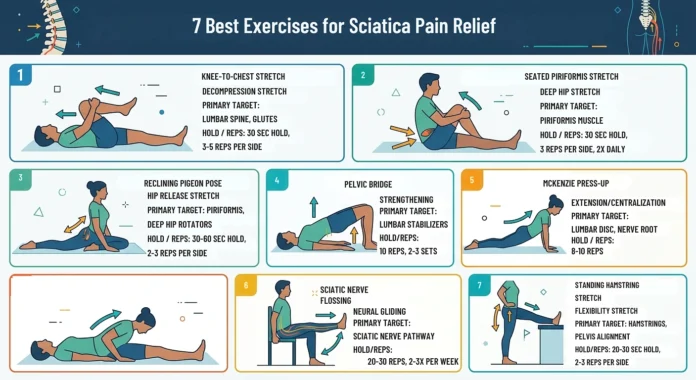
At a Glance: The 7 Exercises
| # | Exercise | Primary Target | Type | Hold / Reps |
|---|---|---|---|---|
| 1 | Knee-to-Chest Stretch | Lumbar spine, glutes | Decompression stretch | 30 sec hold, 3–5 reps per side |
| 2 | Seated Piriformis Stretch | Piriformis muscle | Deep hip stretch | 30 sec hold, 3 reps per side, 2x daily |
| 3 | Reclining Pigeon Pose | Piriformis, deep hip rotators | Hip release stretch | 30–60 sec hold, 2–3 reps per side |
| 4 | Pelvic Bridge | Glutes, lumbar stabilizers | Strengthening | 10 reps, 2–3 sets |
| 5 | McKenzie Press-Up | Lumbar disc, nerve root | Extension / centralization | 8–10 reps |
| 6 | Sciatic Nerve Flossing | Sciatic nerve pathway | Neural gliding | 20–30 reps, 2–3x per week |
| 7 | Standing Hamstring Stretch | Hamstrings, pelvis alignment | Flexibility stretch | 20–30 sec hold, 2–3 reps per side |
1. Knee-to-Chest Stretch
Creates gentle decompression in the lumbar spine, temporarily widening the space between vertebrae and reducing pressure on the nerve roots that form the sciatic nerve.
Lie flat on your back with both legs extended. Gently bend one knee and bring it toward your chest, clasping your hands just below the kneecap.
Pull slowly and steadily until you feel a comfortable stretch across your lower back and buttock. Hold for 30 seconds, then lower and switch sides. Perform 3–5 repetitions per side.
For a deeper version, draw both knees to the chest simultaneously and hold for 10 seconds. This is especially useful first thing in the morning when the spine is at its stiffest.
2. Seated Piriformis Stretch
Directly targets the piriformis muscle the deep buttock muscle that sits over the sciatic nerve and is one of the most common sources of compression.
A review titled “Physiotherapy for Piriformis Syndrome Using Sciatic Nerve Mobilization and Piriformis Release“ published in Cureus (2023) explains that when the piriformis spasms and shortens, it disturbs nerve impulses traveling through the sciatic nerve. The review documents two clinically used stretching techniques hip flexion above and below 90 degrees both shown to reduce the tightening causing nerve impingement.
Sit upright in a firm chair. Cross the affected leg so that its ankle rests on the opposite knee in a figure-four position. Keeping your back straight and chest lifted, lean forward slowly from the hips until you feel a stretch deep in the crossed leg’s buttock.
3. Reclining Pigeon Pose (Supine Figure-4 Stretch)
The lying-down version of the yoga pigeon pose. It targets the same deep hip rotators as the seated piriformis stretch but with zero compressive load on the spine, making it the safer choice during an active flare-up.
Lie on your back with both knees bent and feet flat on the floor. Cross your right ankle over your left thigh, just above the knee.
For a gentle version, simply breathe and hold this position. To deepen it, reach your hands behind your left thigh and slowly draw both legs toward your chest. Hold for 30–60 seconds. Perform 2–3 repetitions per side.
4. Pelvic Bridge (Glute Bridge)
Builds strength in the gluteal muscles the largest muscles in the body and critical stabilizers of the pelvis and lumbar spine.
Because the sciatic nerve runs underneath the gluteal muscles, chronic glute weakness forces smaller, deeper muscles like the piriformis to overcompensate. That overload is a direct pathway back to nerve compression.
A study titled “The effects of gluteus muscle strengthening exercise and lumbar stabilization exercise on lumbar muscle strength and balance in chronic low back pain patients“ (Journal of Physical Therapy Science, 2016) randomized 40 chronic low back pain patients and found that adding gluteus strengthening to a lumbar stabilization program produced significantly greater reductions in disability compared to lumbar stabilization alone.
Lie on your back with knees bent at roughly 90 degrees, feet flat on the floor hip-width apart. Engage your core, squeeze your glutes firmly, and drive your hips upward until your shoulders, hips, and knees form a straight diagonal line. Hold for 5–10 seconds. Lower slowly. Perform 10 repetitions, 2–3 sets.
5. McKenzie Press-Ups (Prone Extension Exercise)
Uses spinal extension to “centralize” pain moving referred leg pain back toward the lower back. This is a positive clinical sign that disc pressure on the nerve root is being reduced.
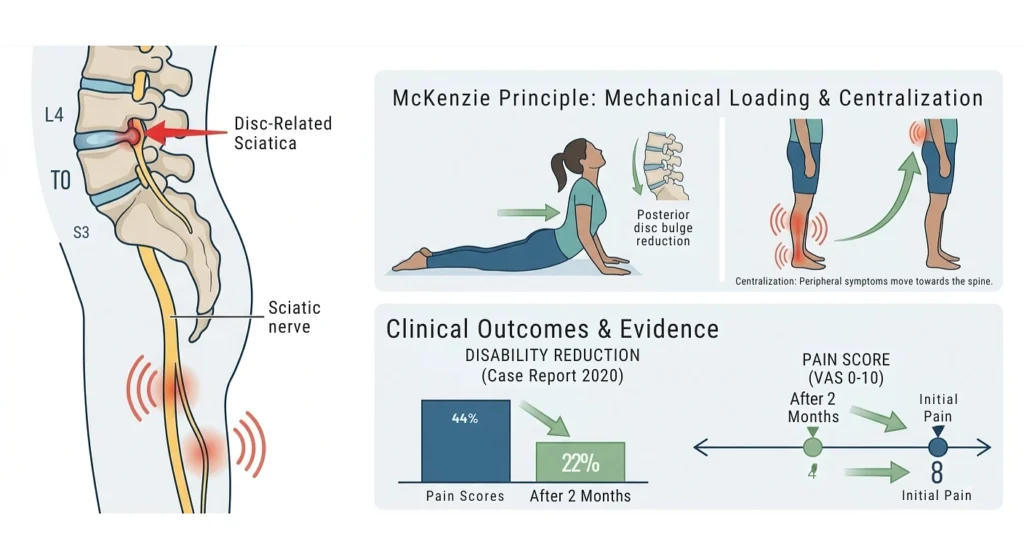
Lie face down on a firm surface. Begin by resting in this position for 1–2 minutes, letting gravity gently extend the lower spine. Progress to propping on your forearms, elbows directly under your shoulders.
If comfortable, press up onto your hands while keeping your hips on the floor and allowing the lower back to sag gently. Hold for 5–10 seconds. Return. Repeat 8–10 times.
6. Sciatic Nerve Flossing (Neural Gliding)
Nerve flossing is different from every other exercise on this list. It does not stretch a muscle it mobilizes the nerve itself.
When the sciatic nerve is compressed or inflamed, adhesions can form along its pathway and restrict its movement. Nerve flossing uses alternating movements at two points along the nerve’s route so one end shortens while the other lengthens, creating a gentle gliding motion through the surrounding tissue.
The Cureus review on piriformis syndrome (PMC9879580) also concluded that neural mobilization combined with piriformis stretching delivers faster and better outcomes than either intervention on its own.
Sit upright in a firm chair with feet flat on the floor. Slowly extend one leg forward while simultaneously flexing your foot so toes point toward you. Hold for 2–3 seconds. Then lower the leg and point your toes away. Repeat this alternating rhythm 20–30 times per leg.
7. Standing Hamstring Stretch
When the hamstrings are chronically tight, they tilt the pelvis backward and flatten the natural lumbar curve. A paper titled “The effect of dynamic stretching on hamstrings flexibility with respect to the spino-pelvic rhythm“ in The Journal of Medical Investigation (2016, Hasebe et al., doi:10.2152/jmi.63.85) demonstrated that hamstring tightness directly affects spino-pelvic rhythm, contributing to conditions that irritate the sciatic nerve at its origin.
Tight hamstrings can also compress the sciatic nerve directly as it travels beneath the biceps femoris a muscle in the back of the thigh.
Stand near a stable surface a sturdy chair, step, or low counter. Place the heel of the affected leg on the surface with the leg as straight as comfortably possible.
Stand tall and hinge very slightly forward from the hips not from the waist until you feel a gentle stretch along the back of the elevated leg. Keep the pelvis level. Hold for 20–30 seconds. Repeat 2–3 times per leg.
Key test: If the sensation intensifies when you flex your foot toward you or gently tuck your chin to your chest, what you are feeling is more likely sciatic nerve tension than hamstring muscle tightness. In that case, reduce the hold to 1–2 seconds and pulse gently in and out converting it from a muscle stretch into a nerve glide.
When to See a Professional
Home exercises are appropriate for mild to moderate sciatica. But certain symptoms demand immediate medical evaluation.
See a doctor if you experience: loss of bladder or bowel control, saddle anesthesia (numbness in the inner thighs and groin), rapid worsening of leg weakness, or pain severe enough to wake you from sleep.
If symptoms have not improved after two to four weeks of consistent exercise, a physiotherapist can assess your condition and create a personalized treatment plan.

References
- Stafford MA, Peng P, Hill DA. “Sciatica: a review of history, epidemiology, pathogenesis, and the role of epidural steroid injection in management.” British Journal of Anaesthesia / ScienceDirect. 2007.
- Davis D. “Sciatica.” StatPearls [Internet]. NIH/NCBI Bookshelf. Updated January 4, 2024.
- Hicks BL, Varacallo M. “McKenzie Back Exercises.” StatPearls [Internet]. NIH/NCBI Bookshelf. Updated July 7, 2025. https://www.ncbi.nlm.nih.gov/books/NBK539720/
- Boyajian-O’Neill et al. “Physiotherapy for Piriformis Syndrome Using Sciatic Nerve Mobilization and Piriformis Release.” Cureus. 2023. PMC9879580.
- Al-horani R, Bataineh A, et al. “McKenzie-type Exercises Improve the Functional Abilities of a Patient with Recurrent Herniated Discs: A Case Report.” The Open Sports Sciences Journal / ScienceDirect. 2020.
- Jeong UC, Kim CY, Park YH, Hwang-Bo G, Nam CW. “The effects of self-mobilization techniques for the sciatic nerves on physical functions and health of low back pain patients with lower limb radiating pain.” Journal of Physical Therapy Science. 2016;28(1):46–50. PMC4755972.
- Kim KH, Yoo WG, Choi BR. “The effects of gluteus muscle strengthening exercise and lumbar stabilization exercise on lumbar muscle strength and balance in chronic low back pain patients.” Journal of Physical Therapy Science. 2016. PMC4713798.

