



At 3 in the morning with a 12 day old, a wet patch on the muslin the size of a dinner plate looks like the entire feed has come back up, and the sentence that goes through your head is “she got nothing”. I know because I said it out loud, twice, in the first fortnight. Then a health visitor did something I have since made every new parent I know do. She took a tablespoon, measured 15 ml of milk from the bottle, and tipped it onto a dry muslin. The patch it made was the size of my hand, and it kept spreading. 2 tablespoons made the dinner plate. The puddle that looks like the whole 90 ml bottle is usually 15 to 30 ml, and the other 60 stayed down.
Do the tablespoon test tonight. It is the single most calming thing you can do with a baby who spits up, and it will change how you read every muslin after it.
Why Newborns Bring Milk Back Up
A newborn’s stomach is tiny and it is fed liquid, lying down, several times a night, through a valve at the top that has not learned to close properly yet. The valve is the lower oesophageal sphincter, a ring of muscle between the food pipe and the stomach, and in a baby it is loose, short, and easily pushed open by a full stomach, a bit of wind, or being laid flat too soon after a feed. So milk comes back. It comes back with a burp, it comes back when she is put down, it comes back an hour later, warm and slightly curdled because it has met stomach acid on the way.
Doctors call it posseting, or reflux, or spitting up, and by 4 months around half of all babies do it every day. It peaks at about 4 months, when the feeds are biggest and the baby still cannot sit up, and most have stopped by 12 months, when they are upright, eating solids, and the valve has toughened.
The stomach size explains the rest. On day 1 it holds about 5 to 7 ml, a cherry. On day 3 it is a walnut, 22 to 27 ml. By 1 week it is an apricot, 45 to 60 ml, and by a month it is closer to the size of an egg, 80 to 150 ml. A 2 week old offered a 120 ml bottle will drink most of it, because sucking is a reflex and not a decision, and then the extra 40 ml comes back, because there was never room for it. That is not vomiting. That is a stomach doing arithmetic.
Spit Up Or Vomiting: How To Tell Them Apart

This is the question that matters and it is easier to answer than it feels at 3 am.
Spit Up
- Milk dribbles or comes out in a small gush, often with a burp, and the baby barely notices or looks mildly surprised.
- It is white or cream, sometimes curdled, and smells of sour milk.
- The baby is otherwise content, feeding well, and producing 6 or more wet nappies a day once she is past day 5.
- It happens after feeds and it happens at the same rough amount most days.
Vomiting
- The milk comes out with force, across the room, or in a steady stream that keeps coming, and the baby is distressed by it.
- It is green or yellow, or it has blood in it, or it looks like coffee grounds.
- The baby is hungry again immediately and desperate, or the opposite, floppy and hard to wake.
- It is getting worse over days rather than staying the same.
The colour is the quickest tell. White or cream is milk. Green or yellow is bile, and bile means something further down is blocked, and that is an emergency department the same hour, not a GP appointment next week.
The 6 Signs That Turn A Spitter Into A Phone Call
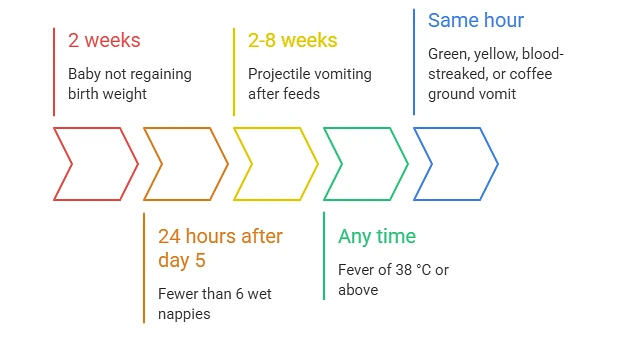
Most babies who spit up are what doctors call happy spitters. They spit, they smile, they grow. A small number are not, and the difference is not how much comes up. It is what else is going on.
- Weight. If she is not regaining her birth weight by 2 weeks, or her weight is drifting down the centile lines at the checks, the milk is not staying in for long enough to count, whatever the muslin says.
- Nappies. Fewer than 6 wet nappies in 24 hours after day 5, dark yellow urine, or a dry nappy for 6 hours is dehydration, and it needs a doctor that day.
- Force. A vomit that shoots out a foot or more, especially after every feed, in a baby between 2 and 8 weeks old who is then ravenous again, is the pattern of pyloric stenosis, a thickening of the muscle at the stomach’s exit. It is fixed with a short operation, it is not rare, and it is missed at home because the baby seems so hungry. Tell the doctor the word projectile and describe the distance.
- Distress. Arching the back during feeds, screaming after them, refusing the bottle or the breast, coughing or gagging when laid flat. This is the difference between reflux and reflux disease, and it can be treated.
- Fever. Any temperature of 38 °C or above in a baby under 3 months is an emergency in its own right, and vomiting alongside it is more so.
- Colour and blood. Green, yellow, blood streaked, or coffee ground vomit, or a swollen or hard tummy, or a bulging soft spot on the head. Same hour, not same day.
If none of those 6 are true, the baby who is soaking 4 muslins a day is very probably fine, and I say that as someone who did not believe it either.
What Reduces The Spitting
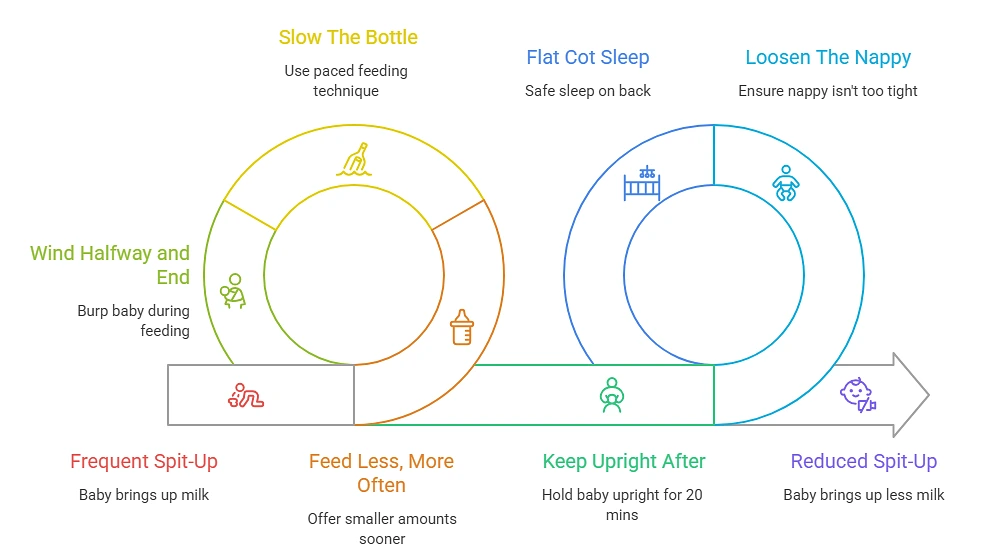
Nothing stops it. A few things reduce it, and the ones that work are cheaper than the ones that are sold.
Feed Less, More Often
The biggest lever. If she is bringing up the last 30 ml of a 120 ml bottle, offer 90 and feed again sooner. For a breastfed baby, offering one side, a break, then the other side does the same job. A full stomach pushes the valve open. A three quarters full one does not.
Slow The Bottle Down
A fast teat pours milk in faster than the stomach can settle, and the baby swallows air with it. Check the flow: milk should drip from an inverted bottle, not run. Hold the bottle nearer to horizontal so she has to work for it, and let her pause. This is called paced feeding and it takes 5 minutes longer and halves the spit up in a lot of babies.
Wind Her Halfway And At The End
Air in the stomach comes up and brings milk with it. A burp halfway through and one at the end, over the shoulder or sat forward with a hand under the chin, lets the air out on its own. If nothing comes after 2 or 3 minutes, stop. Some babies do not burp much, and that is fine.
Keep Her Upright For 20 Minutes After
Not in a bouncer, which folds the stomach in half. Upright against a chest, or in a sling. This is the one that costs nothing and gets skipped most, because the baby is asleep and the bed is right there.
Loosen The Nappy
A nappy fastened tight across the belly presses on the stomach. One finger’s width of give at the waist.
Do Not Prop Her Up To Sleep
Wedges, tilted cots, pillows, and rolled towels under the mattress are all sold for reflux and all of them raise the risk of suffocation and of the baby sliding down. The safe sleep advice, on her back, on a flat firm surface, does not change for a baby who spits up. She will not choke on it while on her back; babies turn their heads and the airway sits above the food pipe in that position. A flat cot and a slightly damp sheet is the right trade.
Thickeners And Medicines, Only Through A Doctor
Thickened formula, and for breastfed babies a thickener stirred into expressed milk, is sometimes suggested for babies who are losing weight or in real distress. Acid reducing medicines are prescribed for a small number of babies with proven reflux disease, and for the happy spitter they do nothing except make the parents feel that something is being done. Neither is a first step, and neither is something to buy from a chemist on a hunch.
What A Doctor Will Want To Know
If you do end up in the surgery, and with a baby who spits a lot you probably will at least once, the visit goes faster with these written on your phone.
- How much comes up, in tablespoons, after doing the test above, and how many times a day.
- The colour, every time. A photo of the worst one is worth taking.
- Whether it comes out with force, and how far.
- Feed sizes and how long between them.
- Wet nappies in the last 24 hours, and dirty ones.
- Weight from the last check and the one before it.
- Anything else: fever, coughing, arching, refusing feeds, sleepier than usual.
The doctor will weigh her, feel her tummy, check the soft spot, and watch her feed if they can. For most babies that is the whole appointment and the answer is “she is fine, keep going, it peaks at 4 months”. For the few who need more, that is the visit where it gets picked up.
My daughter spat up until she was 9 months old. She soaked every top I owned and most of my mother’s. She gained weight the entire time, on the line she started on, and the day she sat up unaided the spitting stopped as if somebody had turned a tap off. I still remember the tablespoon test more clearly than almost anything else from those weeks, because it was the first time in a fortnight I believed a puddle.
This is written from experience and for information. It is not medical advice. Green or yellow vomit, blood in vomit, a fever in a baby under 3 months, fewer than 6 wet nappies a day, or a baby who is floppy or hard to wake all need a doctor the same hour.