



A bag of chicken feet costs about a pound at most butchers, and they’ve been turning up in more and more British kitchens since bone broth became the thing to drink for your skin. The feet do carry hyaluronic acid, so the idea isn’t daft. How much of it ends up in your mug is another matter, and frustratingly, no one has ever measured it.
Key Takeaway: Only animal parts like skin, joints, cartilage and rooster combs contain hyaluronic acid, plants have none, and the small amount in food gets broken up by gut bacteria before some of it reaches your skin. If you want what the skin studies saw, food won’t get you there on its own.
Foods With Hyaluronic Acid Come From The Gristly Bits Of Animals
Animals use hyaluronic acid to hold water in their tissues, so it builds up in the slippery, chewy parts that most of us cut off and throw away. It was first pulled out of cows’ eyes back in 1934, which tells you something about where it hides.
- Rooster combs. The floppy red crest is the richest natural source, and supplement makers used combs for decades before switching to bacteria.
- Chicken feet and wings. Mostly skin, tendon and cartilage, which is where the stuff sits.
- Broth made with joints. Knuckles, necks and feet simmered for hours give up some of their hyaluronic acid along with the gelatine that makes the broth wobble when it’s cold.
- Pork rind and trotters. Plenty of connective tissue, the reason a pan of trotters sets into jelly.
- Fish heads and skin. The inside of a fish eye is mostly water held by hyaluronic acid.
A plain chicken breast or a salmon fillet will give you next to none, since muscle meat isn’t where animals keep it.
Soy, Sweet Potato And Oranges Contain None
Search for hyaluronic acid foods and you’ll see soy, sweet potato, citrus, kale and avocado on almost every list. Plants can’t make hyaluronic acid, so none of those foods contain a trace. They’re on the lists because of a theory that their nutrients might help your skin make more of its own, which is a weaker claim and gets its own section below.
Bone Broth Has Some Hyaluronic Acid, But No One Knows How Much

Norway’s food safety committee went looking for exactly this figure a few years ago, how much hyaluronic acid people take in from ordinary meals, and came back empty handed. The rooster comb was the only food anyone had properly analysed.
That comb work came out of a lab in Brazil, where researchers stripped the hyaluronic acid out of chicken crests to see how much they could get. Their yield came to roughly a few milligrams of hyaluronic acid for every gram of fresh comb, and that’s the best natural source going. Broth made from ordinary bones and feet will be thinner than that per spoonful, and long, hard boiling breaks some of the chains apart before you even drink it.
Set those milligrams against two other figures:
- The supplements in the skin studies gave people 120 mg a day.
- An average adult’s body holds around 15 g of hyaluronic acid already, and rebuilds about a third of it every day without any help.
So your own skin and joints are churning through grams of the stuff daily. The few milligrams in a mug of broth won’t move that much, whatever the label on the jar says.
Swallowed Hyaluronic Acid Does Reach The Skin, In Pieces
Dermatologists used to wave oral hyaluronic acid away, on the grounds that the molecule is far too big to get through the gut wall. They were partly wrong.
Your gut bacteria chop the long chain into short bits of 4 to 6 sugars, and those small bits can get into the blood. Animal studies that tagged hyaluronic acid with a tracer found some of it ended up in the skin and joints. One theory is that the fragments then nudge skin cells into making more of their own, although no one has shown that happening in people yet.
How much gets through is still anyone’s guess. The Norwegian review found estimates running anywhere from a few percent to 90%, and a lot depends on which bacteria happen to live in your gut.
The Capsule Studies Look Promising, With Caveats
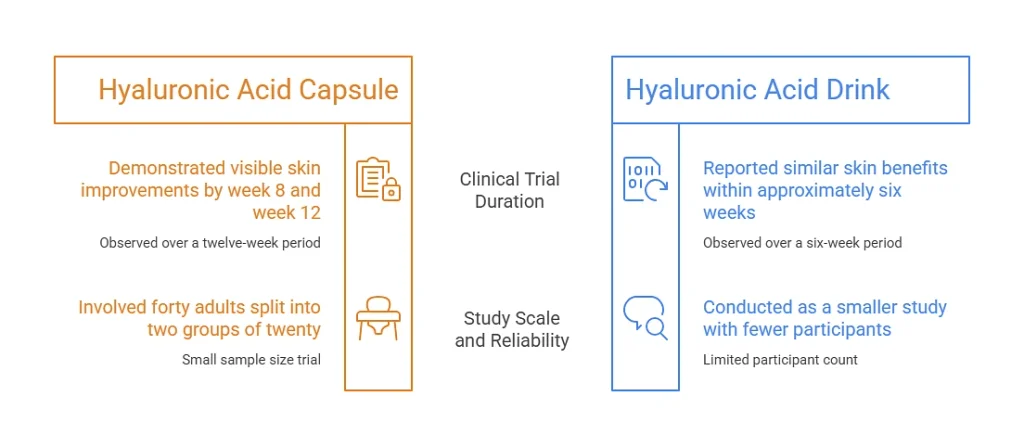
One trial in Asia gave 40 adults in their late thirties to sixties either 120 mg of hyaluronic acid or a dummy capsule daily for 12 weeks. By week 8 the hyaluronic acid group had fewer and shallower wrinkles and their skin held more water, and by week 12 the gap was wider. A smaller German study of a hyaluronic acid drink found something similar in about 6 weeks.
- these trials are small, often 20 people per group.
- several were funded by the firms selling the product.
- they used a fixed daily dose, which a Sunday roast with extra gravy isn’t.
The Norwegians also went through 17 human trials at 25 mg to 225 mg a day, one running a full year, and found no harm at any of those doses.Foods That Might Help Your Skin Make Its Own
Skin cells make hyaluronic acid from ordinary sugars, so there isn’t one vitamin or mineral you can eat to flick a switch. Most of the “boosting” foods online are guesswork. A couple have some evidence behind them.
Soy is the most interesting. Its isoflavones act a little like oestrogen, and falling oestrogen is one reason skin goes dry and thin after the menopause. A few trials in postmenopausal women have found better moisture and bounce with soy isoflavones, and lab work suggests they raise hyaluronic acid in skin cells. Tofu, edamame, tempeh and soya milk all count.
Protein and vitamin C won’t raise hyaluronic acid on their own, but skin can’t build collagen without them, and collagen and hyaluronic acid work as a pair. If you’re short of either, your skin will show it long before it runs low on hyaluronic acid.
Eating It Or Taking It, Which Makes Sense
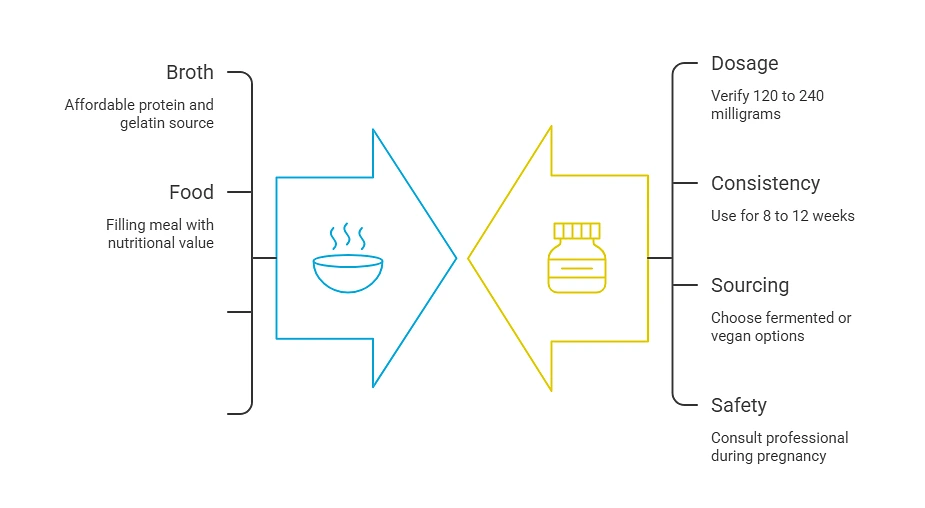
Broth won’t get you anywhere near the dose that was studied. Drink it because it’s cheap, filling and full of protein and gelatine, not because it’s a skin treatment.
If you’d rather try a supplement, these points will save you some money:
- Check the milligrams per day on the label, since most skin trials used 120 mg to 240 mg.
- Stick with it for 8 to 12 weeks before deciding it doesn’t work.
- Plenty of brands now make it by fermenting bacteria rather than from rooster combs, so vegans have options.
- There’s almost no research in pregnancy or while breastfeeding, so ask your GP or midwife first.
Serums are another matter altogether. They sit on the surface and draw water into the outer layer of skin, which has nothing to do with your diet.
If a product or recipe promises hyaluronic acid, check whether it comes from skin, joints or cartilage, and if it’s a supplement, look for a dose in milligrams on the back of the pack before you pay for it.