


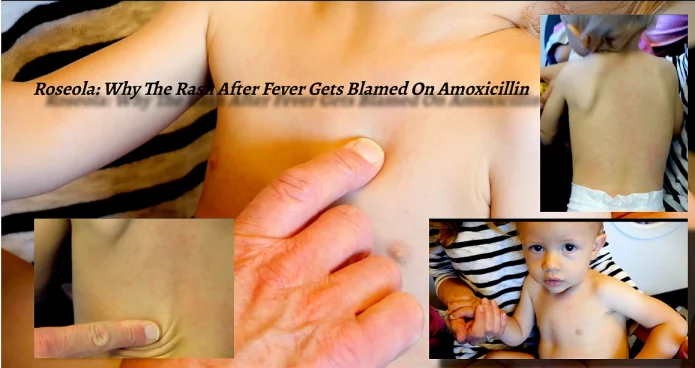
Roseola is the virus where the fever comes first. It runs high for 3 days or so, then it drops, and then, usually by the next morning, the spots come out. Doctors also call it sixth disease or exanthem subitum, and most children catch it somewhere between 6 months and 2 years of age.
A lot of what parents search about roseola isn’t really “what is it.” It’s some version of this:
“He was on amoxicillin for an ear infection, and on day 5 he’s covered in spots. Did the medicine do this?”
Most of the time, no. Getting to that answer means going through the fever days first, though, because that’s where the confusion starts.
Roseola Fever
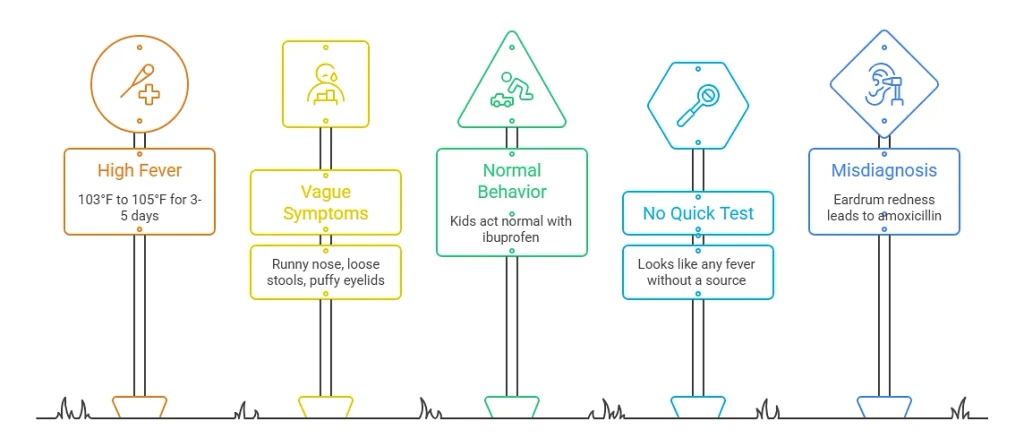
HHV-6 causes most cases. That’s human herpesvirus 6, and its cousin HHV-7 causes some of the rest. The fever usually hits 103°F to 105°F (39.5°C to 40.5°C) with no warning at all, and it can sit there for 3 to 5 days. Some kids get a runny nose or loose stools with it, some get puffy eyelids, and plenty get nothing except the fever. Parents get thrown by how normal a lot of these kids act once the ibuprofen kicks in some of them will be playing on the floor at 104°F.
There’s no quick test for roseola in a regular clinic, so on day 2 it looks like any fever without a source. If the eardrum looks a little red, and a toddler who has been screaming through the exam will often have a red eardrum, the visit can end with a prescription for amoxicillin.
Febrile Seizures
This is the scary part, and I’d rather give the real numbers than a vague “can sometimes cause seizures.” The best-known study on it came out of the University of Rochester’s emergency department:
- 1,653 children under 3 came in with a fever, and 160 of them had a first HHV-6 infection.
- 21 of those 160 had a seizure.
- For kids 12 to 18 months old, the seizure risk was 29%.
- HHV-6 accounted for about a third of all first febrile seizures in children under 2.
That sounds like a lot, but it only counts children sick enough to be taken to an ER. A Seattle team did it the other way around, swabbing healthy babies’ saliva every week at home, and none of the 81 infections they could pin down came with a seizure. I’d guess the risk for an average child at home is well below that 29%, though no study gives a clean number for it.
A first seizure still needs a doctor the same day, even if your child is back to normal in 2 minutes. The same goes for any baby under 3 months who has a temperature of 100.4°F or higher. Giving fever medicine on a strict schedule hasn’t been shown to prevent febrile seizures, so use it to keep your child comfortable and don’t wake them up at 3 a.m. for a dose.
The Rash
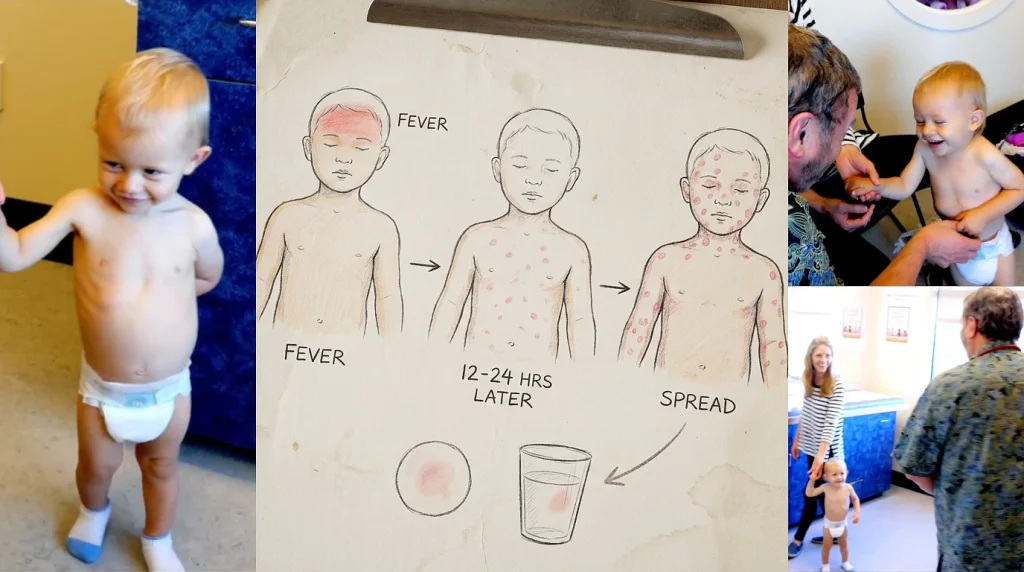
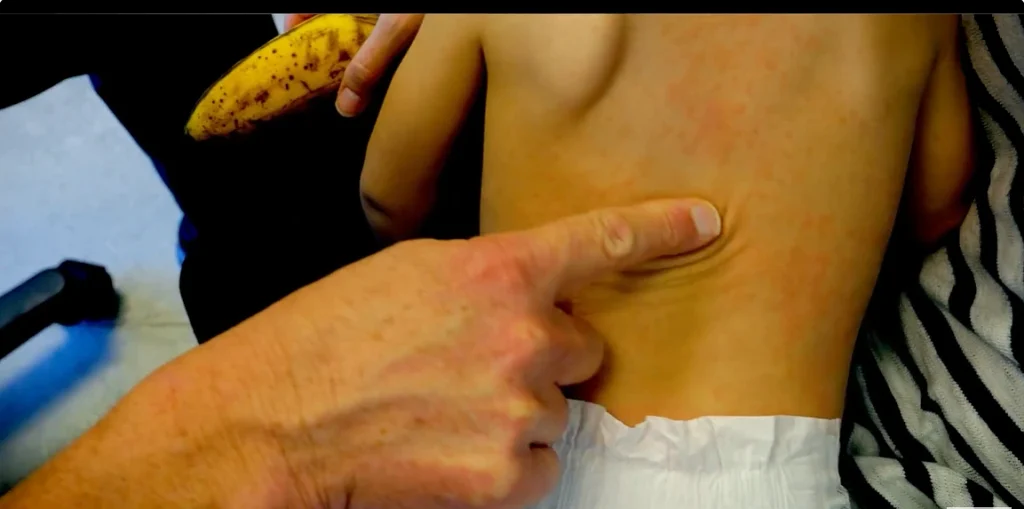
The rash usually shows up within 12 to 24 hours after the fever breaks. It’s pink, and on darker skin it can be hard to see at all.
- It starts on the chest, belly, and back, then spreads to the neck, face, and arms.
- It can be flat or a little raised.
- It doesn’t itch.
- It fades when you press a clear glass on it.
- It’s usually gone in 1 or 2 days.
Not every child gets it, either. The Seattle study followed 277 babies from birth, and 77% had caught HHV-6 by age 2, but only about 1 in 4 of the 81 kids with a clear start date had the fever-then-rash pattern. The rest had a fever, or a runny nose, or a few cranky days, and no one ever called it roseola.
Other Rashes That Look Similar
With roseola, the fever and the rash don’t overlap, and that’s the easiest way to tell it apart:
- Measles starts on the face and behind the ears and works its way down, and the child is really sick while the rash is out.
- Fifth disease gives bright red cheeks first, then a lacy rash on the arms and legs.
- Hand, foot, and mouth disease comes with painful sores in the mouth and spots on the palms and soles.
- Tiny purple or red dots that don’t fade under the glass aren’t roseola. Get those seen that day.
Amoxicillin And The Day 5 Rash
Back to the ear infection. Say the amoxicillin started on day 2. The fever broke on day 4, and on day 5 the child woke up covered in spots. It really does look like the medicine fixed the fever and then caused a reaction, but it did neither. Amoxicillin doesn’t touch a virus, so the fever would have broken on day 4 anyway, and the spots would have shown up on day 5 anyway.
The Latin for this is post hoc ergo propter hoc, “after this, therefore because of this.” It’s the same mistake as deciding the rooster makes the sun come up.
Pediatric offices see it all the time. Columbus Pediatric Clinic’s amoxicillin rash page says the rash shows up in about 10% of children taking the drug, usually starting on day 5, anywhere from day 2 to day 16. It also says the rash is most often caused by a virus, and it names roseola. Day 5 is roughly when a roseola rash would appear anyway, so the two line up almost perfectly.
Then there’s the retesting. A JAMA Pediatrics paper (Mill C et al., 2016;170(6):e160033) took 818 children who had been sent to an allergy clinic after a rash on amoxicillin, most of them under 2, and gave them the drug again in measured doses with doctors watching:
- 777 had no reaction.
- 17 had a mild reaction soon after.
- 31 got a mild rash later on.
None of the reactions were serious. That’s 95% of those kids who could take amoxicillin after all. A smaller Ontario study got 93 out of 96. I didn’t expect the numbers to be that lopsided.
What A Real Allergy Looks Like
A real allergy usually shows up as hives. Hives are raised, itchy welts that move around and change shape over a few hours. Swelling of the lips or face, or any trouble breathing, is an emergency, so call 911. A flat, pink rash that doesn’t itch and showed up the morning after a high fever broke is a much better fit for roseola.
Why does it matter if a toddler’s chart says “penicillin allergy”? Because it stays there. The next ear infection, strep throat, or pneumonia usually gets a different antibiotic, often a broader one, and I don’t think many parents ever go back to get that label checked once the rash is gone. I’d like to hear a doctor explain why a day 5 rash on a 1-year-old whose fever just broke gets written up as an allergy without anyone mentioning roseola.
Is Roseola Contagious?
Yes, mostly while the fever is up. It spreads through saliva, and the worst part is that it’s most contagious when no one knows it’s roseola yet. Once the rash is out, most kids aren’t spreading it anymore.
Cleveland Clinic’s advice is to keep your child home while they have a fever and for 24 hours after it’s gone. The rash alone isn’t a reason to keep them out of daycare.
Daycare didn’t even raise the risk in the Seattle study. Having an older brother or sister did, and girls caught it more often than boys. Almost every adult carries HHV-6 for life and sheds it in their saliva now and then, so you’ll almost never know where your child picked it up. A sibling, a grandparent’s kiss, a shared spoon, any of those could do it.
Roseola Twice, And Roseola In Adults
The American Academy of Pediatrics says HHV-7 may cause a second case in a child who first had roseola from HHV-6. So a second round is a different virus, and the first immunity is still working fine. HHV-7 is often mild.
Adults rarely get it. Most people are infected before they ever start preschool, and a second infection from the same virus is uncommon.
Before The Allergy Label Goes In The Chart
If the rash started while your child was on amoxicillin and everything else fits roseola, meaning the fever came first and the flat, non-itchy spots came after it broke, ask the doctor what’s being written down. “Rash during viral illness, allergy not confirmed” and “penicillin allergy” will mean very different prescriptions for years. Take a photo of the rash in daylight before it fades, with the date on it, and write down which day of the antibiotic it started. If the label is already in there, ask for a referral for an amoxicillin challenge. At a lot of clinics, that’s 1 or 2 doses given in the office and about an hour of waiting, and some clinics send you home with a few more days of the drug to watch for a late rash.