


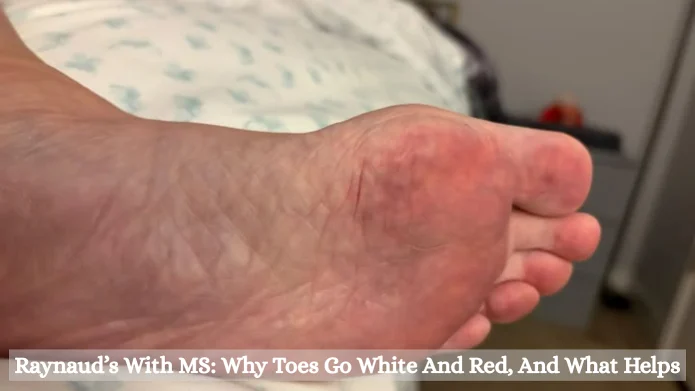
The photo at the top came from a reader with MS. The ball of her foot is blotchy red and purple, two of the toes have gone pale, and the whole thing hurts. She has Raynaud’s in both hands and both feet on top of the MS, and her question was simple: does anybody else have this?
Short version, yes. A lot of people with MS have Raynaud’s. It doesn’t appear on the symptom lists neurologists hand out, which is why so many patients assume they’re the only one, but there are solid reasons the two go together, and a couple of look-alikes worth knowing about before deciding that’s what this is.
What Happens In The Foot During A Raynaud’s Attack
Raynaud’s is a spasm in the small blood vessels of the fingers and toes. Cold sets it off, and so does stress. The vessels squeeze shut, blood stops getting through, and the skin goes through a color change that’s hard to miss once you’ve seen it. First white, as the blood stops and the toes go numb. Then blue or purple, as what little blood is trapped there loses its oxygen. Then red, when the vessels finally open and blood rushes back in. The red stage is the one that hurts. Throbbing, burning, that pins-and-needles feeling.
The foot in the photo looks like it’s in that last stage. The toes are still pale and the ball of the foot has gone red and mottled where the blood has come back. That lacy red-and-purple pattern is typical of the recovery phase. It also shows up in a related cold-triggered condition called livedo reticularis, so the two sometimes get confused.
Roughly one person in twenty has Raynaud’s. For most of them it’s the primary kind no underlying illness, just vessels that overreact to cold. Secondary Raynaud’s is caused by something else, a disease or a drug, and that’s the kind a doctor wants to check for.
Why Raynaud’s Shows Up So Often In People With MS
There are four reasons, and they stack.
MS damages nerves, including the ones that run the body’s automatic functions heart rate, sweating, bladder control, and the widening and narrowing of blood vessels. Trouble with that system, called autonomic dysfunction, is reported in about half of people with MS at some point. When the nerves that tell blood vessels to open and close send bad signals, vessels in the hands and feet clamp down too easily and stay clamped too long.
Moving less makes it worse. Walking uses the calf muscles as a pump that pushes blood back up from the feet. Someone who walks less, or whose legs don’t cooperate the way they used to, loses some of that pump. Cold feet are extremely common in MS for that reason alone.
Then medications. Interferon beta, one of the older disease-modifying drugs for MS, has been linked to new or worsening Raynaud’s in published case reports. Beta blockers prescribed for tremor, some migraine preventives, and some of the stimulants used for MS fatigue all narrow blood vessels as a side effect.
The fourth reason is the one that matters most. MS is an autoimmune disease, and having one autoimmune disease raises the chance of having another. Secondary Raynaud’s is often the first sign of lupus, scleroderma, Sjögren’s syndrome or mixed connective tissue disease. Having MS does not mean any of those is present. It does mean that Raynaud’s that’s new, or getting worse, is a reasonable trigger for a blood test.
Three Conditions That Get Mistaken For Raynaud’s In MS
Erythromelalgia is close to the mirror image. The feet go red, hot and burning, usually in a warm room or in bed at night, and feel better when cooled. It can exist side by side with Raynaud’s. If the pain is worse under a blanket than outside in the cold, that’s the one to bring up.
Chilblains are small, itchy, red or purple bumps on the toes that appear a few hours after cold exposure and hang around for a week or two. People who already have Raynaud’s get them more.
MS sensory symptoms can make the feet burn, tingle or feel ice cold with no change in blood flow at all, because the faulty signal is coming from the spinal cord rather than the skin. The giveaway is that the foot looks completely normal while it feels terrible. The foot in the photo does not look normal, which points to circulation rather than nerves.
One more, not MS-related but worth ruling out in anyone over 60, in smokers, or in diabetics: peripheral artery disease, narrowing of the leg arteries, which causes cold pale feet and calf pain when walking.
When It’s Time To See A Doctor About It
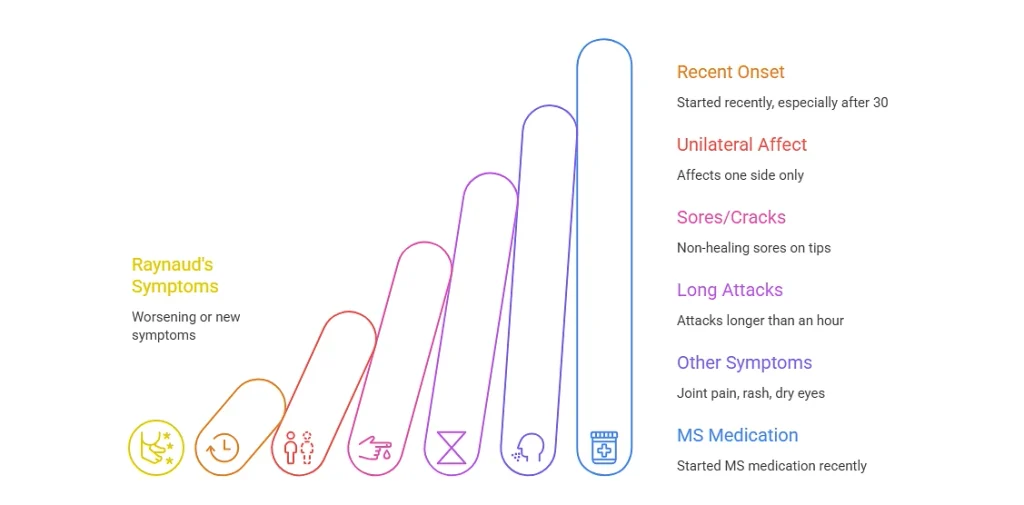
Raynaud’s that’s mild and has been around for years can be handled at home. These are the signs that it needs a proper look:
- It started recently, especially past age 30, or it’s worsening quickly.
- It affects one side only, or one or two toes while the rest are fine.
- There are sores, cracks or dark patches on the tips of the toes or fingers that aren’t healing. That’s urgent.
- Attacks run longer than an hour, or happen with no cold or stress trigger.
- Other symptoms have appeared: joint pain, a rash across the cheeks, dry eyes and mouth, tight or shiny skin on the fingers, mouth ulcers, trouble swallowing.
- An MS medication was started in the months before the Raynaud’s began.
A primary care doctor or the neurologist can order an antinuclear antibody test and a few related ones, and can look at the tiny vessels at the base of the fingernails under magnification, which tells them more than you’d expect.
What Helps Between Attacks And During One
Keeping the core warm does more than anything for the feet. When the trunk gets cold the body shuts off blood to the extremities to protect the organs, so a warm sweater helps the toes more than a second pair of socks. Socks still matter: a thin liner under a thicker pair, shoes with room, slippers indoors, nothing tight around the ankle. Disposable or rechargeable foot warmers are worth keeping around for cold days.
Movement counts even when it’s small. Flexing the ankles and wiggling the toes while sitting pushes blood down. Caffeine and nicotine both tighten blood vessels, nicotine badly, so cutting back helps. Stress triggers attacks as reliably as cold, which is easier said than managed, but it’s worth knowing.
Every medication, prescription and over the counter, is worth running past a pharmacist for anything that constricts vessels. An MS drug should never be stopped without the neurologist, but the neurologist may have alternatives.
If attacks are frequent or painful, ask about nifedipine. It’s a blood pressure medication that relaxes small vessels and is the standard prescription for Raynaud’s that won’t settle with warmth alone. Headaches and flushing are common in the first couple of weeks and usually fade.
During an attack warm up gradually, not with hot water, which hurts numb skin and can burn it. Move the foot, rub it gently, and stay off it until feeling comes back, because a numb foot is easy to injure without knowing.
The Answer For The Reader
Yes, plenty of people with MS have Raynaud’s, and it isn’t bad luck. MS can scramble the nerves that control blood vessels, MS drugs can tighten them, and the autoimmune link means a second condition is worth screening for. A foot that goes white at the toes, then floods red and blotchy and hurts while it does, fits Raynaud’s well. The photo is worth taking to the MS nurse or doctor at the next visit, along with a request for the blood tests if they haven’t been done. Until then, warm the whole body, not just the feet, and keep an eye on the skin at the tips of the toes.
Disclaimer: General information, not medical advice. Sores or dark patches on fingers or toes, or new joint pain or rash alongside Raynaud’s, should be seen by a doctor promptly.
References
- Mayo Clinic, Raynaud’s disease: https://www.mayoclinic.org/diseases-conditions/raynauds-disease/symptoms-causes/syc-20363571
- National Multiple Sclerosis Society, MS symptoms: https://www.nationalmssociety.org/Symptoms-Diagnosis/MS-Symptoms
- Scleroderma and Raynaud’s UK, What is Raynaud’s: https://www.sruk.co.uk/raynauds/
- American College of Rheumatology, Raynaud’s phenomenon: https://rheumatology.org/patients/raynauds-phenomenon