


Picture this. You have already had a wait of 8 months for a consultation for hip replacement surgery, through your local NHS hospital. Your GP tells you that there is an alternative to the usual treatment, which is at a clinic called Sheffield Olympic Legacy Park, which has a team called One Health Group, and they offer consultation-led treatment. You want to know, but you’re not going to take the plunge.
Is it private? Will it cost you? So, the surgeons are really good or is it a downgrade in a fancy new package?
Most of your patients will have these questions, and they want straightforward answers, not sales gibberish. The summary: One Health Group is an NHS commissioned provider, treatment will be free at the point of care for patients who qualify and the consultants running from the Sheffield Olympic Legacy Park are the same quality as those you would find in a traditional hospital. Except the waiting list is shorter and the building was specifically designed for elective surgery and not built around an ED.
Who One Health Group Actually Is
It is not a new operator trying to catch up on the backlog of jobs created by the pandemic. The company was founded in 2004 and has been developing a partnership model with NHS trusts in the north of England for 20 years. The head office is located in Sheffield, which is not a coincidence, as the organisation has developed from the area it serves, not from a London corporate centre.
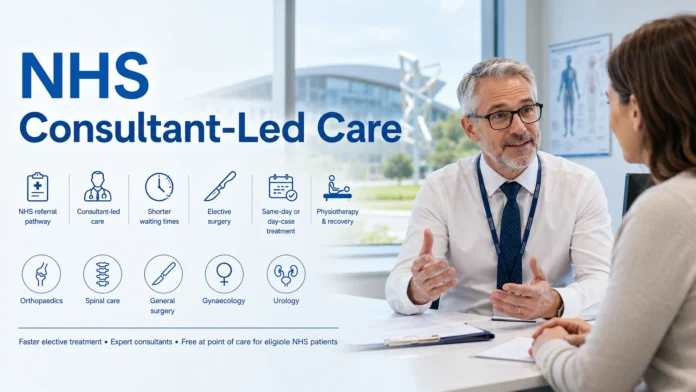
The team describes itself plainly consultant surgeons and Healthcare managers working with the NHS to provide faster, local and expert care across five specialties:
- Orthopaedics.
- Spinal surgery.
- General surgery.
- Gynaecology.
- Urology.
The point is that they’re focused on that. They don’t run A&E. They are not involved with complicated cancer pathways. They are not accepting admissions of multi-system frail elderly. They handle cases that are most appropriate for a focused elective setting, which is why they are able to operate efficient lists and quick waits.
Again, scale plays a role here. It sees approximately 130 NHS Surgeons and Anaesthetists within the network and treats around 17,000 new patients annually with 40+ outpatient clinics in South Yorkshire, Derbyshire, Nottinghamshire, West Yorkshire, the Midlands, North Yorkshire, Lincolnshire and Leicestershire. One of those nodes is the Sheffield Olympic Legacy Park location, and it’s emerging as one of the more visible, thanks to its placement and representation.
What Sheffield Olympic Legacy Park Actually Is
A lot of confusion comes from the name. People assume Olympic Legacy Park is a stadium repurposed as a hospital. It isn’t.
It is located on the site of Don Valley Stadium, the former home for footballers in the East End of Sheffield. The regeneration project was formally proposed in June 2015 as a 26 acre multi-million pound London 2012 Olympic legacy project, driven by a tripartite partnership of:
- Sheffield Hallam University.
- Sheffield Teaching Hospitals NHS Foundation Trust.
- Sheffield City Council.
The Advanced Wellbeing Research Centre, run by Sheffield Hallam, anchored the early phase of the build.
So the Park isn’t a single hospital. It’s an innovation zone, a mixed use space where health, sport, education and research organisations share a postcode, and ideally, share ideas. One Health Group does not take over the Park but fits into the system. As you step onto a location where researchers investigate human movement, you’re essentially walking right up to clinicians working with the human movement disorders that arise.
What “Consultant-Led Care” Actually Means at This Site
This is the part most articles skim over, and it matters more than the building.
You won’t see a registrar or a rotating junior at Olympic Legacy Park. The model is a clearly consultant-based model. You are assessed by a senior clinician with substantive NHS experience who designs your treatment, does surgery if necessary, and reviews you afterwards.
Patients may be most cognizant of the continuity commitment. You will be seen by the same consultant from the point of referral to consultation, from diagnosis to treatment, and the patient liaison team will have a named person who makes appointments. That continuity is very special for current NHS pathways, where rotations of staff and disjointed systems frequently result in a re-historying of your story to a new face at each clinic.
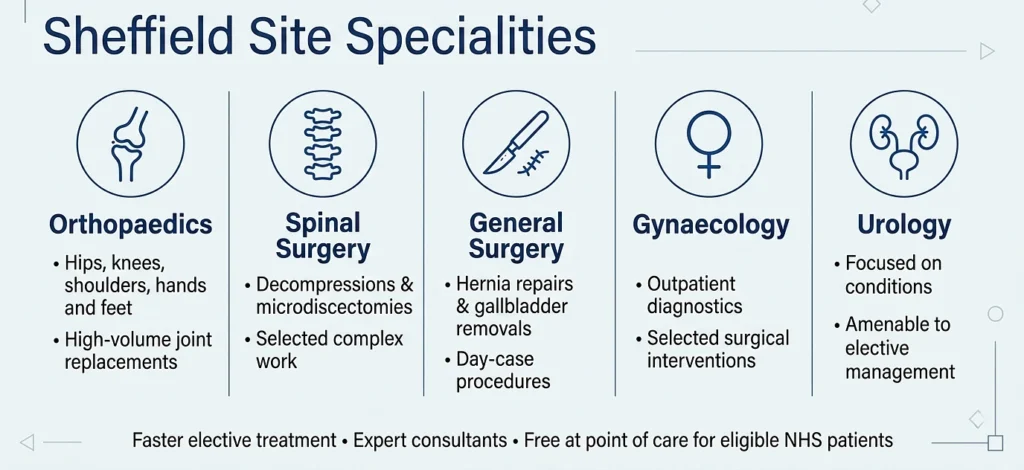
The consultants working from the Sheffield site cover the same five specialties the group is built around:
- Orthopaedics – hips, knees, shoulders, hands and feet, including the high-volume joint replacements that dominate elective waiting lists.
- Spinal surgery – decompressions, microdiscectomies, and selected complex spinal work.
- General surgery – hernia repairs, gallbladder removals, and the bread-and-butter day-case procedures.
- Gynaecology – outpatient diagnostics through to selected surgical interventions.
- Urology – focused on conditions amenable to elective management.
Notice what’s missing: trauma, emergency surgery, anything requiring intensive care backup. That’s not a gap. It’s a deliberate scope.
The Patient Experience
One Health is accessed via NHS e-Referral as you would access any other health provider on the NHS choose-and-book system via your GP’s referral. No separate sign up. The NHS eligible patients do not have a private fee system. No blacklist or whitelist of membership.
What is different about the environment you enter? The Sheffield Olympic Legacy Park facility was designed for elective work. It isn’t the corridor traffic of a general hospital, the smell of an A&E that’s been going for fourteen hours, or the push and pull of elective lists that are pushed into next quarter.
A great deal of the procedures are performed as day-case surgeries. The procedure does not take place until the morning and you head home on the same afternoon with instructions for aftercare. No efficiency trick here. For appropriate procedures, the concept of “same day” discharge is truly a decrease in the risk for hospital-acquired infections and a chance to rest in the comfort of one’s own bed.
On average, waiting times for One Health Group range from 2 to 12 weeks depending on the procedure, with a median of 6 weeks. That’s compared to the 18-week referral-to-treatment target which many NHS specialties are not achieving – and that’s why most patients end up here.
Patient satisfaction is 99.1% inpatients stating they would recommend the service based on the patient satisfaction questionnaire results from April 2025 to September 2025. Any single satisfaction figure must be taken with some caution; selection bias and response rates always come into play, but the uniformity of the pathway design suggests that the figure is not an outlier.
How Physiotherapy Fits Into the Pathway
It’s not just a surgery story, and that’s the model that’s based on. The local post-operative physiotherapy is done by rehabilitation partners so it’s not necessarily a return trip to Olympic Legacy Park for follow-up physiotherapy sessions.
The broader regional partner network covers:
- Local NHS post-operative care across multiple locations close to where patients live.
- Enhanced Recovery Programmes essentially pre-operation preparation sessions for patients awaiting hip and knee surgery.
- Coordinated handover from surgical team to rehab team, so your physio knows what was done in theatre.
The contrast matters. If you’ve been through an NHS joint replacement before and remember being handed a leaflet at discharge and told to phone a number, this is a different experience. The rehab is built into the pathway rather than bolted on as an afterthought.
What This Site Does for the Wider NHS
The purpose of facilities such as the Olympic Legacy Park hub is not so much to provide patients with a more pleasant waiting room. It’s a matter of the capacity of NHS.
Hip replacements performed in any facility other than a general acute hospital release an operating theatre and surgical team from the trauma and emergency care that can only be provided there. The independent sector, when working for the NHS, does not compete for resources. It’s increasing the overall patient capacity of the NHS.
That’s the policy logic and it’s why the capacity for elective surgery has increasingly been built up at the NHS, through One Health and other providers. It is a different political issue whether the model is the correct one in principle. But in reality, if this ability wasn’t there, the NHS’ elective backlog they are still trying to run down would be measurably worse.
Honest Considerations Before Choosing One Health
A few things worth knowing rather than glossing over.
This facility does not have the capacity to cover all types of cases. You might be directed back to the acute hospital if your condition is complex, requires more than one specialty or has a high risk of anaesthetic. It’s the correct action clinically, albeit with a longer wait.
Pre-operative assessment matters. Not all patients referred are appropriate for an independent sector pathway through the day. It’s for safety reasons, not rejection.
You retain choice. As per NHS rules, providers can be chosen but so can the individual’s local hospital. One Health is a choice, not a mandate.
Consultants are NHS consultants. Your surgeon could be operating on an NHS patient at another location on a Wednesday. This is the model: capacity sharing, not parallel workforce.
The Bigger Picture: Why the Location Matters
Sheffield has been quietly developing an innovation cluster in healthcare. The Olympic Legacy Park is located next to the Advanced Wellbeing Research Centre, which from its inception was announced as a centre generating movement and wellbeing technologies for global healthcare companies. This is one research mission that’s truly complementary to an elective orthopaedics and musculoskeletal surgery provider located on the same site.
It’s not just postcode-shopping. It’s a learning-by-doing environment, with evidence feeding back into research and research influencing the provision of care. The direct benefit for patients is small in the short term, but real long-term.
- Services designed by people who are also studying outcomes.
- Buildings designed for the patients they serve.
- Research partners physically close enough to make collaboration practical rather than theoretical.
For anyone in South Yorkshire, Rotherham, Barnsley or Doncaster facing a long elective wait, the One Health Group route through Sheffield Olympic Legacy Park is one of the more sensible options the NHS currently offers. Ask your GP, check your referral options on the NHS e-Referral system, and read your appointment letter carefully so you know what specialty you’ve been referred under. The rest of the pathway is built to do the work for you.
References
- One Health Group Official Site – https://www.onehealth.co.uk/
- One Health Group About (Consultant Network, Patient Numbers, Waiting Times) – https://www.onehealth.co.uk/about
- NHS One Health Group Independent Sector Provider Listing – https://www.nhs.uk/services/independent-sector-provider/one-health-group/NTX
- My Planned Care NHS Sheffield Olympic Legacy Park One Health Group – https://www.myplannedcare.nhs.uk/ney/sheffield-olympic-legacy-park-one-health-group/
- Bdaily News (8 June 2015) Sheffield to Become Host of Multi-Million Pound Olympic Legacy Park – https://bdaily.co.uk/articles/2015/06/08/sheffield-to-become-host-of-multi-million-pound-olympic-legacy-park

