


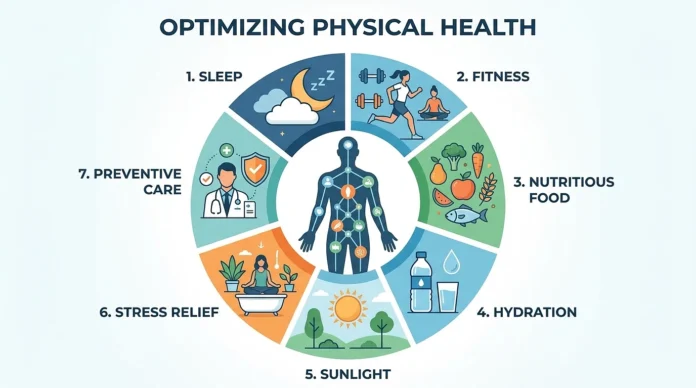
There is no secret to physical health. There are eight principles that are present in nearly every healthy study on longevity and disease avoidance: sleep, aerobic exercise, strength training, protein, food quality, hydration, stress management, and preventive care, to name a few. If you can achieve those that’s the priority you will outperform most high dollar supplements, and all of the latest diets. The challenge is not knowing what to do! Not for weeks, it’s not for years it’s doing it for years!
Key Points
- Sleep at least 7 hours a night. The single highest-leverage habit on this list. Less than 7 is linked to weight gain, type 2 diabetes, heart disease, depression, and earlier death.
- Aim for 150 to 300 minutes of aerobic activity per week. Brisk walking five days a week meets the WHO floor. Most of it should be at a conversational, low-intensity pace.
- Strength train at least 2 days a week. Just 30 to 60 minutes of muscle-strengthening work weekly is linked to a 10 to 20% lower risk of all-cause mortality.
- Eat 1.4 to 2.0 grams of protein per kg of bodyweight (roughly 0.7 to 1 gram per pound) if you train. Anchor every meal around it, especially breakfast.
- Cut down ultra-processed food. Linked to 32 adverse health outcomes in the most recent BMJ umbrella review. You don’t have to eliminate it, just don’t live on it.
- Get 25 to 29+ grams of fiber a day. Most people eat about half. Vegetables, legumes, whole grains, nuts, fruit.
- Drink roughly 3.7 L (men) or 2.7 L (women) of total fluid daily from all sources. Thirst and pale-yellow urine are better signals than fixed cup counts.
- Get 5 to 15 minutes of morning sunlight. Free, fast, and one of the strongest known signals to your circadian clock.
- Manage stress with something you’ll actually do. Walking, slow paced breathing (~6 breaths/min), real time off your phone.
- Get annual bloodwork (lipids, fasting glucose, HbA1c, vitamin D, B12, thyroid) and stay on schedule for age-appropriate screenings.
Sleep The Foundation Nothing Else Replaces
If you only change one thing about your health, make it sleep. Adults need at least 7 hours a night, and the floor isn’t soft. The joint consensus statement of the American Academy of Sleep Medicine and the Sleep Research Society (Watson et al., Sleep, 2015) links regularly sleeping less than that to weight gain, type 2 diabetes, high blood pressure, heart disease, stroke, depression, weaker immunity, and a higher risk of dying earlier from any cause. The CDC uses the same number in its public guidance.
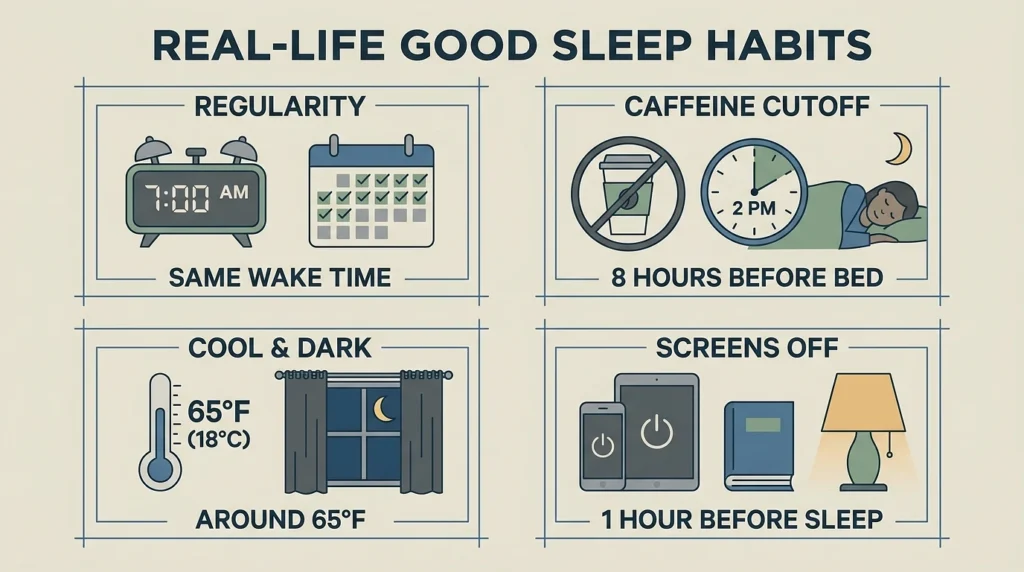
What good sleep actually looks like in real life:
- Same wake time every day, weekends included. Your circadian system runs on regularity, not just total hours.
- Caffeine cutoff around 8 hours before bed. Caffeine has a half-life of about 5 hours, so that 4 p.m. coffee is still in your system at midnight.
- Cool, dark room. Around 65°F (18°C) is the most commonly cited sweet spot.
- Screens off roughly an hour before bed, or at least switched to a warm color setting. Evening light delays melatonin release.
Seven to nine hours is the comfortable range, but seven is the absolute floor. If you’re running on five or six and pushing hard at the gym, you’re not optimizing anything. You’re just digging a hole.
Aerobic Movement 150 Minutes Is the Floor, Not the Ceiling
The 2020 WHO physical activity guidelines (Bull et al., British Journal of Sports Medicine) put the weekly target at 150 to 300 minutes of moderate aerobic activity, or 75 to 150 minutes of vigorous activity, or any reasonable mix of the two. The CDC uses the same numbers for U.S. adults.
The key is 30 minutes of brisk walking 5 days a week! Then, positive reinforcement continues to build. Your chances of developing heart disease, type 2 diabetes, a few cancers, depression, and cognitive decline decrease as you accumulate more weekly minutes, and most people start to see diminishing returns after 300 minutes.
Coaches call it “Zone 2” the most beneficial intensity for overall health is a pace at which you can hold a conversation, but you wouldn’t want to! The percentage range of your max HR is about 60-70%. Consider fast walking uphill, relaxed cycling, a moderate jog or a leisurely row. Yes, it’s boring. That is why it’s effective. The hard intervals can be wonderful when done, but the long easy stuff is what you can continue to do 4-5 days a week, every week, for years.
A point that is not mentioned in the WHO guidelines: reducing sedentary time is a standalone recommendation, in addition to the exercise recommendation. If you sit for nine hours and then for 30 minutes of cardio, that’s nine hours you still have to sit for. The fix is unsexy. Get up regularly, make more frequent trips between meetings, and take the stairs if you can.
Strength Training The Most Underrated Lever After 30
Two days a week, full-body, compound lifts. You don’t need a fancy split or anything you saw on Instagram.
A 2022 meta-analysis of 16 cohort studies in the British Journal of Sports Medicine (Momma et al.) found that people who do any muscle-strengthening activity have a 10 to 20% lower risk of dying from any cause, plus lower rates of cardiovascular disease and total cancer. The peak benefit showed up at around 30 to 60 minutes per week. The curve is J-shaped, meaning more isn’t always better, but the jump from zero to something is enormous.
The fundamentals of a program are the squat (variation), hip hinge (deadlift or Romanian deadlift), horizontal press (bench press or push-up), horizontal pull (row), vertical press (overhead press), vertical pull (pull-up or pulldown), and a load carry (loaded carry). Repeat each pattern over the course of the week and you’ll hit all of the main muscle groups!
It matters more as you get older, not less. Past about age 30, adults lose somewhere between 3 and 8% of muscle mass per decade if they don’t actively train against it a process called sarcopenia. Resistance training is the only intervention that reliably reverses it. Set aesthetics aside for a second. The real reason to lift in your forties and fifties is so you can still carry your own groceries, get up off the floor without help, and not break a hip at seventy.
Protein and Food Quality
The standard 0.8g/kg of bodyweight quoted everywhere is a minimum standard, established decades ago to eliminate malnutrition. Never designed to be optimal, particularly for someone who lifts or trains regularly.
The International Society of Sports Nutrition position stand (Jäger et al., Journal of the International Society of Sports Nutrition, 2017) puts the working range at 1.4 to 2.0 grams per kilogram per day for active people. A meta-analysis of 49 studies and 1,863 participants (Morton et al., British Journal of Sports Medicine, 2018) found that going much above 1.6 g/kg/day didn’t add anything for muscle gain from resistance training. So a sensible target for most active adults is somewhere between 0.7 and 1 gram per pound of bodyweight.
For example, a palm-sized serving of protein at every meal on a plate: eggs, chicken, fish, paneer, lentils, greek yoghurt, tofu, beans anything that fits your diet. Most people find it difficult at breakfast time and then have to scramble throughout the day to make up the lost time.
Zooming out to food quality in general: a BMJ umbrella review of 45 meta-analyses covering nearly 10 million people (Lane et al., BMJ, 2024) found consistent links between high ultra-processed food intake and 32 separate adverse health outcomes, ranging from heart disease and type 2 diabetes to anxiety, depression, and earlier death. Ultra-processed is the term for food made with ingredients you’d never keep in your own kitchen: most packaged snacks, sugary drinks, breakfast cereals, frozen ready meals, instant noodles, processed meats.
You don’t need to cut these out completely. You just shouldn’t be living on them.
Fiber is one of the most overlooked aspects of food quality. According to a series of systematic reviews published in The Lancet (1,2), individuals who consumed 25-29g of fibre a day were 15-30% less likely to die from any cause or cardiovascular disease than those eating minimal fibre, and even greater benefits were seen with higher intake. These are obtained from vegetables, fruits, legumes, whole grains, nuts and seeds. The average American is eating about half that.
Hydration
The National Academies of Sciences, Engineering, and Medicine put adequate daily fluid intake at roughly 3.7 liters (15.5 cups) for men and 2.7 liters (11.5 cups) for women, counting everything you drink and eat (Institute of Medicine, Dietary Reference Intakes for Water, 2005). About a fifth of that usually comes from food.
The practical version is simple:
- Drink to thirst, plus a buffer. Pale yellow urine is the easiest real-time signal you’re doing okay.
- You need more in heat, during exercise, when you’re sick, and during pregnancy or breastfeeding.
- Caffeinated drinks still count. The diuretic effect is real but small.
- You don’t need fancy electrolyte products unless you’re training hard in heat or sweating heavily for over an hour.
The 8-glasses-a-day rule didn’t come from research. It’s an old estimate that hardened into folk wisdom. Thirst and urine color are better guides.
Morning Sunlight The Free Lever Almost Nobody Uses
Bright light early in the day is one of the strongest signals your circadian clock will ever get. Research from Rush University’s biological rhythms lab (Crowley & Eastman, Sleep Medicine, 2015) found that a single 30-minute morning light exposure delivered about 75% of the circadian benefit of a two-hour exposure. Short doses really do work.
What it actually looks like: five to fifteen minutes outside soon after you wake up. No sunglasses. Even on a gray morning, outdoor light is dramatically brighter than anything indoors. Side effects include falling asleep more easily that night, better mood, and sharper morning energy. It’s free. Almost nobody does it consistently.
Stress and Recovery
Most of this gets fed back into everything else on this list, but the chronic stress sneaks up on us and damages sleep, hormones, digestion, blood pressure, immunity, etc. There is no single best technique! The right one will be the one that really reduces your load down, and the one that you’ll actually do again. Walking outside, doing a breathwork exercise, meditating, journaling, praying, spending some real time off the phone, spending time in nature, all of this is backed by research.
One tool worth singling out is slow paced breathing, around six breaths per minute for five to ten minutes. It reliably nudges the nervous system toward a calmer parasympathetic state. It takes minutes. It works almost immediately. It costs nothing.
A piece of advice: Do not get trapped optimizing to more stress. But monitoring all of the macros and steps and sleep scores can definitely become an anxiety issue. Data is supposed to be there for you and not control you.
Preventive Care
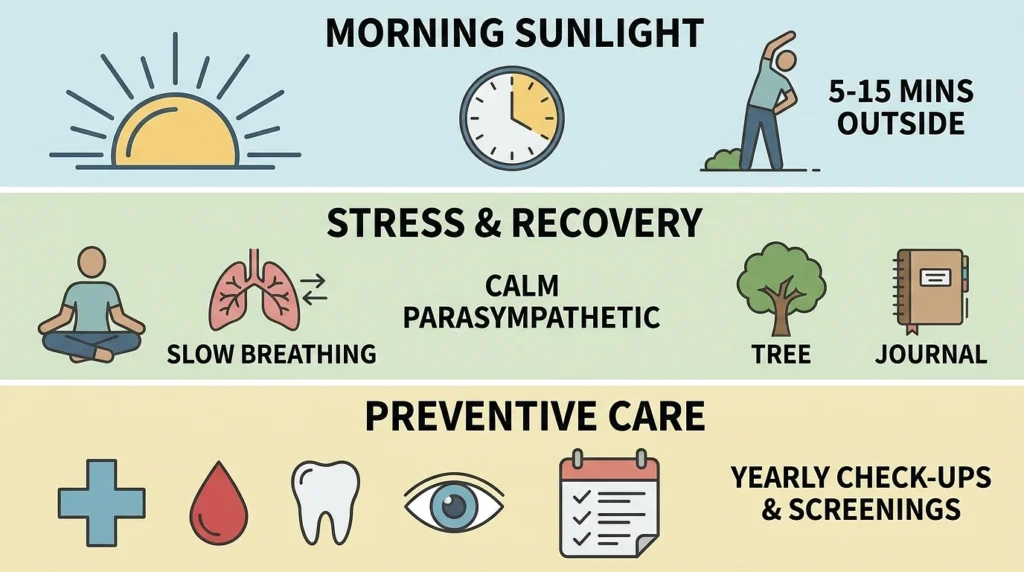
Most of what kills people in middle age heart disease, several cancers, type 2 diabetes is catchable early if anyone’s actually looking. At a minimum, get yearly bloodwork covering a lipid panel, fasting glucose and HbA1c, vitamin D, B12, and thyroid (TSH). Stay on schedule for age-appropriate screenings like colonoscopy, mammograms, prostate exams, and skin checks. Dental cleanings twice a year. An eye exam every couple of years.
This is the most boring part of health and the most important over a long enough timeline. Chronic disease tends to be silent right up until the moment it isn’t.
The Two Principles That Beat Every Tactic
Consistency beats intensity. A boring routine you actually keep up for ten years will outperform a perfect program you abandon after six weeks. Three workouts a week, every week, for a decade is transformative. Five workouts a week for two months and then nothing changes almost nothing.
Don’t optimize one thing at the cost of another. Sleeping five hours so you can train more is a net loss. Eating perfectly while sitting twelve hours a day is a net loss. Hitting your protein target while running on no water and no sleep is a net loss. Your body is one system. Push too hard on one piece of it and the others start to give.
If this whole list felt like a lot, just pick two things to start with:
- Set a fixed wake time and protect at least 7 hours in bed.
- Take a 30-minute walk outside, ideally in the morning sun.
Those two habits take care of sleep, daylight, circadian rhythm and aerobic movement, all in one. Spend two times a week on a strength session and have a protein-rich breakfast and you’ve beat the majority of people that spend hours sifting through protocols. They intentionally make the fundamentals boring. They’re also the methods which function.
References
- Watson NF et al. Recommended Amount of Sleep for a Healthy Adult: A Joint Consensus Statement of the American Academy of Sleep Medicine and Sleep Research Society. Sleep, 2015.
- CDC. FastStats: Sleep in Adults. https://www.cdc.gov/sleep/data-research/facts-stats/adults-sleep-facts-and-stats.html
- Bull FC et al. World Health Organization 2020 guidelines on physical activity and sedentary behaviour. British Journal of Sports Medicine, 2020.
- CDC. Adult Activity: An Overview. https://www.cdc.gov/physical-activity-basics/guidelines/adults.html
- Momma H, Kawakami R, Honda T, Sawada SS. Muscle-strengthening activities are associated with lower risk and mortality in major non-communicable diseases: a systematic review and meta-analysis of cohort studies. British Journal of Sports Medicine, 2022.
- Jäger R et al. International Society of Sports Nutrition Position Stand: protein and exercise. Journal of the International Society of Sports Nutrition, 2017. https://pmc.ncbi.nlm.nih.gov/articles/PMC5477153/
- Morton RW et al. A systematic review, meta-analysis and meta-regression of the effect of protein supplementation on resistance training-induced gains in muscle mass and strength in healthy adults. British Journal of Sports Medicine, 2018.
- Lane MM et al. Ultra-processed food exposure and adverse health outcomes: umbrella review of epidemiological meta-analyses. BMJ, 2024. https://pmc.ncbi.nlm.nih.gov/articles/PMC10899807/
- Reynolds A, Mann J, Cummings J, Winter N, Mete E, Te Morenga L. Carbohydrate quality and human health: a series of systematic reviews and meta-analyses. The Lancet, 2019. https://pubmed.ncbi.nlm.nih.gov/30638909/
- Institute of Medicine. Dietary Reference Intakes for Water, Potassium, Sodium, Chloride, and Sulfate. National Academies Press, 2005. https://www.nationalacademies.org/read/10925/chapter/6
- Crowley SJ, Eastman CI. Phase advancing human circadian rhythms with morning bright light, afternoon melatonin, and gradually shifted sleep: can we reduce morning bright-light duration? Sleep Medicine, 2015.

