



A few months ago I caught up with an old friend over a long lunch and a slightly longer bottle of wine. He’s in his late fifties, runs a successful business, has the kind of life most people would put a deposit on. He also looked like he hadn’t slept properly since the federal election.
He told me he’d been to the cardiologist that week. Mild arterial issue, nothing acute, but enough to be put on a statin and a beta blocker. Three months earlier, his wife had finally cracked it and dragged him to a therapist. Apparently he’d been snapping at the kids and forgetting birthdays and generally being an absolute joy to live with. And just last week, he’d done something he hadn’t done in twenty years. He’d sat in a quiet office attached to a parish hall and told a priest that something had gone out of his life that he couldn’t name, and he wasn’t sure why he was even there.
Three Professionals. Three Offices. Three Diagnoses. One Patient. Him
And here’s the thing that absolutely floored me when he said it. None of them knew about the other two.
The cardiologist was treating his arteries. The therapist was treating his anxiety. The priest was sitting with the part of him that felt hollow. And all three of them, in their own beautifully siloed way, were treating exactly the same condition. They just didn’t know they were colleagues.
This is the bit about holistic health that nobody really wants to say out loud, so I’m going to say it. The case for treating the body, the mind, and the spirit together isn’t some wafty wellness idea you’d find on a Byron Bay retreat pamphlet next to the activated almonds. The actual data behind it is genuinely confronting. And it’s been sitting in plain sight for decades.
A Quick Detour Through Descartes
Bear with me here. The reason your cardiologist, therapist, and (if you have one) priest don’t talk to each other goes back to a French bloke in the 1600s.
René Descartes drew a tidy little line between the body and the mind, and western medicine has been politely pretending the body is a machine ever since. By the time the Victorians worked out that germs caused disease, the model was locked in. Find the bug, find the lesion, fix it. And honestly, it worked brilliantly for about a hundred and fifty years. Smallpox, gone. Surgical mortality, plummeted. Average lifespan, doubled.
But here’s where it gets interesting. The diseases that kill most of us now aren’t really machine breakdowns anymore. Heart disease. Stroke. Type 2 diabetes. Dementia. The cluster of mental health stuff that travels with all of them like a slightly depressing entourage. These aren’t single-organ failures. They’re slow systems failures, and they involve every single layer of the person at the same time.
The World Health Organization actually saw this coming back in 1948. They defined health as “a state of complete physical, mental and social well-being and not merely the absence of disease.” Nobody listened. It took us seventy years and a global epidemic of burnout, anxiety, and lifestyle disease to catch up.
Three Doctors, One Patient

The old Latin terms for these three roles are actually quite lovely, and they capture something modern language has lost:
- Medicus Corporis – the doctor of the body. That’s your cardiologist, your GP, your endocrinologist. They’re managing the organic disease itself. The artery. The blood pressure. The cholesterol. Diet, exercise, pharmacology.
- Medicus Mentis – the doctor of the mind. That’s your therapist, your psychiatrist, your psychologist. They’re helping you handle the anxiety, the depression, and the quiet trauma that always, always travels with serious illness.
- Medicus Animae – the doctor of the soul. Call this whatever you like priest, imam, rabbi, spiritual director, that one ridiculously wise mate everyone seems to have. They’re sitting with the part of you that’s asking what this all means, why now, and whether anything still holds.
A heart condition is never just a heart condition. It drags your emotional life with it, and your existential life behind that, like one of those terrible suitcases on wheels that keeps tipping over. When all three of these professionals work together, even loosely, the patient gets something none of them can deliver solo.
What The Heart Knows About The Mind
Right. Time for the bit that genuinely changed how I think about all of this.
There’s a study out of University College London called Whitehall II. Started in 1985, tracked more than 10,000 British civil servants across decades, and the finding shook even the people running it. Workers in the lowest employment grades had cardiovascular disease rates three times higher than the ones at the top. And the gap couldn’t be explained by smoking. Or diet. Or exercise. Or cholesterol.
What explained it was something called job strain. High demand, low control. The men reporting chronic stress at work had measurably higher rates of coronary disease, independent of every other risk factor they could measure.
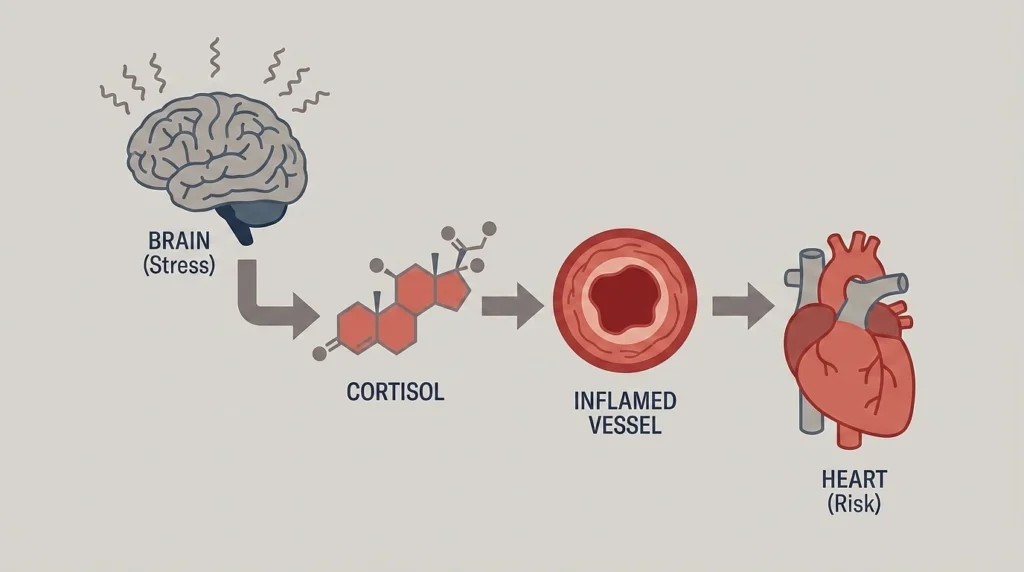
The Mechanism, In Case You’re Wondering:
- Chronic therapeutic psychological stress keeps cortisol elevated.
- Elevated cortisol drives systemic inflammation.
- Inflammation raises blood pressure, wrecks sleep, and messes with glucose regulation.
- The body settles into a low-grade pro-inflammatory state, which is basically the soil heart disease grows in.
The cardiologist sees the narrowed artery and treats it like a plumbing problem. Which it kind of is. But the narrowed artery was a downstream effect of something the cardiologist was never trained to ask about.
And this isn’t a one-way street. The INTERHEART study, published in The Lancet in 2004, looked at heart attack risk factors across 52 countries. Psychosocial stress came out as one of the top contributors, on par with high blood pressure. A meta-analysis in the American Journal of Cardiology of more than 800,000 patients found that depression roughly doubles the risk of coronary disease, even after adjusting for the usual suspects.
Body and mind aren’t on separate floors. They share a thermostat. Adjust one dial and the room never settles.
Read that last bit again. The disease was there. The decline wasn’t.
That’s the layer the priest was working in, whether he called it that or not. My friend had lost something he couldn’t name. His arteries and his anxiety were both downstream of that loss.
The Loop That Closes Around You
Here’s why all of this matters, and why I won’t shut up about it at dinner parties anymore.
The three layers don't just sit politely next to each other. They feed each other in a loop. And when that loop runs in the wrong direction, it's almost impossible to break in one place.
Picture it. You sleep badly for a few weeks. Could be work, could be a new baby, could be grief, could be the news cycle. Sleep deprivation hikes your baseline anxiety and shortens your emotional fuse. The anxiety makes social contact feel like hard work, so you pull back from the people who would normally anchor you. Pulling back erodes the sense of belonging that gives ordinary life its meaning. Loss of meaning makes the small daily disciplines the walk, the cooked meal, the quiet half hour feel completely pointless. The body responds to the loss of those disciplines with worse sleep, higher inflammation, weight gain, and the early metabolic changes that quietly set you up for heart disease and diabetes.
The cardiologist will see the result of all that in ten years. The therapist will see it in two. The priest, if there’s one in the picture, will see it in six months when you walk in not knowing why you came.
But and this is the part that makes me hopeful the loop runs the other way too. A short walk after dinner improves your mood through mechanisms we now understand pretty well, including better vagal tone and a rise in BDNF (basically a fertiliser for your brain). Better mood makes the next conversation with your partner or your best mate go a little better. That conversation strengthens the relationship. The relationship feeds the sense of belonging. The belonging feeds meaning. Meaning makes tomorrow’s walk easier to put on. Body benefits. Mind benefits. Spirit benefits. The loop runs forward.
This is exactly why treating one layer in isolation tends to fizzle:
- The patient handed blood pressure medication, but with no help for the chronic stress driving the pressure up, will comply for six months and then quietly drift off.
- The person meditating daily on four hours of sleep and a diet of convenience food will not feel what the practice is meant to deliver.
- The committed churchgoer with untreated depression will not be reached by the Sunday sermon.
Building A Holistic Care Network Where You Actually Live
If you’re reading this and thinking “great, but I’m in north Austin, not Cambridge,” fair point. Here’s what it can look like on the ground:
- Medical and cardiac care. For first-line cardiac evaluation and ongoing management, the Research Boulevard corridor around 78759 is dense with options. Austin Heart’s Northwest clinic sits just up the road at 11149 Research Blvd, and the Heart Hospital of Austin and the wider St. David’s HealthCare cardiology network are both within easy reach. From an office like 4807 Spicewood Springs Rd, any of them is a short drive for a first consult and ongoing follow-ups.
- Mental health and therapy. Licensed psychotherapists, clinical psychologists, and psychiatrists practice all through north and northwest Austin. A directory like Psychology Today’s therapist finder makes it easy to filter by location and specialty. Plenty now run telehealth sessions too, which kills the travel barrier and makes weekly continuity actually realistic for working people. Use it.
- Spiritual and pastoral support. This is the layer that doesn’t need a referral. It’s accessed through whichever religious leader, imam, priest, or community elder you already trust. The point isn’t the credential on the wall. It’s regular contact and honest conversation.
The model isn’t waiting for the medical system to integrate itself. It’s patients and families putting the three pieces together themselves, and asking each professional to know that the other two exist.
What You Can Actually Do Tomorrow
Nobody needs to overhaul their entire life to start shifting this loop. The research is genuinely consistent that small sustained changes across all three layers will outperform dramatic effort in any single one. So:
- Move. A twenty-minute walk most days. Not heroic. Just consistent.
- Connect. One honest conversation a week with someone who actually knows you. Not a vent. A real one.
- Reflect. A short, regular practice of reflection, prayer, journaling, or just sitting still in a quiet room whichever fits the life you actually have.
- Sleep. Sleep that starts and ends at roughly the same time. Yes, even on weekends. I know. I’m working on it too.
None of these are heroic in isolation. Stack them, and they shift the underlying system the cardiologist, the therapist, and the priest are each trying to repair from their own angle.
My friend, by the way, is doing better. The statin’s helping. The therapy’s helping. And he’s started having a quiet half-hour every Sunday morning before anyone else in the house is up. He’s not even sure what he calls it yet. But he says he feels like himself again, which, in the end, is the whole point.
The question was never which of the three professionals he needed. He needed all three, and he needed them to know they were treating the same patient.
That, more than any single intervention, is what holistic health actually means.
Over to you. Of the three layers body, mind, and the sense of meaning behind both which one have you been quietly neglecting? And what’s the one small thing you could do this week to nudge the loop in the right direction? Tell me in the comments. I read every one.

