


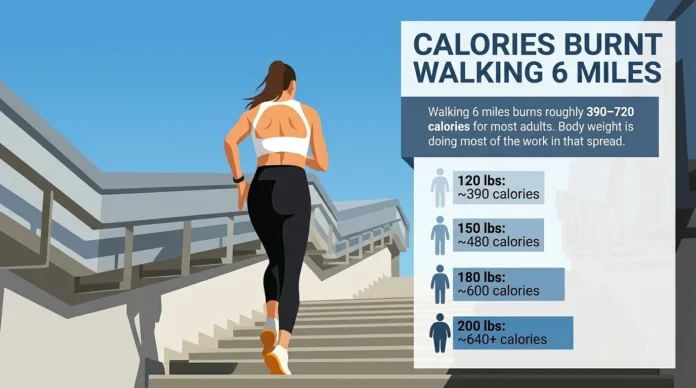
Walking 6 miles burns roughly 390–720 calories for most adults. Body weight is doing most of the work in that spread.
- 120 lbs: ~390 calories
- 150 lbs: ~480 calories
- 180 lbs: ~600 calories
- 200 lbs: ~640+ calories
Pace adds a little. Incline adds a lot. The walking distance of six miles, at a “normal walking pace” of 90 minutes to 2 hours, on its own surpasses the weekly walking goal that health care professionals and the CDC have been urging for the past few years.
Walking 6 miles is the distance at which walking begins to cease to be incidental. One doesn’t stumble 6 miles. You think about it, you put on different shoes and you begin to realize at about mile four that all your hard work is really contributing to something that you can measure.
The Numbers, Weight By Weight
The calorie burn for a 150-pound person for a walk of 3.0 mph on level ground is around 80 calories per mile. If that person is pushed up to 200 pounds, the per mile burn is about 105-110. Reduce them to 120 pounds, and it comes closer to 65. Those slight differences in per mile amounts add up to a significant difference over 6 miles.
The reason is mechanical, not metabolic. Heavier bodies need more energy to move forward, your heart works harder to keep them supplied, and your stabilising muscles do more on every step.
Here’s the working table most people actually want:
| Body weight | Calories per mile | 6-mile total |
|---|---|---|
| 120 lbs | ~65 | ~390 |
| 140 lbs | ~75 | ~450 |
| 150 lbs | ~80 | ~480 |
| 180 lbs | ~100 | ~600 |
| 200 lbs | ~106 | ~636 |
| 220 lbs | ~115 | ~690 |
These figures use the standard MET method a moderate 3.0 mph walking pace is rated at 3.5 METs in the published compendium of physical activities, the same reference set researchers and clinicians have used for decades.
A caveat the textbooks state plainly and most blogs skip MET values were never designed to estimate energy cost for individuals. They were built for population-level epidemiology. Your actual burn can sit above or below the figure depending on biomechanics, fitness, and how efficiently you move. Treat the table as a working estimate, not a verdict.
Why the “100 Calories Per Mile” Rule Fits Almost Nobody
You’ll see the round-number version everywhere “walking burns 100 calories a mile” and it’s a useful shorthand for people in the 150–170-lb range and almost nobody else.
A 125-pound hiker who thinks that the rule will overestimate their burn by nearly 35% for each hike. That’s a big issue if someone is using walking as a weight management tool, and they do this every day. They believe they’ve consumed 100 calories. They’ve banked 65. That’s approximately 4,000 calories they’re undercounting over the course of the month of six-mile walks.
The fix isn’t fancier math. It’s matching the per-mile figure to your actual weight.
Pace: Smaller Effect Than You’d Think
Speeding up burns more calories. But on flat ground, the increase is modest.
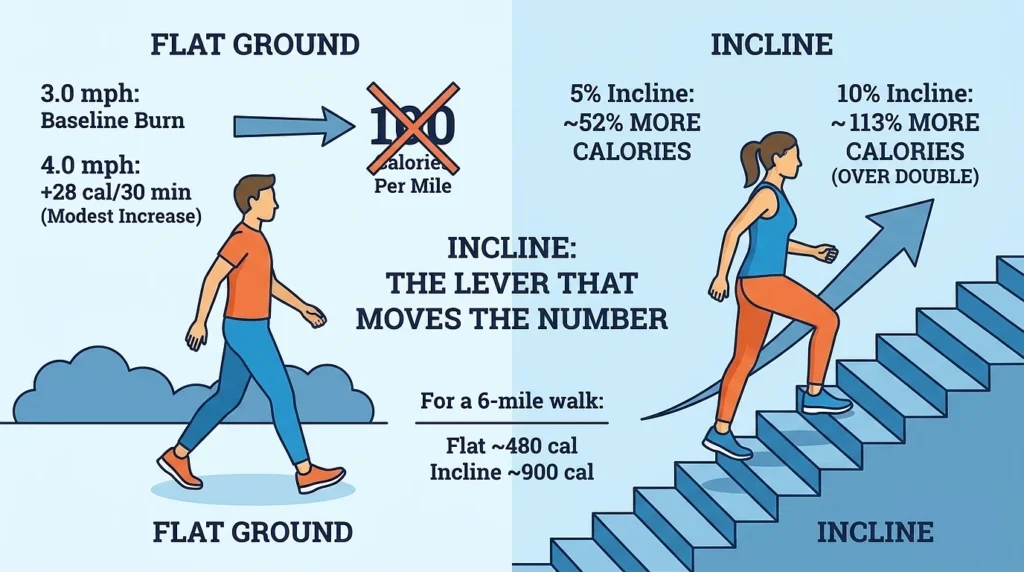
Going from 3.0 mph (a comfortable moderate pace) to 4.0 mph (a brisk walk where you can talk but not sing) adds roughly 28 calories over 30 minutes for an average adult. Stretched across six miles, that’s an extra 60–80 calories at the higher pace. Useful, but nowhere near a doubling.
Why so little? Walking is biomechanically efficient. Your body holds its energy reserves in good condition within its normal range of walking speeds, and even a brisk walk doesn’t significantly impair the efficiency of your body’s energy reserves. But as soon as you get past about 4.5 mph, most walkers unconsciously switch to jogging because, according to a quirk in human locomotion that has been demonstrated in several walk-a-jog studies, walking faster requires more energy than running.
The interesting trade-off with pace is time, not calories. At 3.0 mph, six miles takes two hours. At 4.0 mph, ninety minutes. For most people, the bigger question is whether they have the time, not whether the faster version burns enough extra to matter.
Incline: The Lever That Actually Moves the Number
Walking on an incline isn’t a slightly harder version of flat walking it’s a structurally different activity. Every step now has a vertical component, and lifting your body against gravity is genuinely expensive in energy terms.
The numbers from the ACSM walking equation are stark:
- Flat ground, 3.0 mph: baseline burn.
- 5% incline, 3.0 mph: roughly 52% more calories burned.
- 10% incline, 3.0 mph: roughly 113% more over double.
In 2017, a study in the Journal of Biomechanics carefully quantified these energy increases at each angle of each joint and over each range of each force level and determined that walking uphill is one of the most consistent energy expenditures of human motion once grade is taken into consideration. Incline is by far the more efficient lever movement than simply increasing your walk rate. Every 122 cal/30 min is approximately the amount of calories burned with 8% grade at 3.0 mph. The addition of 1.0 mph of pace, at flat grade, only contributes 28.
For a six-mile walk, this is the difference between a 480-calorie session and a 900-calorie session. Same time on your feet, same distance, very different outcomes.
If your goal is to extract more from the time you’re already spending, find hills before you find a faster pace.
What Most Calculators Don’t Capture
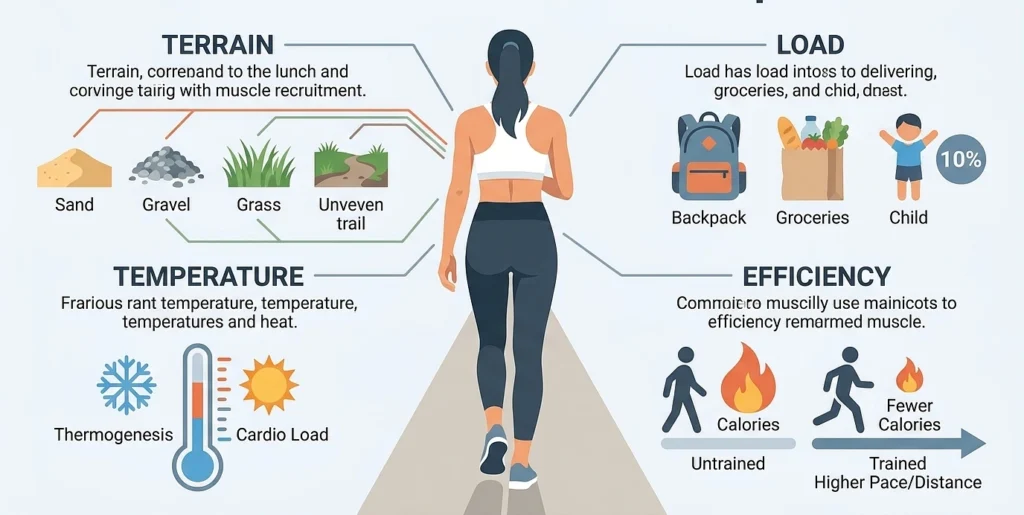
A few variables that don’t show up in MET tables but do show up in real walks:
- Terrain. Sand, gravel, grass, and uneven trails recruit your stabilising muscles harder than pavement. Not a dramatic effect minute-to-minute, but real over six miles.
- Load. Carrying a backpack, groceries, or a child shifts the equation immediately. A 10% body-weight pack pushes burn up noticeably. Ankle and wrist weights, on the other hand, alter your gait and tend to cause more problems than calories.
- Temperature. Cold air costs you a little extra through thermogenesis. Heat costs you a little extra through cardiovascular load. Neither is huge.
- Efficiency. Trained walkers burn slightly fewer calories at the same pace than untrained walkers because their bodies have learned to do the work with less waste. This sounds discouraging but it isn’t fitter walkers can sustain higher paces and longer distances, which more than compensates.
What Six Miles Actually Does for You, Beyond the Calorie Count
The interesting research on walking isn’t really about calories at all. It’s about what regular walking does to long-term mortality, cardiovascular risk, and metabolic physical health.
A meta-analysis of several cohort studies showed that walking for 30 minutes daily, 5 days a week, reduced risk of coronary heart disease by 19%. Two or three times a week, a 6-mile walk is more than enough.
A 2025 European Society of Cardiology study on people with high blood pressure tracked daily step counts against major adverse cardiovascular events. Each additional 1,000 steps above a baseline of 2,300 was linked to a 17% reduction in MACE risk, up to around 10,000 steps. People whose fastest 30-minute walking pace averaged 80 steps per minute had a 30% lower risk than slower walkers.
Six miles is roughly 12,000–14,000 steps for most stride lengths. If you do it at any reasonable pace, you’ve cleared the activity volume that the cardiovascular evidence keeps pointing at.
Practical Framing
When choosing diet, the number of calories is not as important, but the diet itself is more important, especially if you are walking 6 miles. Walking 480 calories is very helpful. Plus it’s one fairly decadent lunch. The walking habit doesn’t work as the all-encompassing solution, it’s only one part of the solution.
When it comes to walking for general health, the number of calories isn’t the most important thing. You have already surpassed the level of activity needed to get a measurable cardiovascular benefit and consistency is more important than any one session.
In order of usefulness (without increasing the time spent burning): increase the incline first, increase the weight a bit second, increase the pace a bit third. Most casual walkers do it the other way around and ask themselves why their tracker isn’t moving that much.
References
- 2024 Adult Compendium of Physical Activities (Herrmann SD, Willis EA, Ainsworth BE, et al.), published in the Journal of Sport and Health Science: https://www.sciencedirect.com/science/article/pii/S2095254623001084
- TrainCalc – ACSM walking equation reference and calculations: https://traincalc.com/calculators/calories-burned-incline-treadmill-walking
- Silder A, Besier T, Delp SL – Predicting the metabolic cost of incline walking, Journal of Biomechanics: https://www.sciencedirect.com/journal/journal-of-biomechanics
- Murphy MH, Nevill AM, Murtagh EM, Holder RL – Walking: the first steps in cardiovascular disease prevention, PMC: https://pmc.ncbi.nlm.nih.gov/articles/PMC3098122/
- European Society of Cardiology – Walking further and faster linked to reduced cardiovascular risk in people with high blood pressure (2025): https://www.escardio.org/news/press/press-releases/Walking-further-and-faster-is-linked-to-a-reduced-risk-of-heart-attacks-heart-failure-and-stroke-in-people-with-high-blood-pressure/
- Healthline – Calories Burned Walking (per-mile and pace breakdowns): https://www.healthline.com/health/calories-burned-walking
- Harvard Health Publishing – Calories burned in 30 minutes for people of three different weights: https://www.health.harvard.edu/diet-and-weight-loss/calories-burned-in-30-minutes-for-people-of-three-different-weights