


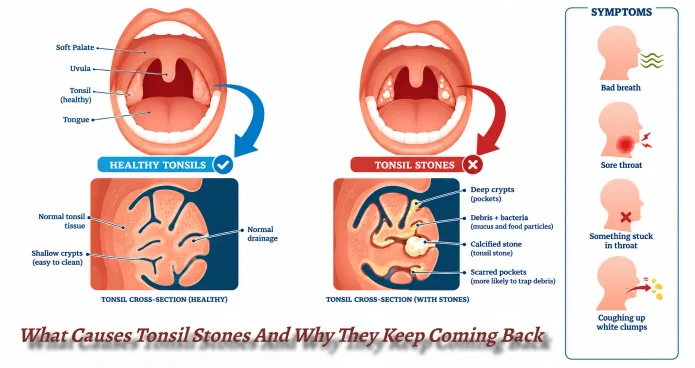
Ask a room of people whether they have ever had a tonsil stone and most will say no. Scan their necks and nearly half of them would be wrong. That was the finding when a dental hospital went back through 482 CT scans taken for other reasons: 46% had tonsil stones, and almost none of those people had ever noticed one. So the question isn’t why you get them. Most of us do. The question is why yours are big enough to cough up, smell the way they do, and come back a week after you’ve got rid of the last one.
A tonsil stone needs a pocket to grow in and a steady supply of rubbish to grow from, and some people have been dealt both.
What A Tonsil Stone Is Made Of
Your tonsils are riddled with pits, 10 to 30 of them on each side, called crypts. They’re meant to be there. Germs fall into them, the immune system gets a look, and the pit empties itself. That’s the theory, at least.
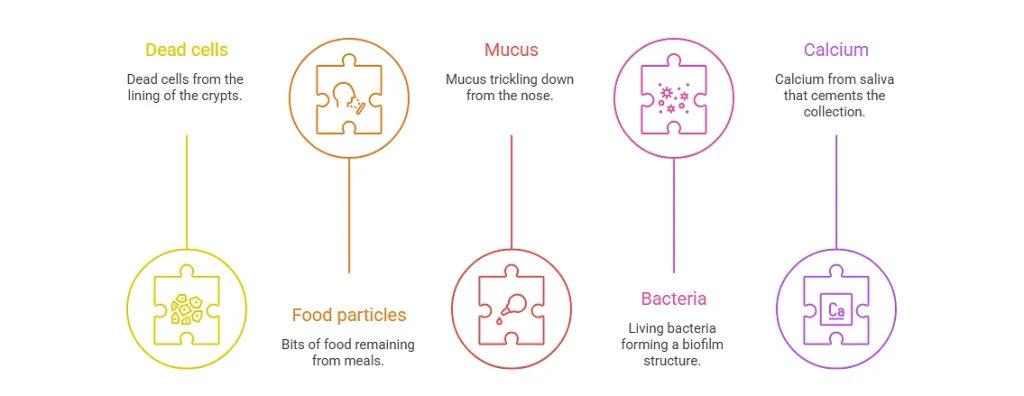
Some crypts don’t empty. Dead cells from the lining, bits of last night’s dinner, mucus trickling down from the nose, bacteria, all of it collects at the bottom where saliva can’t reach. Give it a few weeks and calcium from your spit cements it into something firm, the same way plaque turns into tartar on teeth.
Stone is the wrong word for it. A research group that cut one open and put it under a microscope found a living thing, not a pebble. Layers of bacteria wrapped in slime of their own making, still alive on the outside, calcified in the middle. A biofilm, in other words, the same family of structure as the gunk inside a drain. Which is why they smell. Those bacteria give off the sulphur gases behind bad breath, and in one Brazilian clinic, patients with a tonsil stone were roughly 10 times more likely to fail a breath test than patients without.
Why Some People Get Tonsil Stones And Others Never Do
There’s no one answer, but there’s one that matters more than the rest.
Scarred Tonsils With Deep Pockets
Every bout of tonsillitis leaves a scar, and scarring drags the crypts wider and deeper. Someone who had a sore throat every winter as a child, or a run of strep infections in their teens, ends up with tonsils that catch everything and let nothing go. Doctors call them cryptic tonsils. Look in the mirror with a torch and you may see white specks sitting in the holes even when your throat feels fine.
This is the part you can’t change, and it’s the reason your partner, who had tonsillitis once in 1998 and never again, has no idea what you’re talking about.
What Feeds The Pockets
The second half is supply. The crypts fill faster when more lands in them.
- Post-nasal drip. Hay fever, sinusitis, a bent septum. Mucus runs down the back of the throat all day and the crypts drink it in. People with allergies often notice their stones get worse in June and better in October, which is not a coincidence.
- A dry mouth. Saliva is the rinse. Mouth breathing at night, snoring, antihistamines, antidepressants, some blood pressure tablets, not drinking enough, smoking. All of them leave the crypts sitting in their own debris for longer.
- Age. Children hardly ever get them, because their crypts are shallow. The scan study found a sharp jump after 40 and a steady rise after that.
The Dairy Question
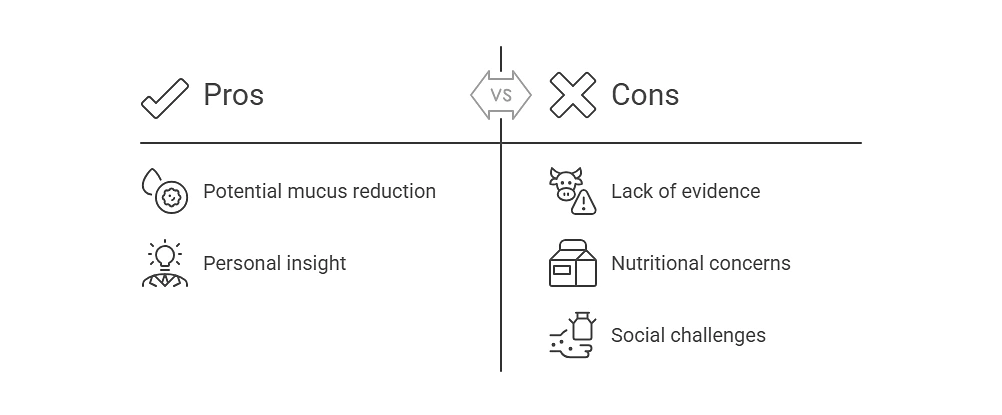
Half the internet will tell you to stop drinking milk. No trial has ever tested it. ENT Scotland’s advice sheet for doctors lists a dairy-free diet among the things patients try, alongside salt water gargles, and says plainly that none of them has solid evidence behind it. Milk does thicken mucus for some people, though, so a month without it costs nothing and will tell you more than any forum post.
Why Tonsil Stones Keep Coming Back After You Get Rid Of Them
Because you removed the stone and not the pocket. Same crypt, same shape, same drip feeding it. A new one starts the day the old one leaves.
Picking at them makes it worse, and not only a little. A cotton bud or a fingernail breaks the surface of the biofilm and leaves the base of it behind, so the next stone gets a head start. Worse, poking at tonsil tissue scars it, scars deepen the crypts, and deeper crypts grow bigger stones. The habit that clears today’s stone builds next month’s. People who have been at it for years often have crypts you can see from across the bathroom.
What Cuts Down Tonsil Stones Without Surgery
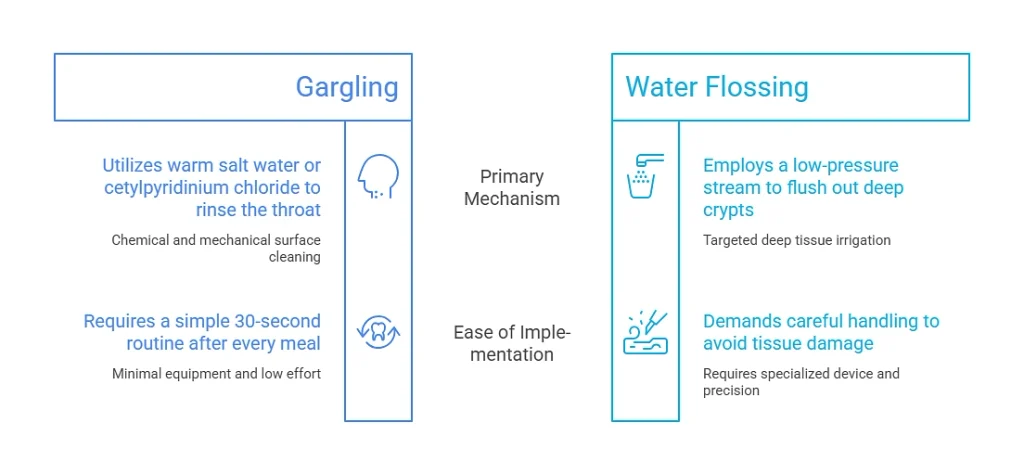
Nothing on this list reshapes a tonsil. All of it reduces what goes in.
- Gargle after eating. Warm salt water, or a mouthwash with cetylpyridinium chloride in it. Head back, 30 seconds, every meal if you can be bothered.
- A water flosser on the lowest setting, aimed at the tonsil, flushes a crypt far better than any gargle. Low pressure only, because a hard jet will tear the tissue and you’re back to scarring.
- Scrape your tongue. The back of the tongue carries the same bacteria that live in the stones.
- Fix the nose first. A saline rinse, a steroid nasal spray for hay fever, treating the sinus infection. For a lot of people this does more than anything they do in the mouth, because it turns off the tap.
- Drink water, and look at your tablets. If one of them is drying your mouth, a pharmacist can often suggest a swap.
One thing to avoid is the mouthwash that burns. Alcohol based rinses dry the mouth out, and a dry mouth is where this started.
When Surgery Makes Sense For Tonsil Stones
For most people it doesn’t. Stones are a nuisance, not an illness. But a few get them every few days, with breath that nothing fixes and the constant feeling of something stuck, and those people have 2 options.
Laser Or Coblation Cryptolysis
An ENT surgeon smooths the surface of the tonsil under local anaesthetic, sealing the crypts so they can’t hold debris. About 20 minutes in a clinic chair, back to normal food within a day or two. Stones can return if new crypts open up, and some people go back for a second round. In Britain it’s almost always private, and the going rate sits somewhere in the low thousands.
Tonsillectomy
Taking the tonsils out takes the crypts with them, and it’s the only thing that ends stones for good. It’s also a miserable fortnight, with real pain and a small but genuine risk of bleeding. ENT Scotland has said in writing that tonsillectomy for stones alone is not a good use of NHS resources and shouldn’t be offered on the NHS for that reason. Surgeons will think about it when the stones come with repeated tonsillitis or a tonsil big enough to be causing other trouble.
One stone on one side only, getting bigger, with pain, trouble swallowing or a lump in the neck, is a different matter and wants a GP appointment, because a couple of other things can look like a tonsil stone and those need ruling out.
Give the water flosser and the nasal rinse 6 weeks together before deciding anything bigger, and if the stones are still turning up every few days after that, ask your GP for an ENT referral and take a photo of your tonsils with you.

