


The first time my daughter said no to the potty, she said it politely. The fourth time, she lay face down on the bathroom floor and screamed until the neighbour knocked. She was 2 years and 5 months, she’d shown every sign of being ready, and I’d bought the little frog potty and the sticker chart and read the book with the cartoon owl. None of it mattered. She’d decided, and she was far more stubborn about it than I was.
If you’re here, your toddler has probably said no too. Maybe loudly, maybe by going stiff as a plank the minute you head towards the bathroom. Here’s what I wish someone had told me that week, and what eventually worked.
Why Toddlers Refuse The Potty Even When They’re Ready

It’s rarely about the potty itself. Between 2 and 3, toddlers are working out that they’re separate people who can say no, and their body is one of the few things they’re completely in charge of. You can’t make a child wee. They know it, and at some point they figure out that you know it too.
Other common reasons, in roughly the order I’d check them:
- It hurt once. A hard poo that stung can put a child off the potty for months, and they may not be able to tell you that’s why.
- It’s scary. The noise of the flush, the hole in the big toilet, the feeling of something leaving their body. These seem silly to us and huge to them.
- Something else changed. A new baby, a new childminder, moving house, even a parent going back to work. Toddlers often dig in on the one thing they can control.
- It’s become a battle. If every nappy change comes with “shall we try the potty?”, the potty now means pressure.
- They’re just not ready yet. Showing some signs isn’t the same as being ready in every way.
None of these mean your child is behind or that you’ve done something wrong. In a well-known US study that followed about 480 children through toilet training, around 1 in 5 refused to poo in the potty or toilet for at least a month. It’s that common.
Should You Stop Potty Training After A Refusal?
Usually, yes, for a bit. This was the hardest thing for me to accept, because stopping felt like losing. But carrying on while your child is refusing tends to turn a phase into a standoff, and the longer the standoff, the longer the whole thing takes.
Most children’s health guidance, including the approach doctors call child-led training, suggests putting nappies back on and taking a proper break of 1 to 3 months if a toddler is clearly resisting. Not a sulky break where the potty stays in the middle of the room and you keep mentioning it. A real one. Potty away, no talk about it, no stickers, nothing.
We took 6 weeks. It felt like forever. When we brought the potty back out, she walked over and sat on it by herself, fully clothed, to show her teddy. That was the real start.
How To Restart Potty Training Without A Fight
Let Them Watch, Not Perform
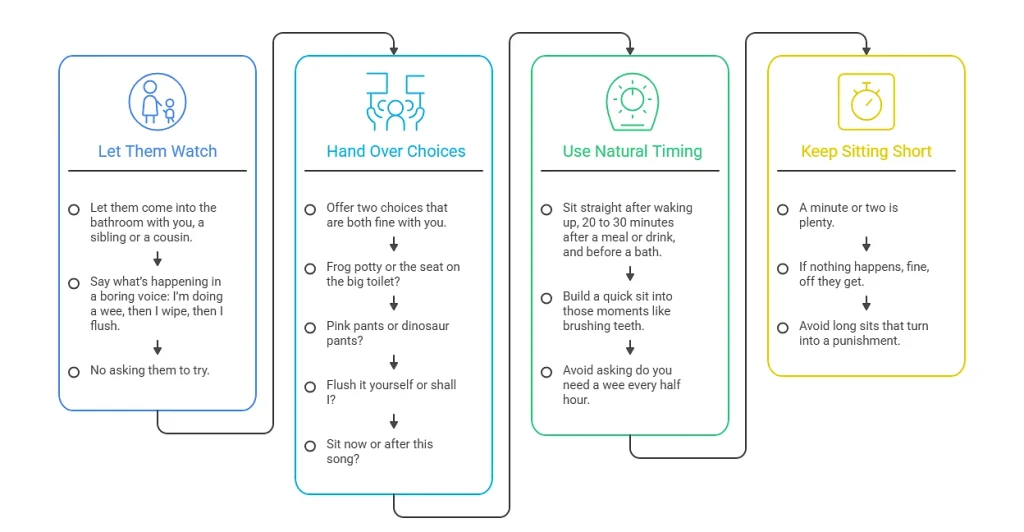
Toddlers copy. Let them come into the bathroom with you, a sibling or a cousin, and say what’s happening in a boring voice. “I’m doing a wee, then I wipe, then I flush.” No asking them to try.
Hand Over Small Choices
A child who’s refusing wants control, so give them some that doesn’t matter to you:
- Frog potty or the seat on the big toilet?
- Pink pants or dinosaur pants?
- Flush it yourself or shall I?
- Sit now or after this song?
Two choices, both fine with you. It’s the oldest trick in the parenting book, and it works because the child still gets to decide something.
Use Timing, Not Nagging
The most natural moments to sit are straight after waking up, about 20 to 30 minutes after a meal or a big drink, and before a bath. Build a quick sit into those moments like brushing teeth, rather than asking “do you need a wee?” every half hour. That question gets “no” every single time.
Keep Sitting Short
A minute or two is plenty. If nothing happens, fine, off they get. Long sits turn into a punishment, and a toddler who’s been kept on the potty for ten minutes won’t want to go back.
What To Do About Poo Refusal
Poo refusal is its own thing and deserves proper attention, because it can turn into a medical problem if it’s left.
Some toddlers will happily wee in the potty but ask for a nappy to poo in, or hide behind the sofa to go. If yours does this, give them the nappy. It sounds backwards, but a poo that comes out in a nappy is far better than a poo that’s held in for days. Holding it makes it bigger and harder, which makes it hurt, which makes them hold it even more.
The way out is usually in small steps, over weeks:
- Nappy on, but go in the bathroom.
- Nappy on, sitting on the potty.
- Nappy loosened while sitting.
- A hole cut in the nappy so the poo drops into the potty.
- No nappy.
Keep the poo soft in the meantime with plenty of water, fruit, veg and fibre, and ease off milk if they’re drinking a lot. If your toddler is straining, crying when they poo, going fewer than 3 times a week, or getting little smears in their pants, see your GP or doctor. Constipation is very often behind potty refusal, and a doctor may suggest a stool softener to break the cycle. That’s normal and it’s not a sign of failure.
What Helps And What Backfires

Some things made a real difference for us. Others I tried once and quietly abandoned.
Things That Tend To Help
- Calm praise. “You did a wee in the potty, well done” is enough. Some nervous kids find a big celebration more stressful, not less.
- Books and toys. A doll that “uses” the potty, or picture books where a character goes through the same thing.
- Accidents without drama. Clean up, change clothes, move on. “Wee goes in the potty” and nothing else.
- Their own step and seat. Feet flat on something helps them relax enough to go, especially for poo.
Things That Tend To Backfire
- Punishing or shaming accidents. It’s one of the surest ways to end up with a child who holds on.
- Bribes that grow. A sticker is fine. A new toy every wee is a negotiation you’ll lose.
- Comparing them to other children. “Your cousin’s already dry” means nothing to a 2-year-old except pressure.
- Forcing them to sit. Holding a child on a potty almost always makes the next attempt harder.
When A Refusing Toddler Needs A Doctor
Most potty refusal sorts itself out with a break and a gentler restart. It’s worth speaking to your GP or health visitor if:
- Your child is over 3 and a half and still refusing completely after a break.
- They seem to be in pain when they wee or poo.
- They’re constipated, or there’s blood in their poo.
- They were dry and have suddenly gone back to lots of accidents, which can sometimes be a urine infection.
- You’re worried about their development in other areas too.
It’s not a fuss to ask. Health visitors see this all the time.
This is based on my own experience and reading, not medical advice. Speak to your GP or health visitor if you’re worried about your child’s toileting or bowel habits.