



Somebody with type 2 diabetes who has spent years eating the way they were told to, lots of vegetables, fruit instead of candy, nuts instead of chips, brown bread instead of white, will eventually sit across from a renal dietitian and hear that a fair bit of that list now has to go. It doesn’t go over well. It sounds like being punished for doing the right thing.
It isn’t that. The foods were fine. What’s changed is the kidneys, which used to clean up the leftovers from all that healthy eating and now can’t keep up. That’s the whole story, and once that clicks, the rest of the list is easier to accept.
How Diabetes Gets To The Kidneys Without You Noticing
High blood sugar, year after year, scars the small filters in the kidneys. About 1 in 3 adults with diabetes has some degree of kidney damage. Most have no symptoms at all until a lab result turns up at a routine visit.
Two numbers tell the story eGFR, which estimates how well the kidneys are filtering (over 90 is normal, under 60 for a few months is chronic kidney disease, under 30 is advanced), and uACR, a urine test for protein leaking through, which often changes before the eGFR does.
When the filtering slows, things a healthy kidney would clear start to collect in the blood. Potassium. Phosphorus. The waste that protein leaves behind.
Sodium, which drags blood pressure up and speeds the whole thing along. Every food that ends up on a “cut this” list is there because of one of those four.
Don’t Start Cutting Foods Too Early
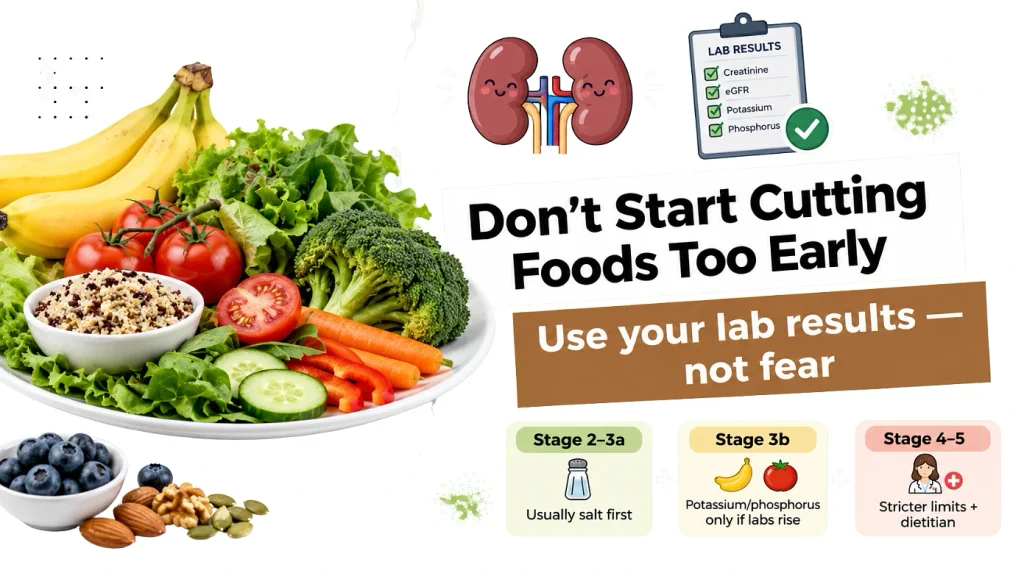
This is where a lot of people go wrong, and it’s usually from fear rather than bad advice. Somebody gets a stage 2 or 3a result, reads a kidney diet online, and stops eating bananas and tomatoes that same week. For most people at that stage, nothing about the food needs to change except salt.
The potassium and phosphorus limits generally start around stage 3b, when the eGFR is somewhere between 30 and 44, and even then only if the blood work shows those numbers climbing. By stage 4 the limits get stricter and a renal dietitian usually gets involved. At stage 5 the diet is rewritten properly, and rewritten again if dialysis starts.
The point is that the limits come from your own lab results, not from a stage number. Cutting fruit and vegetables you don’t need to cut makes blood sugar harder to manage, and the kidneys get nothing out of it.
Potassium: Why Bananas, Potatoes And Salt Substitute Go First
Potassium is what keeps the heart beating in rhythm. Normally the kidneys keep it in a tight range. When they can’t, it can climb high enough to stop the heart, which is why this is the first list a kidney patient sees and the one doctors are strictest about.
| Usually limited | What people switch to |
|---|---|
| Bananas, oranges, cantaloupe, kiwi | Apples, berries, grapes, pineapple |
| Potatoes and sweet potatoes | Rice, pasta, white bread, cauliflower |
| Tomatoes, tomato sauce, ketchup | Red bell pepper, a little fresh tomato |
| Cooked spinach, chard, kale | Cabbage, green beans, cucumber, lettuce |
| Avocado | Rarely, and a small amount |
| Dried fruit, juice, smoothies | Whole fresh fruit from the low list |
| Beans, lentils, nuts | Smaller servings, less often |
| Salt substitutes | Herbs, lemon, vinegar, pepper, garlic |
The salt substitute is the one that needs underlining. NoSalt, Nu-Salt, Morton Salt Substitute and most of the store brands are potassium chloride.
They sit on the shelf next to regular salt, aimed at people with high blood pressure, which describes nearly everyone with kidney disease.
For a kidney patient, that shaker is one of the most dangerous things in the grocery store, and ER doctors see the results of it every year.
Potatoes are worth a word too, because people miss them badly. There’s an old dietitian’s trick called leaching peel, cut small, soak in a big pot of water for a couple of hours, then boil in fresh water and drain.
It pulls out a good share of the potassium. The potato still counts, but a small serving once in a while becomes possible again.
Phosphorus: The Slow Problem With Dairy, Nuts And Whole Grains
Phosphorus does its damage quietly. When the kidneys can’t clear it, it builds up in the blood and starts pulling calcium out of the bones, then leaves that calcium in the walls of blood vessels. Nobody feels it. The labs catch it, and by then it’s been going on a while.
The main sources are dairy, nuts and seeds, beans and lentils, whole grains, and dark cola, which has phosphoric acid in it.
Dairy is the hardest because it’s in everything, so the usual advice is smaller portions rather than none, and checking plant milks for added phosphates. Nuts go from daily to occasional. Beans get smaller.
Whole grains are the one that throws everybody. After years of hearing “brown, not white” for diabetes, a dietitian at stage 4 or 5 will often say the opposite, because by that point the phosphorus in the bran costs more than the fiber gives. Same person, opposite advice, a couple of years apart. It isn’t a mistake. It’s the kidney diet and the diabetes diet pulling in different directions, and only somebody looking at your labs can say which one wins that round.
The Phosphate Additives Hiding In Food That Looks Fine
Natural phosphorus in food is only partly absorbed. The phosphates that manufacturers add to processed food get absorbed almost completely, so they hurt more than the nutrition label would ever suggest. They show up on ingredient lists as phosphoric acid, sodium phosphate, calcium phosphate, pyrophosphate, polyphosphate, basically anything with “phos” in it.
They’re in injected chicken and pork (the packages that say “enhanced” or “contains up to 15% solution”), lunch meat, American cheese, flavored water, cola, instant pudding, cake mix. And protein bars and shakes, which is the trap for diabetics, because those get picked as the low-sugar snack and plenty of them are loaded with the stuff.
How Much Protein To Eat When Both Conditions Are In Play
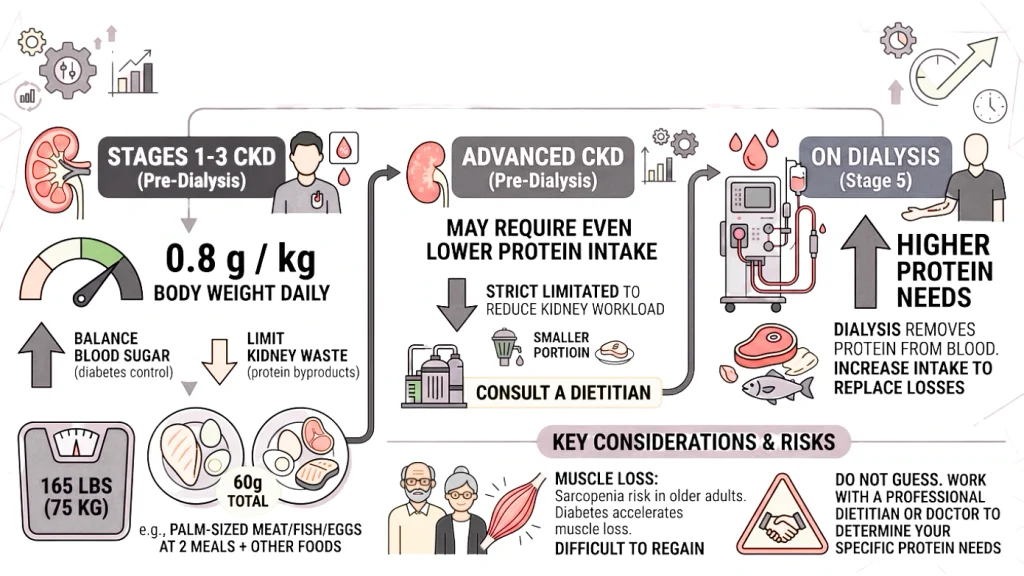
Protein leaves waste that the kidneys have to clear, so the high-protein eating that helps many people control blood sugar is off the table once kidney disease is confirmed. The number most dietitians work from for stages 1 through 3 is about 0.8 grams of protein per kilogram of body weight a day.
For somebody who weighs 165 pounds, that’s roughly 60 grams, which works out to a palm-sized piece of meat, fish or eggs at two meals and a little from everything else. Before dialysis it can go lower. On dialysis it goes back up, because dialysis takes protein out.
Going too low has a cost of its own. Older adults with diabetes lose muscle fast and get it back slowly. This is a number to settle with a professional, not one to guess at.
Where The Sodium Hides In “Healthy” Food
Salt raises blood pressure, and blood pressure is what pushes kidney damage forward. Most clinics aim for under 2,300 milligrams of sodium a day, often less, counting what’s already in the food. The places it hides on people who think they eat well: low-fat frozen meals and jarred sauces, where salt stands in for the fat; sugar-free cookies and anything labeled “diabetic”; bread, cereal and canned soup; bouillon, soy sauce and gravy mix; cheese, ham and smoked fish.
Lemon, vinegar, garlic and pepper at home beat any product with “kidney-friendly” on the front.
What A Day’s Eating Can Look Like At Stage 3b
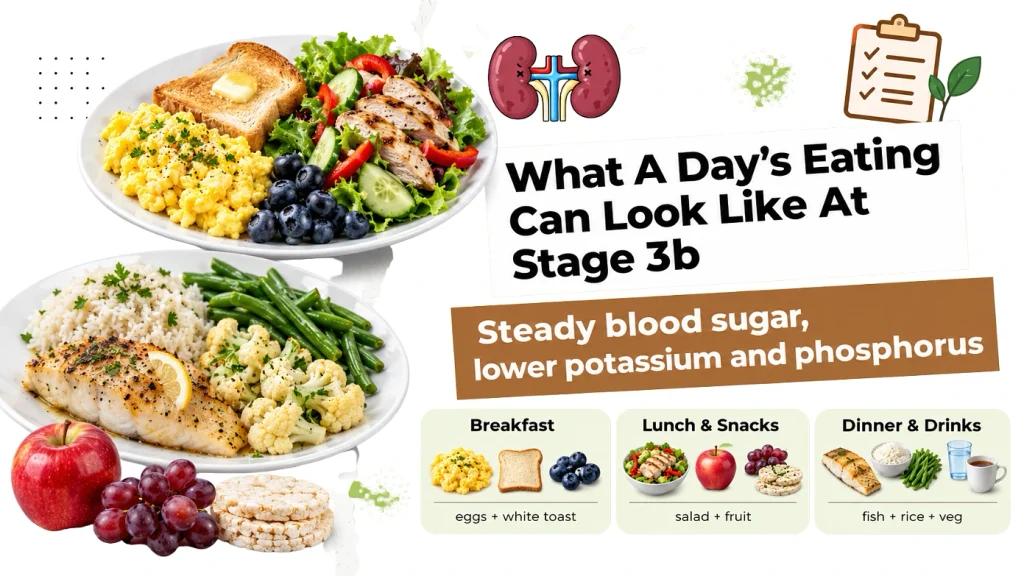
One example, for somebody whose potassium and phosphorus are starting to creep up and who still needs steady blood sugar. Every portion has to be checked against your own numbers.
- Breakfast: 2 scrambled eggs, a slice of white toast with a little butter, a handful of blueberries.
- Mid-morning: an apple, or a few plain rice cakes.
- Lunch: grilled chicken over lettuce, cucumber and red bell pepper with olive oil, and 2 small slices of white bread.
- Afternoon: some grapes, or a small plain yogurt if dairy is still allowed.
- Dinner: baked fish, white rice, green beans and cauliflower with lemon and herbs.
- Drinks: water, unsweetened tea or coffee. No soda, no juice.
Carbs get counted the way they always did. The change is which foods they come from.
Disclaimer: This is general information, not a substitute for a renal dietitian or doctor who has seen your lab results. Kidney diet limits are individual and they change over time.
References
- National Kidney Foundation, Diabetes and Kidney Disease: https://www.kidney.org/atoz/content/diabetes-and-kidney-disease-stages1-4
- National Kidney Foundation, Potassium and Your CKD Diet: https://www.kidney.org/atoz/content/potassium
- National Kidney Foundation, Phosphorus and Your Diet: https://www.kidney.org/atoz/content/phosphorus
- NIDDK, Diabetic Kidney Disease: https://www.niddk.nih.gov/health-information/diabetes/overview/preventing-problems/diabetic-kidney-disease
- American Diabetes Association, Kidney Disease (Nephropathy): https://diabetes.org/about-diabetes/complications/kidney-disease-nephropathy
- NIDDK, Eating Right for Chronic Kidney Disease: https://www.niddk.nih.gov/health-information/kidney-disease/chronic-kidney-disease-ckd/eating-nutrition