


A sore lump, or blood on the paper, and a quick search that turns up the word “surgery” far too early. Day four a bit better. Day ten: mostly gone, or stubbornly the same, and that’s where the real question starts.
Most hemorrhoids follow the first path. A minority follow the second, and knowing which one you’re on by the end of week two is more useful than anything else on this subject.
Hemorrhoids are swollen veins in and around the rectum. Everyone has the cushions of tissue they grow from; they only get a name when they swell, bleed, itch or push out.
Around three in four adults will have symptomatic ones at some point, and the great majority never see a doctor about them. That’s roughly right as a strategy, with a few important exceptions.
Which Hemorrhoids Clear Up On Their Own Within A Couple Of Weeks
Small ones do. Both kinds.
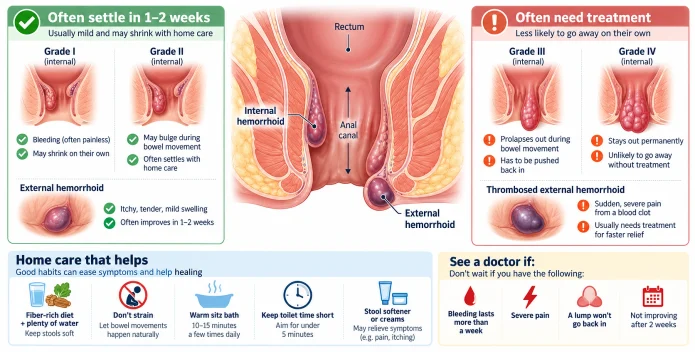
Internal hemorrhoids sit inside the rectum, where there are few pain nerves, so they usually announce themselves as bright red blood on the paper or in the bowl rather than as pain. Grade I ones, which bleed but don’t come out, and grade II ones, which push out during a bowel movement and go back in by themselves, generally settle within a week or two once the stool softens and the straining stops.
External hemorrhoids form under the skin around the anus, which has plenty of nerves, so they hurt, itch and feel like a lump. A simple swollen one also calms down over a week or two. The painful version is a thrombosed external hemorrhoid, where a clot forms inside the lump and it turns hard, purple and very tender.
That one is miserable but still self-limiting: pain peaks around the second or third day and fades over seven to ten days as the body dissolves the clot. A small skin tag is often left behind and is harmless.
Which Ones Tend To Stay Unless Something Is Done
Grade III internal hemorrhoids come out with a bowel movement and have to be pushed back in with a finger. Grade IV ones stay out and can’t be pushed back. Neither grade reliably shrinks on its own, because the tissue has stretched too far to recover. They can be lived with, and plenty of people do for years, but they won’t disappear through fiber alone.
Hemorrhoids that keep coming back every few weeks also count as “not going away,” even if each episode settles. Something is still driving them, usually constipation, long sitting on the toilet, or a job that involves heavy lifting, and until that’s dealt with the cycle repeats.
What Makes A Hemorrhoid Heal Faster At Home
Almost all of this is about making stool soft and getting it out without a fight.
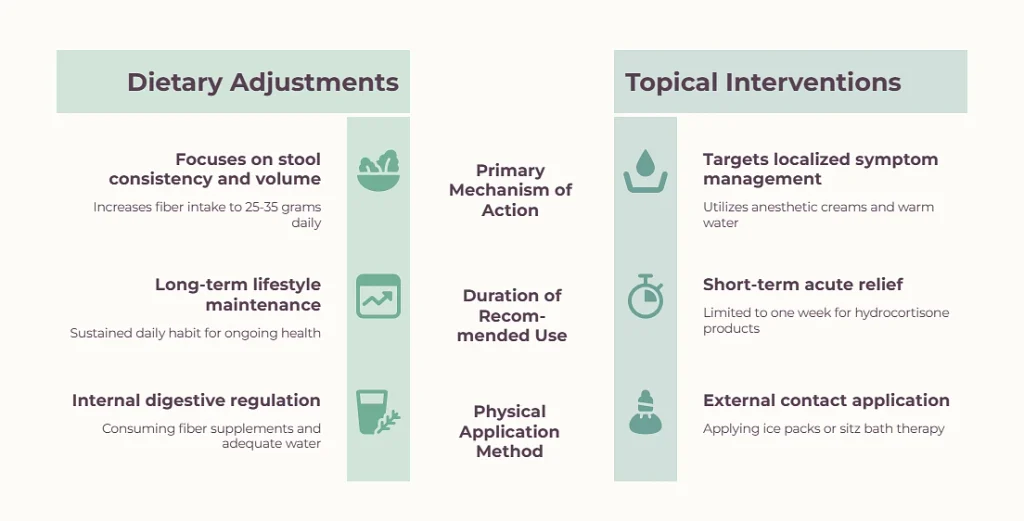
- Fiber to 25 to 35 grams a day. Fruit, vegetables, beans, oats, wholegrain bread. A psyllium supplement is the simplest way to get there if diet alone doesn’t; studies show it roughly halves bleeding and pain in people with hemorrhoids.
- Water, enough that urine is pale. Fiber without water makes things worse.
- Don’t strain, and don’t sit long. Go when the urge comes, aim for under five minutes, and leave the phone outside. Sitting on the toilet with the pelvic floor relaxed is what pools blood in those veins.
- Feet on a small stool so the knees are higher than the hips. It straightens the rectum and cuts straining.
- Warm sitz baths, ten to fifteen minutes two or three times a day, especially after a bowel movement. Plain warm water; no need for salts.
- Over-the-counter creams or suppositories with a local anesthetic or hydrocortisone for the itch and pain. Hydrocortisone products should stop after about a week, because longer use thins the skin.
- A stool softener such as docusate for a few days if the stool is hard despite the fiber.
- Ice wrapped in a cloth for a thrombosed external one in the first two days, then warmth.
- Keep the area clean and dry with water or unscented wipes rather than dry paper, which scrapes.
If this is all in place and things are improving by day seven, keep going. Most people are done by day fourteen.
When It’s Time To See A Doctor Rather Than Wait
- Bleeding that lasts more than a week, or any bleeding in someone over 45 to 50 who hasn’t had a colonoscopy. Hemorrhoids are the commonest cause of rectal bleeding, but colorectal cancer and polyps bleed the same color, and the only way to tell is to look.
- Dark or black stool, or blood mixed into the stool rather than on it. That points higher up the bowel.
- A change in bowel habit alongside the bleeding, unexplained weight loss, or feeling tired and breathless, which can mean anemia from slow blood loss.
- Severe pain, especially with a hard purple lump less than 72 hours old. A thrombosed hemorrhoid can be lanced under local anesthetic in that window and the relief is immediate; after three days it’s better left to settle.
- A hemorrhoid that’s out and won’t go back, particularly if it’s swollen, dark or very painful, which can mean the blood supply is cut off.
- Pus, fever, or a lump that feels deeper than the surface, which suggests an abscess rather than a hemorrhoid.
- Anything that hasn’t improved after two weeks of proper home care.
A doctor can usually tell what’s going on with a quick examination and, if needed, a short scope in the clinic.
What The Office Treatments Involve If Home Care Isn’t Enough
For internal hemorrhoids that bleed or prolapse and haven’t settled, there are three procedures done in an outpatient room with no anesthetic, each taking a few minutes.
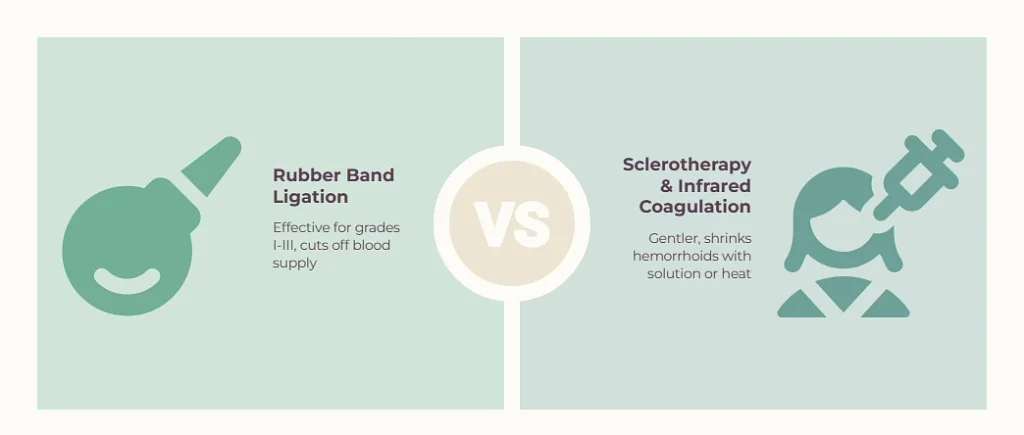
Rubber band ligation is the most common and the most effective. A tiny band is placed around the base of the hemorrhoid it cuts off the blood supply and the tissue falls off within a week. It works for grades I to III and about eight in ten people get lasting relief, though some need more than one session. Expect a dull ache and pressure for a day or two.
Sclerotherapy injects a solution into the hemorrhoid that shrinks it. It’s gentler, suits people on blood thinners who can’t have banding, and is used mostly for grade I and II.
Infrared coagulation uses heat to scar the base of the hemorrhoid so it shrinks. Similar range to sclerotherapy, often needs repeating.
When Surgery Is The Right
Surgery is for the minority: grade IV hemorrhoids, large grade III ones that keep prolapsing after banding, mixed internal and external disease, or a strangulated hemorrhoid that’s an emergency.
Hemorrhoidectomy, cutting the hemorrhoids out, is the most reliable fix and the least likely to recur. It is also the most painful recovery in this field, with two to four weeks of real discomfort and painkillers, and bowel movements that hurt for the first week or so. Surgeons reserve it for people whose symptoms justify that.
Stapled hemorrhoidopexy pulls prolapsing tissue back into place and staples it, with less pain afterwards but a higher chance of the problem returning. Hemorrhoidal artery ligation uses ultrasound to find and tie off the feeding arteries, also less painful, also with more recurrence than cutting.
A colorectal surgeon will steer this based on grade, how much the hemorrhoids affect daily life, and how much recovery time someone can afford.
Hemorrhoids In Pregnancy And After Childbirth
Pregnancy brings them on in a large share of women, through the weight of the uterus on the pelvic veins, hormones that relax vein walls, and constipation. They usually appear in the third trimester or straight after delivery, and the pushing of labor can make them dramatically worse for a few days.
The reassuring part: most pregnancy hemorrhoids shrink and disappear within a few weeks of the birth, once the pressure comes off. Home care is the same, with the caveat that any cream should be checked as safe in pregnancy, and procedures are almost always postponed until well after delivery because the problem so often resolves itself.
How To Stop Hemorrhoids Coming Back Once They’ve Gone
The habits that heal them are the habits that prevent them, and the ones that matter most are the dull ones. Enough fiber every day, not just during a flare. Going when the body asks rather than holding on. Five minutes on the toilet, not twenty. Lifting with a breath out rather than a held breath, which spikes pressure in the pelvic veins. Moving around during long shifts of sitting or driving. And treating constipation early, before it becomes a week of straining, because that week is where most hemorrhoids begin.
Disclaimer: General information, not medical advice. Rectal bleeding, severe pain, or a hemorrhoid that hasn’t improved in two weeks should be assessed by a doctor.