


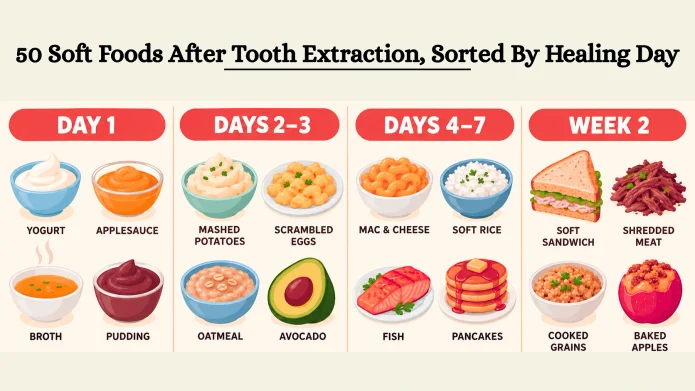
Ask anyone who’s had a wisdom tooth out what they ate that week and the answer is usually “mashed potatoes, for about six days, until I never wanted to see one again.” That’s the problem with the advice patients leave the office with. “Soft foods” is accurate but it isn’t a plan, and it doesn’t tell you that scrambled eggs are a bad idea Monday morning and a perfectly good idea by Monday night.
The list below is sorted by the day each food is safe, from the first 24 hours through the second week. It’s fifty foods because that’s roughly how many it takes to get through ten days without eating the same thing three times.
What Happens In The Socket, And Why Day Three Is The One To Respect
Within an hour of the tooth coming out, a blood clot fills the empty socket. The gum heals over the top of that clot, and the bone fills in underneath it over the following weeks. Lose the clot early and the bone is left bare. That’s dry socket. The pain is a deep throb that often shoots toward the ear, there’s a foul taste, and it usually shows up on day two, three or four. It happens after roughly 2 to 5 percent of extractions, more with lower wisdom teeth and in smokers.
The things that pull a clot out are suction (straws, cigarettes, spitting hard), heat, chewing on that side, and hard or crumbly food that gets packed into the hole. By about day seven the clot has been replaced by new tissue and most of the risk is gone. By two weeks nearly everyone is back to normal food, still a little careful on that side. The sorting below follows that timeline.
Day 1: Cold Or Lukewarm, Smooth, Spoon Only
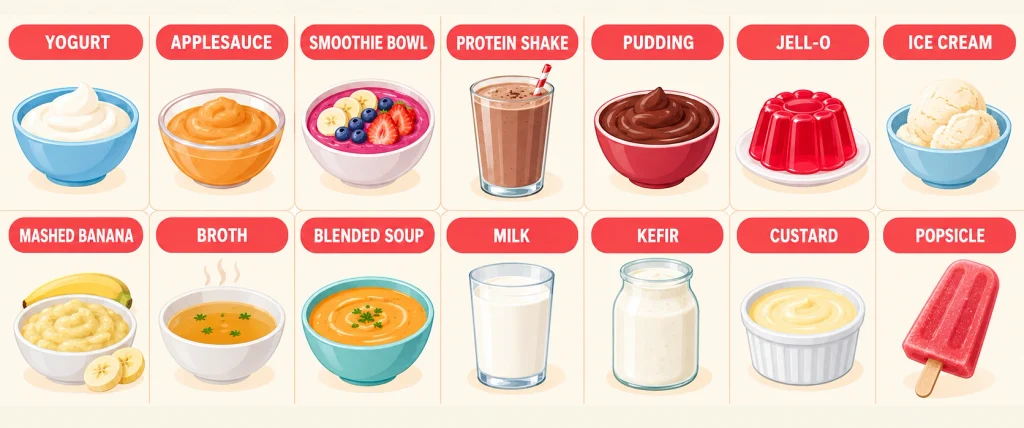
Nothing hot, nothing that needs chewing, nothing with bits in it, and no straws. Cold food also helps the swelling. Eat with a spoon, keep the head upright, and rinse with nothing at all today; even gentle swishing can disturb the clot in the first 24 hours.
- Plain yogurt, Greek or regular, no fruit chunks at the bottom.
- Applesauce. Cold from the fridge is nicer than room temperature today.
- A smoothie in a bowl, blended until there’s nothing to chew and strained if there were berries, because seeds find the socket.
- Protein shake, poured into a cup and sipped without tipping the head back hard, or eaten from a bowl like the smoothie.
- Pudding, any flavor. Rice pudding works if it’s run through a blender first.
- Jell-O. Easy, cold, and it counts toward fluids.
- Ice cream or soft serve with no nuts, cookie dough, or chocolate chunks. Vanilla is the safe pick.
- Mashed banana, as ripe as possible.
- Broth, lukewarm, from a spoon. Chicken, beef, or vegetable. Hot broth is one of the most common day-one mistakes.
- A cold blended soup, gazpacho or chilled cucumber, if the idea of sweet food all day is already wearing thin.
- Milk, cold, plain or with chocolate syrup.
- Kefir or drinkable yogurt, worth having if antibiotics were prescribed.
- Custard or flan, straight from the fridge.
- Popsicles, sucked gently. Some surgeons prefer patients skip these until bleeding has fully stopped, so ice cream is the safer bet on day one.
Days 2 And 3: Warm Food Is Back, Chewing Still Isn’t
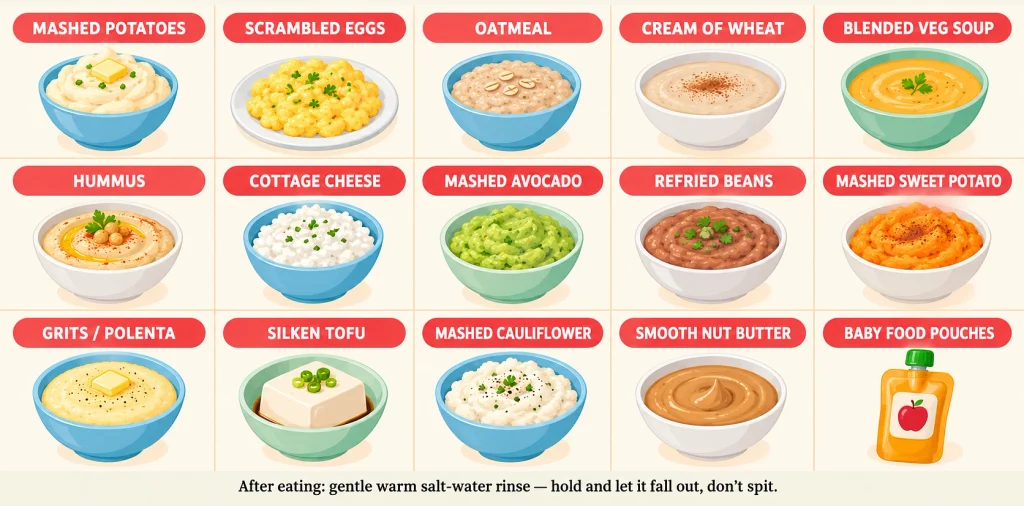
Bleeding should be done. Swelling and soreness usually hit their worst on day two or three, which is also the dry socket window, so the rules only loosen a little. Food can be warm now, as long as it’s not steaming, and it can have some texture as long as the tongue can mash it. Everything stays on the opposite side of the mouth. After eating, a gentle salt-water rinse, half a teaspoon in a cup of warm water, held in the mouth and let fall out rather than spat.
- Mashed potatoes, loose and buttery. Instant is fine. Nobody is judging.
- Scrambled eggs, cooked soft and a little wet.
- Oatmeal, cooked past the point you’d normally stop and left to cool a few minutes.
- Cream of Wheat or farina, smoother than oatmeal, good for anyone who can barely open their mouth.
- Blended vegetable soup: butternut squash, tomato, carrot, cauliflower, potato leek, whatever’s in the pantry, through the blender.
- Hummus, eaten with a spoon for now.
- Cottage cheese, small curd.
- Mashed avocado with salt and a squeeze of lime.
- Refried beans, warm, from a can is fine.
- Mashed sweet potato with butter and cinnamon.
- Grits or soft polenta, loose, with cheese stirred in.
- Silken tofu, cold with a splash of soy sauce or warmed in broth.
- Mashed cauliflower, for anyone sick of potatoes already.
- Peanut or almond butter, smooth only, stirred into oatmeal or yogurt. Not on bread yet.
- Baby food pouches. Not glamorous. Widely used by adults in exactly this situation.
Days 4 To 7: Soft Solids, Chewed Slowly On The Good Side
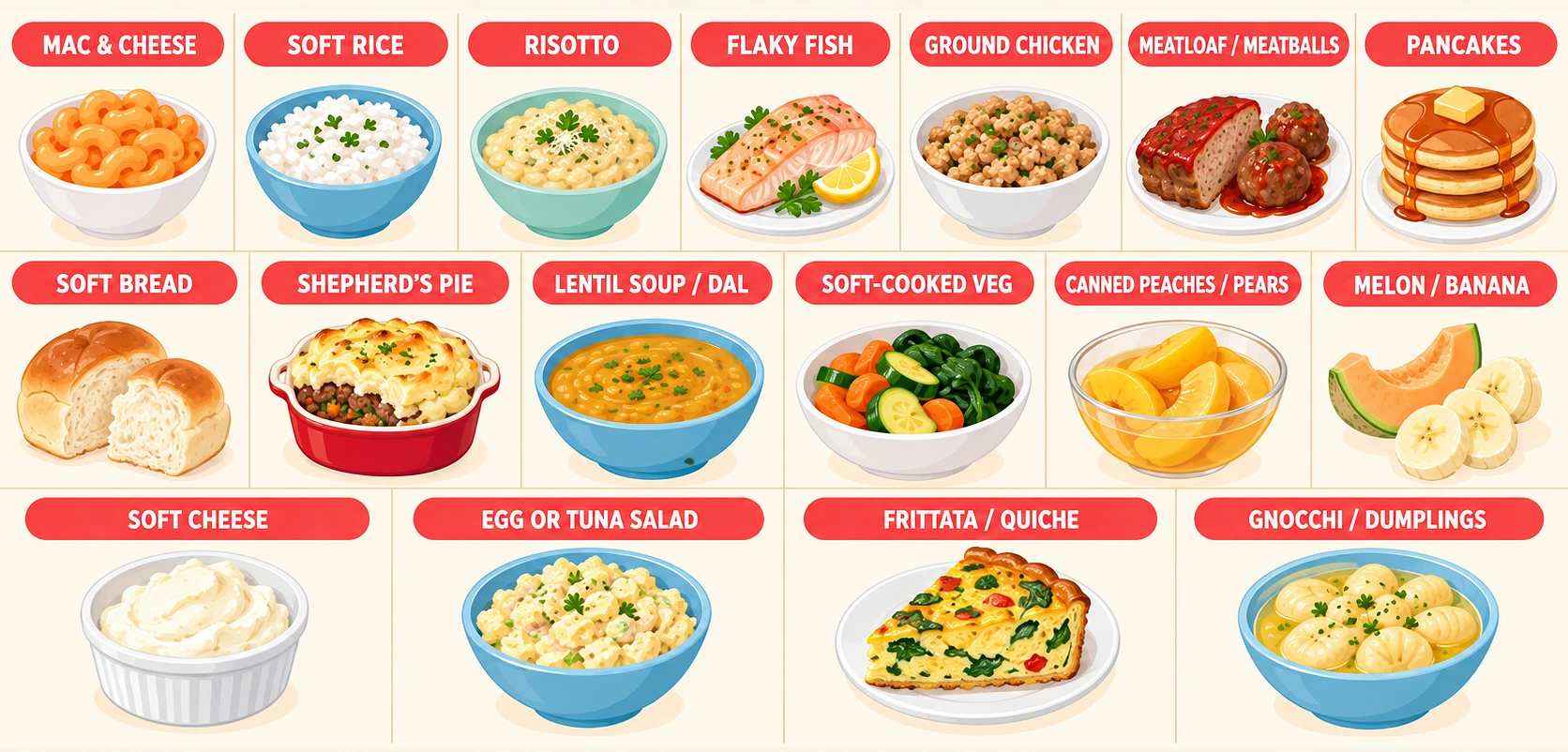
Pain should be easing. The clot is more stable. Soft solids come back, in small bites, chewed on the other side. Still no crunch, no small hard pieces, and no straws until at least day seven.
- Mac and cheese, or any well-cooked pasta with a smooth sauce. Overcook the pasta a minute or two on purpose.
- Soft rice, or congee, the rice porridge that most of Asia already eats when sick.
- Risotto.
- Flaky fish, baked or poached: cod, tilapia, salmon. Check for bones.
- Ground chicken or turkey simmered in sauce rather than browned crisp.
- Meatloaf or meatballs, moist, no crusty edge.
- Pancakes or French toast soaked in syrup until soft all the way through.
- Soft white bread with the crust cut off, or a soft dinner roll torn into pieces.
- Shepherd’s pie. Mashed potato on top, soft meat and vegetables underneath. Built for this week.
- Lentil soup or dal, cooked until the lentils fall apart.
- Soft-cooked vegetables: carrots, zucchini, spinach, peeled squash, boiled or steamed until a fork goes through with no resistance.
- Canned peaches or pears in juice.
- Overripe melon or sliced banana.
- Soft cheese: ricotta, cream cheese, brie with the rind off.
- Egg salad or tuna salad, mashed fine, without celery, onion, or pickle pieces.
- Frittata or crustless quiche.
- Gnocchi or soft dumplings in broth or butter.
Week 2: Most Foods Come Back, A Few Still Wait
By day eight to ten new tissue covers the socket and the diet opens up almost completely. What still waits is anything that could jam into the hole or needs real grinding: popcorn, chips, nuts, seeds, hard crusts, steak, jerky, chewy candy. For a simple extraction that’s usually two to three weeks. For a wisdom tooth, where the socket is bigger, closer to a month.
- Soft sandwiches on untoasted bread with soft fillings: egg salad, tuna, cream cheese.
- Shredded slow-cooked meat, pulled pork, braised chicken thighs, pot roast that falls apart.
- Cooked grains like couscous or quinoa, which are small but soft enough once the tissue has closed over.
- Soft cooked fruit: baked apples, stewed plums, a fruit crumble with the crunchy topping scraped off.
What To Keep Away From The Socket Until It Has Close
- Straws, for a week minimum. Suction is the number one cause of dry socket.
- Hot drinks and hot soup for the first three days. Warm is fine. Steaming is not.
- Alcohol for at least 24 hours, and for as long as pain medication is being taken.
- Smoking or vaping, ideally the whole first week. Both slow healing and multiply dry socket risk.
- Soda and sparkling water for the first few days; the fizz irritates the clot.
- Spicy food, which burns an open wound.
- Anything with seeds or crumbs: sesame, poppy, chia, strawberry seeds, popcorn hulls, crackers, granola. These are what end up packed in the socket.
- Crunchy or chewy food: chips, nuts, raw carrots, hard crusts, tough meat, gum, taffy.
- Very acidic food in the first two days, citrus and tomato especially.
Signs The Socket Isn’t Healing Right
Soreness that fades a little each day, swelling that peaks around day two or three, and some oozing in the first 24 hours are all normal. Call the dentist for any of these:
- Pain that gets worse after day three, especially a deep throb toward the ear or temple. That’s the dry socket pattern, and a dentist can pack the socket with a medicated dressing that relieves it within minutes.
- A bad taste or smell that rinsing doesn’t clear.
- Bleeding that won’t stop after 20 minutes of firm bite pressure on gauze or a damp black tea bag.
- Swelling still growing after day three, or a fever.
- Numbness in the lip, chin, or tongue that outlasts the anesthetic.
- Food stuck in the socket that a gentle rinse won’t move. The office can flush it out in two minutes with a syringe.
Disclaimer: General information, not dental advice. The dentist or oral surgeon who did the extraction may give different instructions for a particular case, and those come first.
References:
- American Dental Association, MouthHealthy: Extractions: https://www.mouthhealthy.org/all-topics-a-z/extractions
- Mayo Clinic, Dry socket: https://www.mayoclinic.org/diseases-conditions/dry-socket/symptoms-causes/syc-20354376
- Cleveland Clinic, Tooth extraction: https://my.clevelandclinic.org/health/treatments/22120-tooth-extraction
- NHS, Wisdom tooth removal recovery: https://www.nhs.uk/conditions/wisdom-tooth-removal/recovery/