


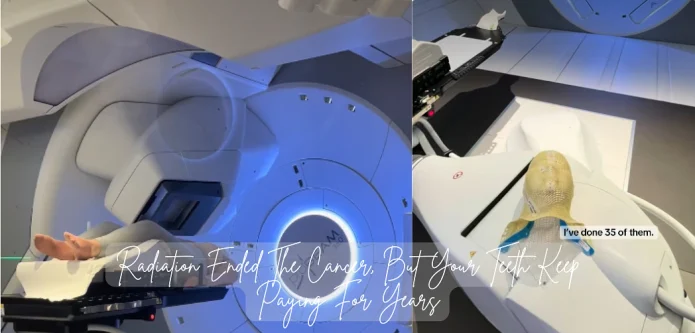
The cancer is gone, but the ghost of radiation therapy still haunts the dinner table.
Years after ringing the victory bell, many head and neck cancer survivors find themselves facing an unexpected, agonizing second battle: the rapid, painful decay of their teeth.
While radiation successfully destroys the tumor, it often leaves behind a permanent wake of collateral damage in the jaw, quietly robbing survivors of their smiles long after they are declared cancer-free.
The Radiation Does To Your Mouth In The First Place
It’s not complicated. The beams go through the tumour and out the other side, and in between they go through your salivary glands and your jawbone.
The glands get scarred. The little blood vessels in the bone get scarred too, and blood is what bone uses to repair itself.
Less saliva, less blood in the jaw. Every problem I’m about to describe comes from one of those two.
Mine was on one side, and they used the newer shaped beams (IMRT, the letters on my notes), so my left parotid gland was mostly spared. I know people who had both sides done twenty years ago on the old machines. Their mouths are a different level of dry from mine. It depends enormously on what you had and when.
The Dryness That Never Went Away
For the first six months my saliva was thick and stringy, like glue. Then it mostly stopped. My mouth is drier than it used to be, every day, and it’s been five years, and I’ve stopped waiting for it to come back.
What that actually means, day to day. Bread needs a drink to get it down. Crackers are impossible. I wake up at night and my tongue is stuck to my palate. I talk for ten minutes and my mouth goes claggy. Restaurants that bring bread and no water annoy me out of all proportion.
Things that have helped, roughly in order:
- Water. Always. On the desk, in the car, by the bed. Small sips, not gulps.
- Pilocarpine tablets, which squeeze more out of whatever gland tissue survived. They make me sweat and they don’t work for everyone, but for me they were the biggest single improvement.
- XyliMelts, the little discs you stick to your gum overnight. Odd at first. Now I can’t sleep without one.
- Biotène gel before bed and the spray in my pocket.
- Chewing gum with xylitol, constantly. My dentist encourages it.
- Throwing out the mouthwash. Anything with alcohol strips what little moisture you’ve got.
The Decay That Came Out Of Nowhere
This is the part nobody warned me about in a way that landed.
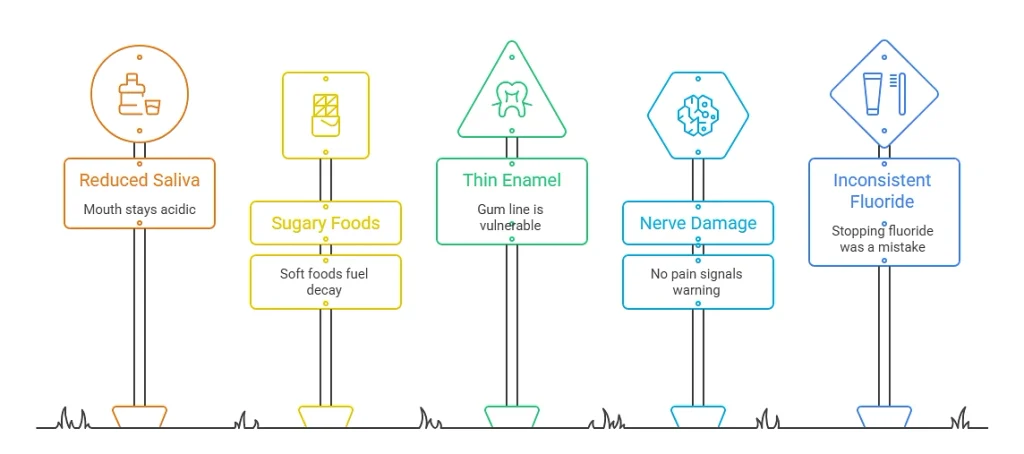
Before the cancer I had two fillings in fifty-three years. Within about a year of finishing treatment, I had decay in six teeth, all at the gum line, in a ring round the neck of each tooth. Nothing hurt.
Radiation can deaden the nerves, so you don’t get the warning. The first I knew was a molar snapping off at the gum while I was eating toast.
The dentist called it radiation caries and explained it flatly: no saliva, so the mouth stays acidic; soft sugary food through treatment; enamel thinnest at the gum line. It doesn’t behave like normal decay. It’s faster and it goes round the tooth like a collar.
The one thing that stops it, and I mean the one thing, is fluoride at a strength you can’t buy off the shelf.
I was given trays before treatment started, plastic mouthguards you fill with fluoride gel and wear for five minutes every night, and a 5,000 ppm toothpaste on prescription. I stopped using the trays around month eight because I felt fine and they were a faff.
That was a mistake I paid for with four teeth. I’m back on them every night now. Trays, gel, toothpaste, floss, for the rest of my life. My dentist says the decay has all but stopped since. I believe her because the last two check-ups found nothing new.
The Jaw Conversation I Wasn’t Ready For
When the molar broke, my normal dentist wouldn’t take the root out. She said, “Not in an irradiated jaw. Not here.” I didn’t understand why she looked so serious about a tooth.
The word is osteoradionecrosis. ORN. A patch of jawbone whose blood supply has been damaged by radiation can’t heal from an injury, and pulling a tooth is an injury. The bone can die, become exposed in the mouth, get infected, and in the worst cases the jaw breaks and a surgeon has to cut the dead section out.
It’s mostly the lower jaw. It’s more likely in the areas that got the highest dose. And the risk doesn’t fade with time. Fifteen years after radiotherapy, an extraction can still set it off.
Mine came out in the hospital, under an oral surgeon who had my radiotherapy plan on the screen beside her, with antibiotics before and after and a course of two tablets (pentoxifylline and vitamin E) for weeks either side to help the blood flow in the scarred tissue. It healed. I was lucky, and I was careful, and I’m aware those aren’t the same thing.
So: nobody touches an irradiated jaw without knowing it’s irradiated. I carry a copy of my radiotherapy summary now. New dentist, hygienist, emergency clinic on holiday, they get it before they get my mouth open.
The Jaw That Slowly Stopped Opening
About a year after treatment I noticed I couldn’t get a whole sandwich in. Then the dentist said she was struggling to fit the mirror. That’s trismus, the muscles and joint scarring and tightening, and it creeps. You don’t notice a millimetre a month until you’ve lost two centimetres.
I was given jaw exercises at the start and, again, let them slide. Stacking wooden tongue depressors between your teeth and adding one at a time. Boring. Slightly ridiculous. I do them every morning now, and I measure the gap with a ruler on Sundays, because once you’ve lost opening it’s very hard to get back and much easier to stop losing.
The Smaller Things
Taste came back, mostly, over the first year, but salty things still taste of tin. I get thrush in my mouth if I’m run down, white patches that taste foul, and a week of drops sorts it. Crusty bread cuts the roof of my mouth. My bottom denture, which replaced three of the four lost teeth, has to be checked constantly for rubbing, because a sore patch on an irradiated jaw is a sore patch that might not heal.
None of these are dramatic on their own. They’re just there, every day, and they all trace back to the same two things.
What My Life Looks Like Now, Dentally Speaking
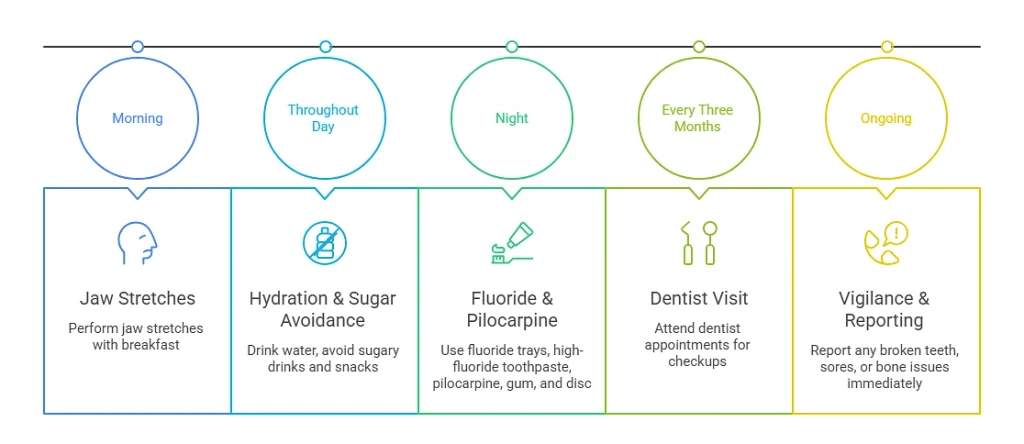
- Dentist every three months. Not six. Not twelve.
- Fluoride trays every night, high-fluoride toothpaste twice a day, soft brush, floss.
- Water bottle, pilocarpine, gum, disc at bedtime.
- Jaw stretches with breakfast.
- Almost no sugar, and never anything sweet sipped over hours.
- The radiotherapy summary in my wallet.
- Anything broken, any sore that hasn’t healed in two weeks, any bone I can see or feel, and I ring the same day.
Written out, it looks like a lot. It’s about fifteen minutes a day. The tooth I lost cost me two months of appointments and a hospital extraction, so the fifteen minutes is cheap.
Why I’m Writing This Down
I’m not angry with the hospital. When you’re being fitted for a mask and your wife is crying in the car park, “your teeth will be a problem for the rest of your life” is not what anyone wants to hear, and I probably wouldn’t have taken it in.
But I’d have taken in the trays. I’d have understood “use these every night or you’ll lose teeth” if someone had said it exactly that way. So that’s what I’m saying, to whoever’s reading this with the mask still fresh in their mind. The radiation ends. The mouth it leaves behind is yours to look after for good, and the boring nightly stuff is what decides how that goes.
Disclaimer: Written from my own experience, not as medical or dental advice. If you’ve had head and neck radiotherapy, talk to your oncology team and a dentist who knows your treatment before any dental work at all.
Reference:
- NHS, radiotherapy side effects:
- https://www.nhs.uk/tests-and-treatments/radiotherapy/side-effects/