


Key Takeaways
- My X-ray said KL4 two and a half years before I had the operation. The knee wasn’t bad enough to justify it until much later.
- I made my own list of “go” signs and waited until at least two of them were true.
- Physio made more difference than I expected, and it bought me time.
- The thing that finally decided it was sleep, not the scan.
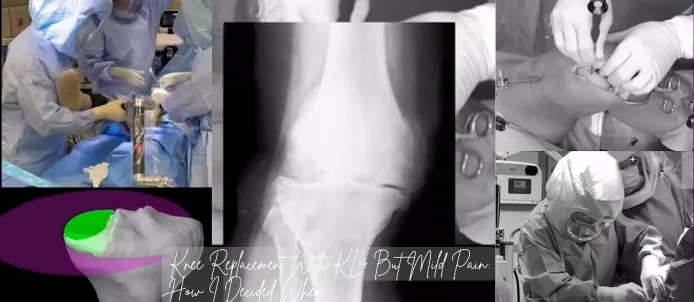
I got the KL4 result by accident. I’d gone in about a sore calf after a long walk in the Lake District, the GP had a feel of my knee as well, and a week later there was a letter saying “severe tricompartmental osteoarthritis, Kellgren-Lawrence grade 4″ and a phrase I had to look up. I was 61. My knee ached on steep downhills and after a day on my feet at work. That was it.
I rang my sister, who’s a practice nurse, and her first words were “don’t let anyone rush you.” Good advice, as it turned out. Here’s how I actually went about deciding, for anyone sitting with the same letter and a knee that doesn’t feel like it matches.
What The Surgeon Told Me About KL4
The consultant I saw at the first appointment spent about two minutes on the X-ray and fifteen asking me questions. How far could I walk, did it wake me up, did I use the handrail on the stairs, had I tried physio. When I said the pain was maybe a 3 out of 10 on a normal day, he sat back and said something close to: “Then I’d be operating on your X-ray, not on you.”
I found out later that’s pretty much the standard line. Howard Luks, an American knee surgeon who writes a lot for patients, says he can’t look at an X-ray and tell whether someone would benefit from a replacement, because some people with horrible-looking films have minimal pain. And the NICE guideline here in the UK says referral should depend on symptoms substantially affecting your quality of life, with non-surgical treatment not working. The grade on its own doesn’t come into it.
He also told me something I hadn’t known. The bone isn’t really what hurts. It’s the lining of the joint getting inflamed, or the bone marrow underneath getting irritated. That’s why my knee could be fine for weeks and then grumpy for a fortnight for no reason I could see.
The Criteria I Wrote Down
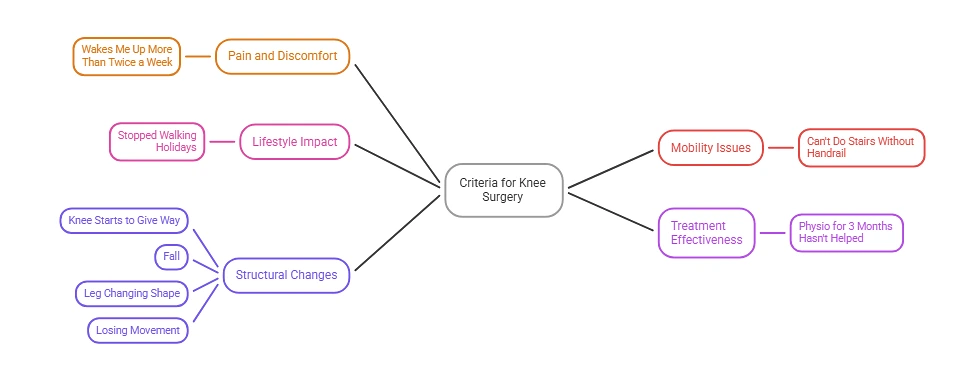
I’m a list person, so I wrote mine on the back of the clinic letter and stuck it on the fridge. I told myself I’d go back and ask for surgery when two of these were true, not one.
- The knee wakes me up more than twice a week.
- I can’t do the stairs at home without the handrail, both ways.
- I’ve stopped doing something I care about because of it. For me that was walking holidays.
- I’ve done proper physio for 3 months and it hasn’t helped.
- The knee starts to give way, or I have a fall.
- The surgeon says the leg’s changing shape or losing movement.
The last one was my sister’s addition. She said a knee that’s going bow-legged or can’t straighten is harder to operate on later, so it’s worth getting it measured each time, not just X-rayed.
What I Did While I Waited
Physio first. I was sceptical, honestly, but I did the exercises most days for about 4 months. Straight leg raises, sit-to-stands from a kitchen chair, a bit of step work, and a stationary bike I bought secondhand for £40. The downhill ache got noticeably better. Not gone, better.
I lost about 6 kilos over the next year, mostly by cutting the biscuits at work. I started using a walking pole on hills, which I’d resisted because I thought it made me look old. It didn’t matter.
For the bad fortnights I used an anti-inflammatory gel and paracetamol, and I went easier for a few days rather than pushing through. That was harder than the exercises.
When Two Of My Criteria Came True
It took about two years. The stairs went first, slowly. I noticed one morning I was going down sideways, like my dad used to. Then over one winter the knee started waking me most nights, and turning over in bed became a thing I had to plan.
I also realised I hadn’t booked a walking holiday in two summers and had stopped saying it was “just this year”. That made three, really.
When I went back, the surgeon measured the knee and said it had lost a bit of straightening since the first visit. So four.
Why I’m Glad I Didn’t Rush It
A knee replacement mostly takes away pain. When I had hardly any, there wasn’t much for it to take away, and I’ve since read that around 1 in 5 people aren’t fully happy with the result, with people who had milder symptoms beforehand more likely to be in that group.
And the recovery was long. Crutches for about 3 weeks, a stick for a few more, physio twice a week for months, and it was close to a year before I stopped thinking about the knee at all. I’m glad I went into it strong from all that physio, because the nurses said the people who’d been inactive for years had a much rougher time. Luks makes that point too, that leaving it too long can mean you go in weaker and struggle more afterwards.
What I’d Tell Someone With The Same Letter
Don’t let the word “severe” make the decision. Ask whether your X-ray was taken standing up, because lying down can make a knee look better than it is. Write your own list of what would make you go ahead, and put it somewhere you’ll see it. Do the physio properly, not for a week.
And if anyone tells you to book surgery off the X-ray alone, before anything else has been tried, get a second opinion. My sister was right about that.
This is my own experience and some reading, not medical advice. Speak to an orthopaedic surgeon who’s examined your knee.