Twenty seven years. That was the number in the post that stopped us. A woman in an epilepsy support group, 38 now, wrote that her seizures have never once been under control. She gets a feeling in her stomach first and can usually warn whoever is nearby, and then she blacks out for somewhere between 30 seconds and a minute.
Partway through she gets the urge to use the bathroom, so she stands up and heads for it, and when people tell her to sit down she doesn’t hear them, and sometimes she ends up on the floor. She’s on Trileptal, Fycompa and lamotrigine. None of it has worked, and she asked if anyone else has seizures like hers and what they tried.
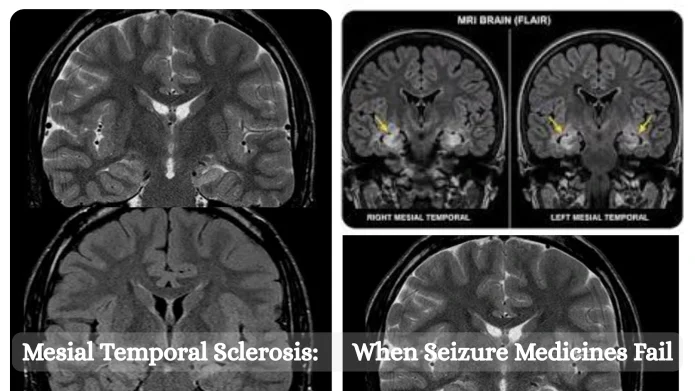
If you’ve got the same diagnosis she does, mesial temporal sclerosis, which is scarring in the hippocampus deep in the temporal lobe, you’re far from alone, and we wanted to answer her properly.
This kind of epilepsy tends to beat medicine, and the people who finally get control usually get it through an epilepsy center and very often through surgery.
Her post didn’t mention a center or a surgery workup. Maybe she’s been down that road already. If not, that’s the conversation we’d want her to have next.
How To Keep Someone Safe When They Walk During A Seizure
Start with the falls, because they’re happening now and they can be fixed sooner than anything else.
What she describes is a seizure that keeps her moving while switching off the part of the brain that understands words. So when a family member says “sit down, sit down” and grabs her arm, she isn’t being stubborn. She can’t take it in. She keeps going, and somebody pulling on her while she walks is a good way to end up on the floor.
So what should the people around her do? Pretty much the opposite of what feels natural:
Don’t hold her back or push her into a chair, since people in a seizure often fight restraint without knowing it.
Walk with her instead, a hand light on her elbow, and steer her around stairs, doorframes and anything hot.
If the bathroom is close and the way is clear, let her get there with someone beside her.
Time it. Call 911 if it runs past 5 minutes, if another one starts before she’s come back, if she’s hurt, or if she’s anywhere near water.
At home, a shower beats a bath, a bathroom door that swings out is easier to open if she slumps against it, and those cheap foam corner guards for coffee tables are worth the 10 dollars.
What A Bathroom Urge During A Seizure Can Mean
That bathroom urge may matter for another reason too. Needing to pee during a seizure is uncommon, and in the small groups of patients doctors have studied, it pointed to seizures starting in the right temporal lobe every time, at least in right handed people. One symptom can’t decide which side it is. Her neurologist should hear about it, though, if they haven’t already, because it’s exactly the kind of clue a surgery team wants.
Why Trileptal, Fycompa And Lamotrigine Often Fail With Hippocampal Scarring
We don’t think she or her doctor did anything wrong here, but her medicine list does tell a story.
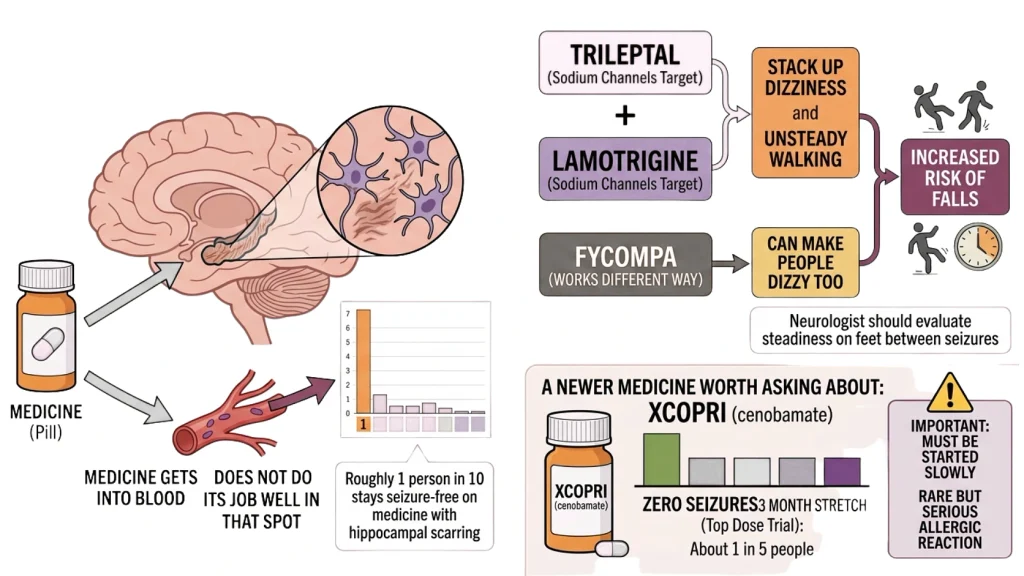
Hippocampal scarring is famously stubborn with drugs. In the studies that split epilepsy up by cause, it comes out near the bottom, with roughly 1 person in 10 staying seizure free on medicine. Researchers who’ve looked at scarred tissue taken out during surgery found the nerve cells there had changed in a way that made some of the most common seizure drugs work worse on them. The pill gets into your blood fine. It doesn’t do its job well in that spot.
Then there’s the mix she’s on. Trileptal and lamotrigine go after the same target in the brain, the sodium channels. A lot of people take them together and do okay, but the pair can stack up dizziness and unsteady walking. Fycompa works a different way, and it can make people dizzy too. Put that on top of seizures that already send her to the floor, and we’d want her neurologist looking hard at how steady she is on her feet between seizures as well as during them.
A Newer Medicine Worth Asking About
Has she been told about Xcopri (cenobamate)? It came out in 2019 for focal seizures, and in one of its trials about 1 in 5 people on the top dose had zero seizures over a 3 month stretch while still taking their other medicines. Three months isn’t forever, and it has to be started slowly because of a rare but serious allergic reaction. Still, if she hasn’t tried it, it’s a fair thing to bring up.
Honestly though, after 3 drugs and 27 years, we’d be more interested in the next item.
When Surgery Becomes An Option, Even After 27 Years Of Seizures
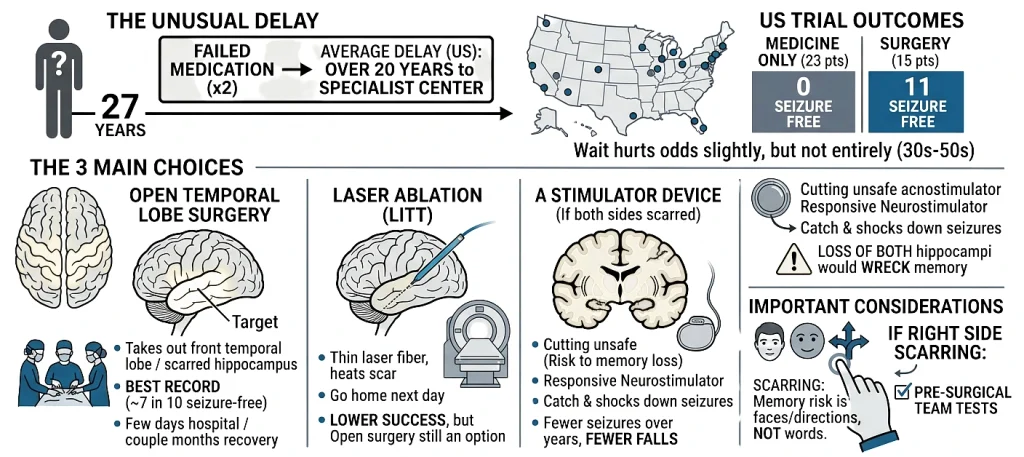
Two failed medicines is the point where epilepsy doctors are supposed to start talking about a specialist center. She passed that point a long time ago, and she’s not unusual. In the US, people who end up having epilepsy surgery have been living with seizures for over 20 years on average before they get there.
That wait hurts the odds a little, but it doesn’t kill them. One US trial took people with her type of epilepsy and gave half of them surgery and the other half more medicine. A year later, 11 of the 15 surgery patients were seizure free. Of the 23 who stayed on medicine, none were. That trial caught people early, so her numbers would likely be lower, but surgery for this condition is done on people in their 30s, 40s and 50s all the time.
The surgeon takes out the front part of the temporal lobe along with the scarred hippocampus. It has the best record, with somewhere around 7 in 10 people seizure free, and it means a few days in the hospital and a couple of months taking it easy.
Laser Ablation (LITT):
A thin laser fiber goes in through a hole about the size of a pencil and heats the scar while an MRI watches. Most people go home the next day. The success rate runs lower than open surgery, but if it doesn’t work, open surgery can still happen afterward.
A Stimulator Device When Both Sides Are Scarred:
If the scarring turns out to be on both sides, cutting isn’t safe, because losing both hippocampi would wreck memory. Then a device like a responsive neurostimulator can be implanted to catch seizures as they start and shock them down. It usually cuts seizures back over a few years instead of ending them, but for someone who has never had a good stretch, fewer falls would be a real change.
If her seizures are coming from the right side, which that bathroom urge hints at, the memory risk from surgery mostly falls on things like faces and directions, not words. Her team would test all of that before anyone picked up a scalpel.
What To Tell Your Neurologist And What To Ask For
Write it down before you go, because it’s easy to forget once you’re sitting in the exam room:
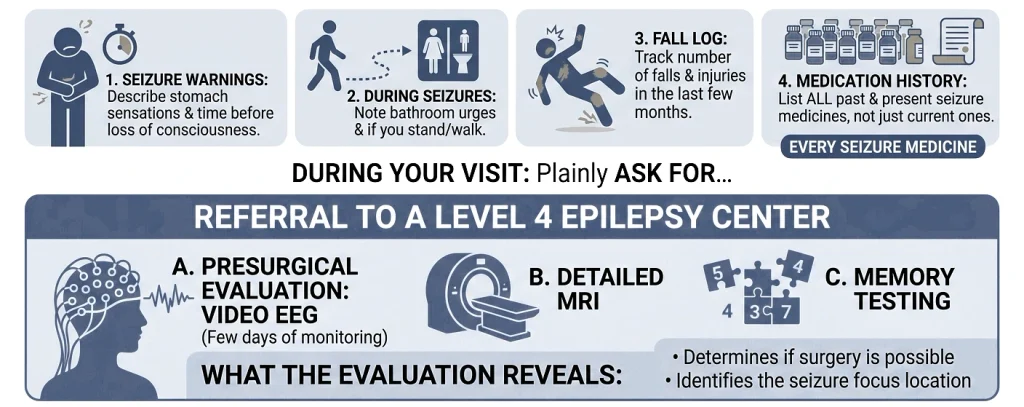
The stomach warning and how long you get before you black out.
The bathroom urge, and that you stand up and walk during seizures.
How many falls in the last few months and what you hurt.
Every seizure medicine you’ve ever taken, not just the 3 you’re on now.
Then ask, plainly, for a referral to a Level 4 epilepsy center for a presurgical evaluation. That’s a few days of video EEG, a detailed MRI and memory testing. It doesn’t sign you up for surgery. It tells you whether surgery is possible and which side your seizures come from, and after 27 years, she deserves to know that.
This article is general information and not personal medical advice. Your own results, history and doctor should guide your treatment.
Dr SYED TAHIR ZAFAR BUKHARI is General Physician, expert in Allergy Medication, Hearing Aid Fitting. After retirement writing researched healthcare opinions online.