



“When did you last have your eyes tested?” the optician asked. I said about three years. She looked at the screen and said it was six. In those six years I’d started holding my phone further away, bought two pairs of cheap readers from the chemist, and decided the glare from headlights at night was the fault of other drivers. None of it felt like a problem. All of it was.
The eye rarely sends a clear message. It sends a small change you adjust to without noticing you’ve adjusted. So here are twelve common eye conditions, listed by the first thing people actually notice rather than the medical description, with a note on which ones can wait and which ones can’t.
1. Dry Eye: Gritty Eyes That Won’t Stop Watering
Not dry, strangely. Watery. The surface of the eye gets rough, the eye panics and pours out thin tears that run down your face but don’t do the job.
- First sign: grit, stinging and watering, with a blur that clears when you blink.
- Worse when: you’ve been at a screen for hours, or you’re in an air-conditioned room.
- Who gets it: women more than men, people over 50, and anyone who forgets to blink while working.
- What to do: lubricating drops first. Look up from the screen every 20 minutes at something 20 feet away for 20 seconds. If a few weeks of drops don’t help, ask an optometrist to check the oil glands in your lids.
2. Blepharitis: Crusty Lashes Every Morning
Flakes and crusts along the lash line when you wake, lids that feel heavy and a bit sore, eyes gritty all day. It’s inflammation of the lid edges, and it often travels with dry eye.
- First sign: lashes stuck together in the morning.
- What to do: a warm flannel on closed eyes for 5 to 10 minutes, then clean the lid edges with a lid wipe or a cotton bud dipped in diluted baby shampoo. Every day until it settles, then a few times a week.
- Stop doing it and it comes back, so treat it like brushing your teeth.
3. Stye: A Sore Bump On The Edge Of The Lid
A tender pink lump right on the lash line, sore to touch, sometimes with a small yellow head. A blocked gland at the root of a lash has got infected.
- First sign: a tender red bump on the lid edge.
- What to do: warm compresses a few times a day. Most clear in a week or two.
- Don’t squeeze it.
- See a doctor if: it’s still there after two weeks, the whole lid swells, or it keeps coming back in the same spot.
4. Conjunctivitis: A Pink Eye With Discharge
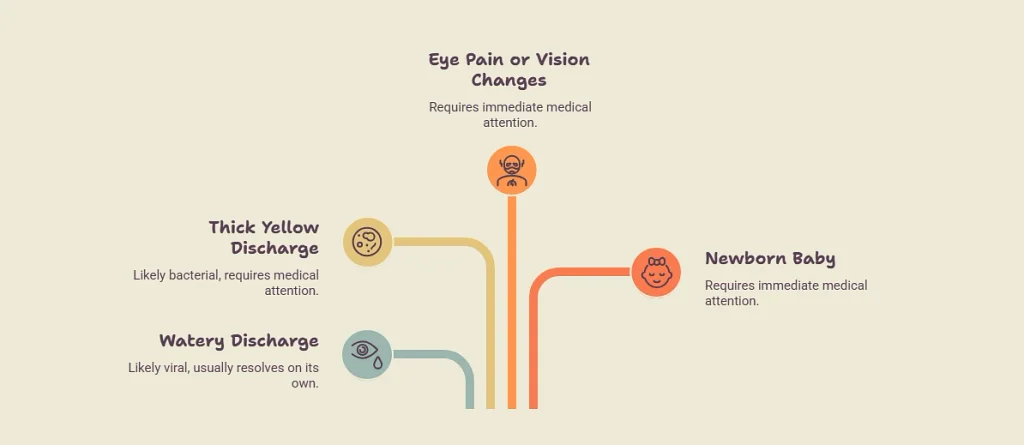
The white of one eye goes pink, then the discharge starts.
- Watery and after a cold: usually a virus.
- Thick, yellow and gluing the lashes shut overnight: usually bacteria.
- Both spread easily. Wash your hands and keep your towel to yourself.
- Get it looked at if: the eye actually hurts, your sight is affected, bright light is painful, or it’s a newborn baby.
Most cases clear on their own within a week or two.
5. Eye Allergies: Itching In Both Eyes At Once
Itch is the tell. Allergic eyes itch, both at the same time, often with sneezing and a runny nose, and often at the same time every year or around a particular pet.
- First sign: itching, both eyes, same time.
- Looks like: pink whites and puffy lids.
- What to do: cold compresses, antihistamine drops from the pharmacy, and keep your hands off your eyes.
- Rubbing makes it worse. Every time.
6. Short Sight: Squinting At Anything Far Away
Myopia usually turns up in childhood or the teens, and the signs are easy to miss because children don’t know what they’re supposed to see.
- In children: sitting close to the TV, not reading the board, squinting at distance, headaches after school.
- In adults: the number plate ahead harder to read at night, departure boards going fuzzy.
- What to do: an eye test, then glasses or contact lenses.
- With children, don’t put it off. Short sight tends to get worse through the growing years, and daylight hours outdoors have been shown to slow that down.
7. Presbyopia: Reading At Arm’s Length In Your 40s

The phone drifts further away. Menus in dim restaurants become a struggle. Reading in bed makes your eyes ache. The lens inside the eye stiffens with age and stops focusing close.
- First sign: holding small print further off, usually between 40 and 50.
- Is it a disease? No. It comes for almost everyone.
- What to do: reading glasses from the chemist suit many people. Book an eye test anyway, for a proper prescription and because this is the age when the serious conditions further down start.
8. Astigmatism: Lights That Streak At Night
Headlights and streetlights look stretched, starburst-shaped or smeared, and letters seem to carry a faint shadow. The front of the eye is curved unevenly, so light doesn’t focus to one point.
- First sign: streaky or smeared lights after dark.
- How common: very. Lots of people have a little and never know.
- What to do: glasses or lenses correct it if it bothers you.
- If the streaky lights are new and you’re over 50, get checked. An early cataract does the same thing.
9. Cataract: Glare And Halos When Driving At Night
The lens inside the eye slowly clouds over, and the first place you feel it is behind the wheel after dark.
- First sign: oncoming headlights throw a glare or sit inside a halo.
- Later: colours look yellowed or washed out, and new glasses don’t help as much as they should.
- Who gets it: nearly everyone has some by their 70s.
- What to do: nothing until it gets in the way of your life, then surgery, which is quick, common and very reliable.
10. Glaucoma: No First Sign At All
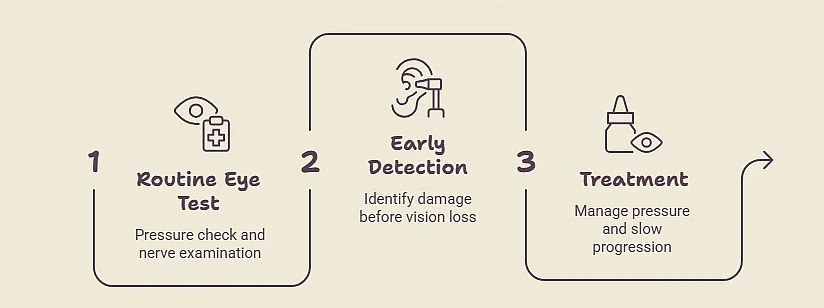
This is the one that makes routine eye tests matter. Glaucoma damages the nerve at the back of the eye, usually from raised pressure, and it takes your side vision so slowly that your brain papers over the gaps.
- First sign: none you’d notice. The only early warning is a pressure check and a look at the nerve at an eye test.
- By the time you notice a gap, sight has been lost that won’t come back.
- Test every: two years for most adults, every year if you’re over 60 or a parent or sibling has it.
- The rare emergency form: a sudden painful red eye, blurred vision, halos round lights and feeling sick. That’s A&E the same day.
11. Macular Degeneration: Straight Lines That Look Bent
Age-related macular degeneration affects the centre of your vision, and the first sign is oddly specific.
- First sign: a door frame, a line of text or the edge of the bath looks slightly wavy in one eye.
- Later: a smudge or blank spot in the middle of what you look at, and faces become hard to make out.
- Check yourself: cover each eye in turn and look at a straight edge.
- If a line is wavy in one eye and fine in the other, see an optometrist within days. The “wet” form is treated with injections, and the earlier they start, the more sight is saved.
12. Floaters And Flashes: A Sudden Shower Of Specks

A few drifting specks or threads you’ve had for years are normal. What’s different is a sudden burst of new ones.
- First sign: a shower of new floaters, often in one eye, sometimes with flashes of light at the edge of vision.
- Usually: the jelly inside the eye coming away from the retina with age, which does no harm.
- Sometimes: it tugs the retina and tears it.
- A sudden burst of floaters, flashes, or a shadow creeping in from the side means emergency eye care today. A torn retina caught early is a short laser treatment. A detached one is surgery, and every day counts.
Which Eye Symptoms Need Attention The Same Day
- Sudden loss of vision, or a curtain or shadow over part of it.
- A sudden shower of new floaters, with or without flashes.
- A painful red eye, especially with blurred sight, halos or feeling sick.
- Sudden double vision.
- A chemical splash, an injury, or something stuck in the eye.
- A newborn with sticky or red eyes.
For the first four, ring your optometrist or the nearest eye casualty department. For chemicals and injuries, rinse with clean water for 15 minutes and go to A&E.
How Often Adults And Children Should Have An Eye Test
Most of the serious conditions above are caught in the chair, before you’d have noticed anything.
- Adults: every two years.
- Over 60, diabetic, or with glaucoma in the family: every year.
- Children: a first test around age 4 or 5, then every one to two years.
Mine, when I finally went, turned up a bit of astigmatism and a reading prescription. Nothing dramatic. But it’s booked for two years’ time now, in the diary, and the headlights have stopped being other drivers’ fault.
General information only, not medical advice. If you notice any of the urgent signs above, contact an optometrist or emergency eye service straight away.
References
- NHS, Floaters and flashes in the eyes: https://www.nhs.uk/conditions/floaters-and-flashes-in-the-eyes/
- NHS, Glaucoma: https://www.nhs.uk/conditions/glaucoma/
- NHS, Age-related macular degeneration: https://www.nhs.uk/conditions/age-related-macular-degeneration-amd/
- NHS, Dry eyes: https://www.nhs.uk/conditions/dry-eyes/
- American Academy of Ophthalmology, Eye Health A-Z: https://www.aao.org/eye-health/a-z
- RNIB, Eye conditions A-Z: https://www.rnib.org.uk/your-eyes/eye-conditions-az/

