

The honest answer? It depends. But by the end of this post, you’ll know exactly how long it’ll take you not just some average person on a treadmill.
Walking Time by Speed Reference Chart For 7 Miles Time
Your pace is the single biggest factor in how long 7 miles takes. Here’s a clear breakdown:
| Walking Speed | Pace (min/mile) | Time to Walk 7 Miles |
|---|---|---|
| Slow (2.0 mph) | 30 min/mile | 3 hrs 30 min |
| Leisurely (2.5 mph) | 24 min/mile | 2 hrs 48 min |
| Average (3.0 mph) | 20 min/mile | 2 hrs 20 min |
| Moderate (3.2 mph) | 18:45 min/mile | 2 hrs 11 min |
| Brisk (3.5 mph) | 17 min/mile | 2 hrs 00 min |
| Fast (4.0 mph) | 15 min/mile | 1 hr 45 min |
| Power Walk (4.5 mph) | 13 min/mile | 1 hr 33 min |
| Race Walk (5.0 mph) | 12 min/mile | 1 hr 24 min |
Most people fall naturally in the 3.0–3.5 mph range on flat ground. If you’ve never timed yourself on a mile, do it once it makes planning every future walk much easier.
For most adults walking at a comfortable, steady pace, 7 miles takes between 1 hour 45 minutes and 2 hours 30 minutes. The sweet spot for an average healthy adult lands around 2 hours and 20 minutes, based on a pace of roughly 3 mph.
That said, your age, gender, fitness level, terrain, and weather can all push that number up or down quite a bit. Let’s break it all down.
How Far Is 7 Miles?
Before jumping into timing, it helps to put 7 miles in perspective.
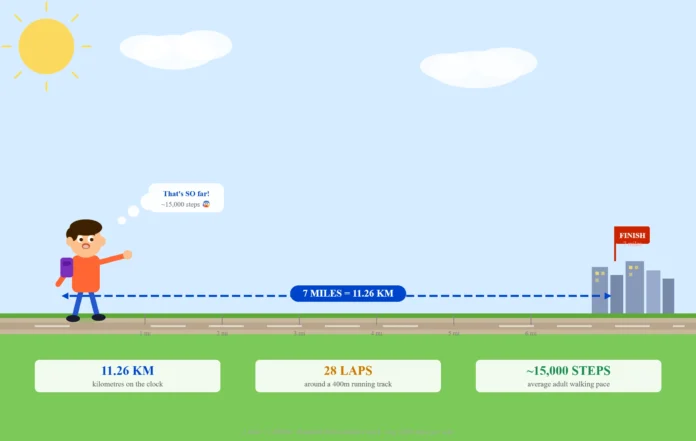
- 7 miles = 11.26 kilometers
- 7 miles = roughly 28 full laps on a standard 400-meter track
- 7 miles = approximately 14,000–15,000 steps for the average adult
That’s a solid chunk of ground. Most people prefer walking somewhere rather than doing 28 laps around a track and honestly, fair enough.
How Age and Gender Affect Your 7-Mile Time
Age and gender both play a documented role in walking speed. Men in their 30s–50s tend to walk a little faster than women in the same range, though the gap closes noticeably in older age groups.
Average Time to Walk 7 Miles for Women by Age
| Age Group | Average Time | Speed (mph) | Pace (min/mile) |
|---|---|---|---|
| 20–29 | 2 hr 20 min | 3.00 | 20:00 |
| 30–39 | 2 hr 20 min | 3.00 | 20:00 |
| 40–49 | 2 hr 15 min | 3.11 | 19:18 |
| 50–59 | 2 hr 23 min | 2.93 | 20:29 |
| 60–69 | 2 hr 31 min | 2.77 | 21:40 |
| 70–79 | 2 hr 46 min | 2.53 | 23:43 |
Average Time to Walk 7 Miles for Men by Age
| Age Group | Average Time | Speed (mph) | Pace (min/mile) |
|---|---|---|---|
| 20–29 | 2 hr 18 min | 3.04 | 19:44 |
| 30–39 | 2 hr 11 min | 3.20 | 18:45 |
| 40–49 | 2 hr 11 min | 3.20 | 18:45 |
| 50–59 | 2 hr 11 min | 3.20 | 18:45 |
| 60–69 | 2 hr 20 min | 3.00 | 20:00 |
| 70–79 | 2 hr 29 min | 2.82 | 21:17 |
Use your own age and gender column as a starting point. It’s a far more accurate baseline than a generic “average adult” figure.
How Body Weight Impacts Your Walking Speed
Body weight doesn’t just affect how many calories you burn it also affects how fast you move and how quickly you tire out.
Heavier individuals tend to walk at a slightly slower pace because carrying more mass takes more energy per step. Over 7 miles, that adds up. You might need more frequent rest stops, which pushes total time up.
This isn’t a reason to avoid the walk it’s just a reason to plan honestly. If you carry significant extra weight, add 15–30 minutes to your estimate and pack water and a small snack.
Terrain: The Factor People Always Underestimate
The surface under your feet can shift your 7-mile time by 30 minutes to over an hour. Here’s how different terrain types affect your pace:
- Flat Pavement or Treadmill This is the baseline. Pace stays consistent, and all the chart estimates above apply here directly.
- Grass, Gravel, or Dirt Paths Soft and uneven surfaces slow you down by 10–20%. Add 15–25 minutes to your estimate on off-road flat terrain.
- Hills and Inclines Use Naismith’s Rule as a rough guide: add about 30 minutes for every 1,000 feet of elevation gained. A hilly 7-mile trail can easily take 3–4 hours.
- Sand or Snow These are the hardest surfaces to walk on. Deep sand or snow can cut your speed by 30–50%, pushing a 7-mile walk up to 3.5–5 hours depending on conditions.
How Weather Changes Your Walking Time
Weather is often ignored in walking time estimates but it makes a real difference.
- Heat and humidity: Your body works hard to cool itself down, slowing your pace. Above 90°F (32°C), add 20–40 minutes and carry extra water.
- Cold weather: Actually good for pace, as long as you’re dressed right. Your body generates heat through movement. Watch out for ice though.
- Wind and rain: Headwinds create resistance. Wet surfaces make you cautious. Add 15–30 minutes in rough weather.
Calories Burn Walking 7 Miles
Walking 7 miles burns roughly 420 to 770 calories, depending on body weight and pace. The chart below uses a steady 3.0 mph on flat ground:
| Body Weight | Calories Burned (7 miles) |
|---|---|
| 120 lbs (54 kg) | ~420 calories |
| 150 lbs (68 kg) | ~525 calories |
| 180 lbs (82 kg) | ~630 calories |
| 200 lbs (91 kg) | ~700 calories |
| 220 lbs (100 kg) | ~770 calories |
Walking uphill or on rough terrain bumps these numbers up noticeably. A heart rate monitor or fitness watch gives you the most accurate personal reading.
Should You Split Your 7 Miles Into Two Walks?
Absolutely and more people should consider this. There’s no rule that says 7 miles has to happen in one stretch.
Here are a few ways to split it sensibly:
- 3 miles in the morning + 4 miles in the evening
- 5 miles before work + 2 miles at lunch
- 3.5 miles twice a day
Research shows that multiple shorter walks provide similar cardiovascular benefits to one long walk of the same total distance. Splitting also reduces joint stress and makes it much easier to fit into a busy day. If 7 miles in one go feels too ambitious right now, two sessions is a perfectly smart plan.
The Smarter Way to Cover 7 Miles
Most walking guides skip this entirely which is a shame, because interval walking is one of the best tools available for long-distance walkers.
The idea is simple: alternate between a fast, challenging pace and a comfortable recovery pace throughout your walk. Here’s a structure that works well for 7 miles:
- Mile 1: Easy warm-up pace (2.5–3.0 mph)
- Miles 2–6: Alternate every quarter-mile fast (4.0–4.5 mph) then easy (3.0 mph). Repeat.
- Mile 7: Relaxed cool-down pace
Why does this work so well?
- Burns significantly more calories than steady walking at the same distance
- Improves aerobic fitness faster than a consistent pace
- Breaks up the mental monotony of a long walk
- No special equipment needed use landmarks or a simple phone timer
A study in the Journal of Applied Physiology found that interval walkers improved fitness and lost more body fat than those who walked at a steady pace. For a 7-mile distance, that’s a meaningful upgrade for the same time investment.
The Mental Health Benefits of Walking 7 Miles
Every article on this topic focuses on calories and pace. Hardly anyone talks about what a 7-mile walk does to your mind which may actually be its biggest gift.
Walking at distances of 5 miles or more triggers a sustained release of endorphins and serotonin. This isn’t a mild lift Stanford University research found that walking in nature for 90 minutes reduced activity in the part of the brain linked to rumination, the repetitive negative thinking that feeds anxiety and depression.
Beyond the brain chemistry, a 7-mile walk gives you something rare in modern life: unstructured time. No notifications. No tasks. Just movement and surroundings. Many writers, entrepreneurs, and creative thinkers swear by long walks as their best tool for solving problems and getting unstuck.
Here’s what a regular 7-mile walking habit has been linked to:
- Reduced symptoms of anxiety and depression
- Lower cortisol (stress hormone) levels
- Improved sleep quality
- Better focus and mental health clarity throughout the day
- A genuine sense of accomplishment after each walk
If you’ve been on the fence about making long walks a regular habit, this is the angle that might finally tip it.
How to Build Up to 7 Miles Comfortably
If 7 miles sounds like a lot right now, here’s how to get there without hurting yourself:
- Start short and build slowly. Add half a mile to a mile each week. Don’t rush it tendons and joints need more time to adapt than your lungs do.
- Get proper footwear. A good walking shoe with arch support and cushioning is non-negotiable. Worn-out soles or fashion sneakers will cause pain by mile 4.
- Stay hydrated. Bring at least 500ml (16 oz) of water per hour. For walks over 90 minutes, add a small snack banana, granola bar, or nuts.
- Warm up and cool down. Five minutes of easy walking at the start, and gentle stretching of calves, hamstrings, and hip flexors at the end. Your legs will thank you the next morning.
- Track your pace. Even a basic phone pedometer helps you understand your natural speed and spot improvements over time.
7 Miles in Practice
Sometimes numbers don’t tell the full story. Here’s what 7 miles looks like in the real world:
- The Morning Dog Walker – 2.5 mph, flat suburban streets, stops every few blocks. Total time: ~2 hours 45 minutes.
- The Trail Hiker – 2.8 mph on a moderately hilly path, two short breaks. Total time: ~3 hours.
- The Commuter Walker – 3.5–4.0 mph on city sidewalks, motivated to arrive on time. Total time: 1 hour 45 minutes to 2 hours.
- The Charity Walk Participant – Casual 2.5–3.0 mph with stops to chat and rest. Total time: 2.5 to 3 hours.
- The Interval Walker – Alternating fast and easy pace. Total time: ~1 hour 50 minutes, higher calorie burn.