

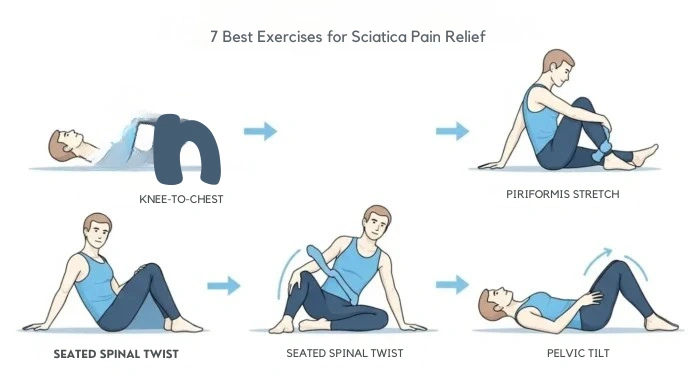
If you’ve ever felt a sharp, electric-like pain shoot from your lower back all the way down your leg, you already know sciatica doesn’t mess around. It’s the kind of pain that makes putting on socks feel like an Olympic event. The good news? You don’t have to just live with it. The right exercises can make a real, lasting difference and no gym membership required.
This guide covers the 7 best exercises for sciatica pain relief, explains how to do each one, and fills in the gaps that most other articles leave out. Whether you’re dealing with a mild ache or a full-blown “please don’t make me sneeze” situation, there’s something here for you.
What Is Sciatica and Why Does It Hurt So Much?
Sciatica isn’t a standalone diagnosis it’s a symptom. It happens when the sciatic nerve gets compressed or irritated. This nerve is the longest in your body, running from the lower spine (L4 to S3), through your hips and buttocks, and all the way down the back of each leg to your foot.
When something puts pressure on it, you feel it sometimes as a dull ache, sometimes as burning, and sometimes as that jolting pain that stops you mid-step. The cause is usually one of these:
- A herniated or bulging disc pressing on a nerve root.
- A bone spur on the lumbar spine.
- A tight piriformis muscle squeezing the nerve in the buttock.
- Inflammation from injury, pregnancy, or another condition.
There are also two main types to know about. Mechanical sciatica comes from a physical structure pressing on the nerve like a disc or bone spur. Inflammatory sciatica comes from swelling around the nerve. Both types respond well to the exercises in this guide.
Here’s what surprises most people resting too much actually makes sciatica worse. Gentle, consistent movement promotes circulation to the nerve, reduces muscle tension, strengthens your spine’s support structures, and releases the body’s natural pain-relieving endorphins.
| # | Exercise | Target Area | Difficulty | Best For |
|---|---|---|---|---|
| 1 | Knee-to-Chest Stretch | Lower back, glutes | Beginner | Morning stiffness |
| 2 | Piriformis Stretch | Piriformis, hips | Beginner | Buttock & hip pain |
| 3 | Bird-Dog | Core, lower back | Beginner–Intermediate | Spine stabilization |
| 4 | Pelvic Tilt | Lower back, core | Beginner | Chronic ache, posture fix |
| 5 | Sciatic Nerve Floss | Sciatic nerve | Intermediate | Nerve mobility |
| 6 | Glute Bridge | Glutes, core | Beginner | Strength & decompression |
| 7 | Half Cobra Press-Up | Lumbar discs | Beginner | Disc-related sciatica |
The Knee-to-Chest Stretch
Why It Works
This stretch gently decompresses the lower spine the area where the sciatic nerve is most often pinched. Physiotherapists describe it as creating “gapping” in the lumbar spine, opening up the tiny spaces where nerve roots exit. Think of it like releasing a kink in a garden hose.
How to Do It
- Lie flat on your back on a mat with both knees bent and feet flat on the floor.
- Slowly bring one knee toward your chest and hold it with both hands just below the knee.
- Hold for 20–30 seconds, breathing slowly and deeply.
- Lower the leg gently and repeat on the other side.
- Do 2–3 reps per side, morning and night.
The Detail Most Articles Skip
Breathing is everything here. When you exhale fully, your surrounding muscles relax more deeply and the stretch actually reaches the nerve. Most people hold their breath, rush through it, and get half the benefit. Slow down, breathe, and let the stretch do its work.
The Piriformis Stretch (The Hidden Culprit)
Why It Works
The piriformis sits deep in the buttock right next to, and in some people directly over, the sciatic nerve. When it tightens (hello, desk workers), it can compress the nerve and trigger all the classic sciatica symptoms. This is called piriformis syndrome, and it’s far more common than most people realize.
How to Do It
- Lie on your back with both knees bent.
- Cross your right ankle over your left thigh, just above the knee.
- Flex your right foot to protect the knee joint.
- Reach both hands behind your left thigh and gently pull it toward your chest.
- Hold for 30 seconds. Switch sides.
- Repeat 3 times each side, twice a day.
Can’t get on the floor? Do it seated cross your ankle over the opposite knee, gently press down on the raised knee, and hinge forward slightly with a flat back. Same stretch, no floor required.
Pro Tip
If you can’t reach behind your thigh, loop a towel or resistance band around it and pull from there. Keep your head relaxed on the floor the work is in your hip, not your arms. If this stretch immediately worsens your leg pain, stop. It may mean the piriformis isn’t the main culprit.
The Bird-Dog
Why It Works
The bird-dog trains what physiotherapists call “anti-rotation stability” your core’s ability to stay steady while your limbs move independently. It simultaneously strengthens your core muscles and lower back extensors, giving your spine a more stable, protective environment. Less spinal instability means less pressure on the discs and nerve roots.
How to Do It
- Get on all fours with your hands under your shoulders and knees under your hips.
- Keep your back flat imagine balancing a glass of water on your lower back.
- Slowly extend your right arm forward and left leg straight back at the same time.
- Hold for 5 seconds, then return to start.
- Repeat with the left arm and right leg.
- Do 10 reps per side, 2 sets.
The Pelvic Tilt
Why It Works
The pelvic tilt targets the deep abdominal muscles specifically the transverse abdominis that act like a natural corset around your lumbar spine. These muscles are often underactive in people with sciatica, leaving the lower back doing far more work than it should.
How to Do It
- Lie on your back with knees bent, feet flat on the floor.
- Notice the natural arch in your lower back a small gap between your back and the floor.
- Gently tighten your abdominals and press your lower back flat against the floor.
- Hold for 5 seconds, then release.
- Do 10–15 reps, 2–3 times daily.
The Root Cause Link Nobody Explains
Many people develop anterior pelvic tilt from hours of daily sitting where the pelvis tips forward and the lower back arches excessively. This increases compressive load on lumbar discs and, over time, contributes directly to the disc herniation that causes sciatica. This exercise doesn’t just ease current pain; it corrects one of the posture-based root causes. Most articles skip over this entirely.
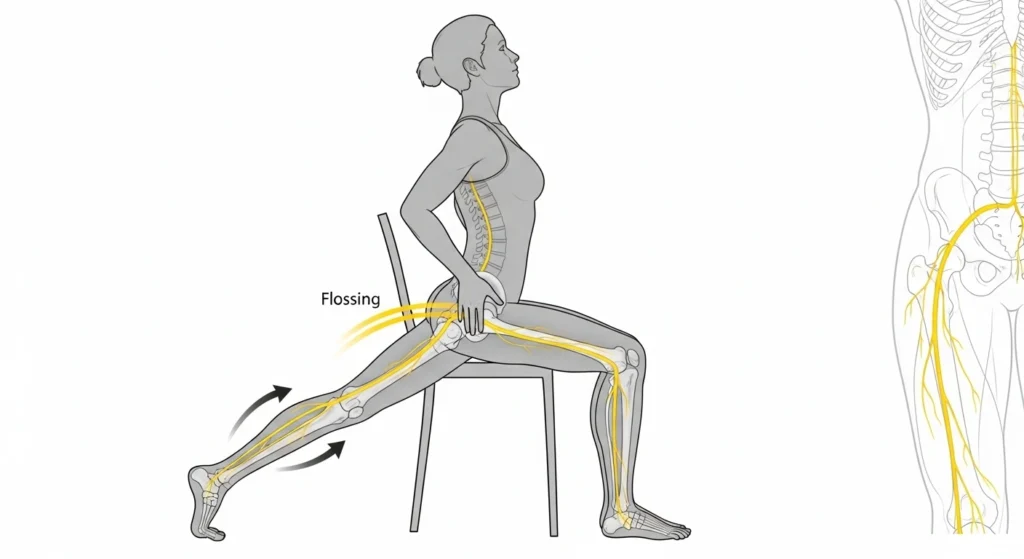
Sciatic Nerve Flossing (Neural Mobilization)
Why It Works
When a nerve is compressed for a long time, it can become “stuck” and lose its ability to glide freely within its protective sheath. This makes the nerve hypersensitive meaning even normal movement causes pain. Nerve flossing gently restores that gliding ability, reducing the hypersensitivity over time. Think of it as loosening a rope that’s been tied too tight.
How to Do It
- Sit upright in a chair with feet flat on the floor.
- Straighten your right knee and pull your toes up toward your shin.
- At the same time, tuck your chin toward your chest.
- Hold for 2 seconds you should feel a mild tension down the back of the leg.
- Reverse the movement: lower the foot and tilt your head back gently.
- Do 10–15 slow reps per side.
Important Warning
Nerve flossing should feel like mild tension not sharp, shooting pain. If it makes your symptoms significantly worse, stop and consult a physical therapist. This exercise works best in the sub-acute or chronic phase of sciatica, not during a severe acute flare when the nerve is highly inflamed.
Practical Weekly Plan How to Put It All Together
You don’t need to do all seven exercises every day. Here’s a realistic routine that works:
Every Day (10–12 minutes):
- Knee-to-Chest Stretch
- Piriformis Stretch
- Pelvic Tilt
- Glute Bridge
3–4 Times Per Week:
- Bird-Dog
- Sciatic Nerve Flossing
- Half Cobra Press-Up
During a Flare-Up:
- Stick to the Pelvic Tilt, Knee-to-Chest Stretch, and (if tolerated) the Half Cobra Press-Up
- Skip nerve flossing until the acute inflammation settles
Morning vs. Evening: Do stretches in the morning to ease overnight stiffness. Save the strengthening exercises (Bird-Dog, Glute Bridge) for the afternoon or evening when your muscles are warmer.
Habits That Make Sciatica Worse
While you’re working through these exercises, a few everyday habits can quietly undo your progress:
- Prolonged sitting – stand up and walk for 2 minutes every 45 minutes
- Poor sitting posture – use a chair with lumbar support, keep feet flat on the floor, and position your screen at eye level
- Sagging mattress – sleeping on an unsupportive surface stresses your spine all night
- Twisting while bending – this movement pattern puts enormous stress on lumbar discs
- High-impact exercise during a flare – running on hard pavement or heavy deadlifts can aggravate an inflamed nerve
- Unsupportive footwear – poor shoes change lower body mechanics and worsen sciatic symptoms
The Hamstring Connection Nobody Talks About
Here’s something most sciatica articles completely overlook: tight hamstrings. These muscles attach to the sitting bones via the sacrotuberous ligament, which connects directly to the sacrum. When they’re chronically tight, they alter sacral mechanics and increase tension along the entire sciatic nerve pathway sometimes mimicking or directly worsening true sciatica.
A simple standing hamstring stretch can help:
- Stand with your right foot about 3 feet in front of your left.
- With a straight back, hinge at the hips and lean slightly forward.
- Hold for 5–10 seconds.
- Repeat on each side, 3–5 times.
This small addition to your routine can make a noticeable difference, especially if your pain runs mainly down the back of the thigh.
When to See a Doctor
Exercises are powerful, but some symptoms require immediate medical attention. See a doctor right away if you experience:
- Loss of bladder or bowel control
- Numbness in the inner thighs or groin area
- Progressive leg weakness that worsens over days
- Fever or chills alongside your back pain
- Pain that began after a significant fall or accident
These can be signs of cauda equina syndrome or another serious condition. Don’t wait it out.
If your pain hasn’t improved after 4 to 6 weeks of consistent exercise, a physical therapist can assess exactly which structures are involved and create a targeted plan for your specific case.
Final Thoughts
Sciatica is painful, disruptive, and genuinely exhausting but it’s also one of the most treatable musculoskeletal conditions when you approach it with the right exercises and a little patience. The seven movements in this guide work from multiple angles: decompressing the spine, releasing tight muscles, rebuilding strength, restoring nerve mobility, and fixing the postural habits that caused the problem in the first place. Start gently, stay consistent, and trust the process your body knows how to heal when you give it the right tools.