


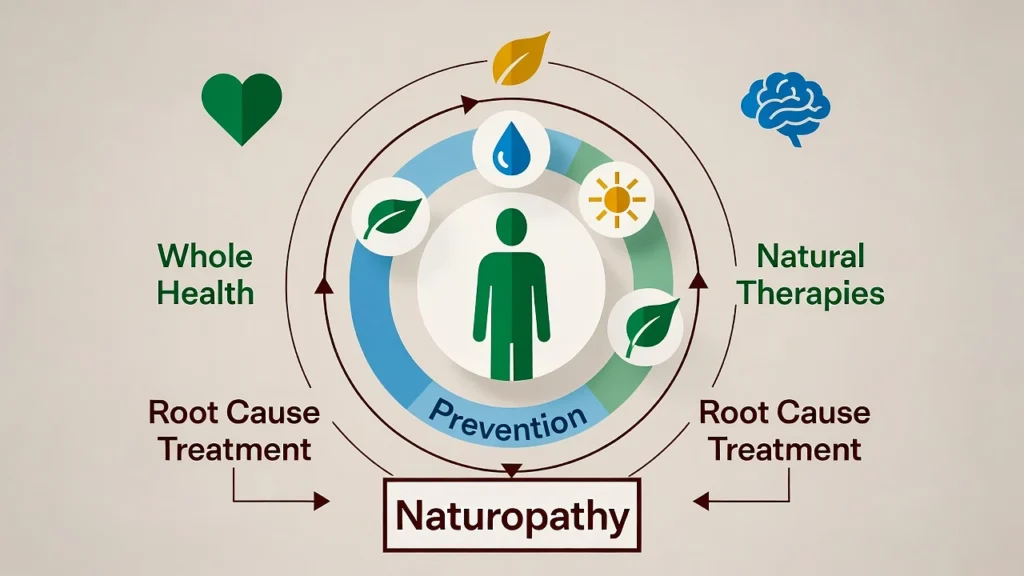
Naturopathy, or naturopathic medicine, is a distinct system of primary healthcare that emphasizes the body’s innate ability to heal itself through natural, non-invasive, and evidence-based therapies. It takes a “whole health” approach, focusing on identifying and treating the root causes of illness rather than merely suppressing symptoms, promoting long-term wellness and disease prevention.
Naturopathy isn’t a single therapy. It’s a whole system of care built around a simple idea: give the body what it needs, remove what’s blocking it, and it will often do a lot of healing on its own.
What Is Naturopathy?
Treatment toolkits vary by practitioner and by jurisdiction. The NCCIH Naturopathy fact sheet (2025) lists the common modalities used in naturopathic practice:
- Dietary and nutritional counseling.
- Herbal medicine.
- Homeopathy (in some practices).
- Physical therapies like massage and hydrotherapy.
- Exercise recommendations.
- Stress reduction techniques.
- Psychotherapy and counseling (in some regions).
A typical first visit is long, often 60 to 90 minutes. The practitioner takes a detailed history, looks at lifestyle patterns, and often orders standard lab tests.
The resulting plan tends to be layered. Dietary changes plus a specific herb or supplement plus a sleep or stress habit, with follow-ups to track how things shift.
Key Principles of Naturopathy

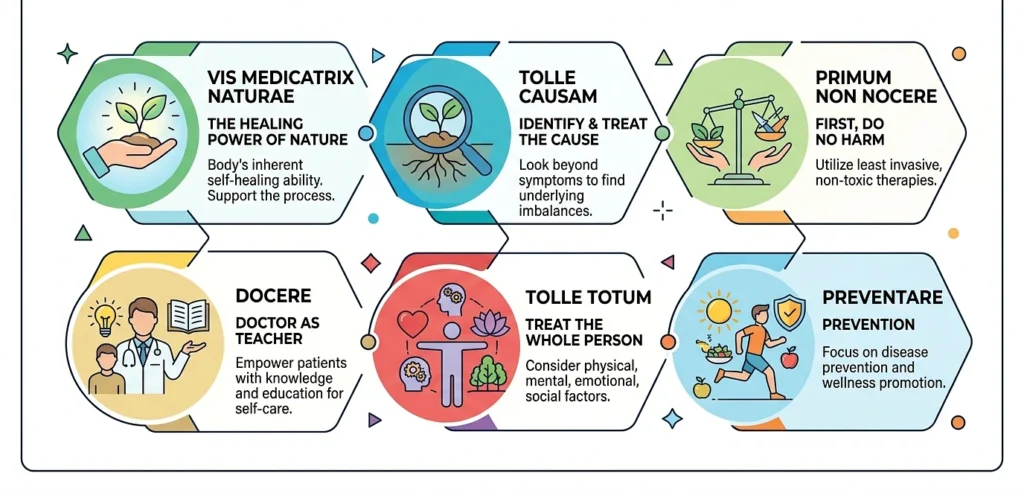
Naturopathy is defined by principles rather than by a specific list of treatments. The American Association of Naturopathic Physicians formally adopted six unifying principles in 1989, described in Pamela Snider and Jared Zeff’s 2019 paper Unifying Principles of Naturopathic Medicine Origins and Definitions in Integrative Medicine: A Clinician’s Journal.
In plain language, the six principles are:
- The healing power of nature – the body has an intelligent, self-organizing ability to maintain and restore health, and the practitioner’s job is to support that process.
- Identify and treat the cause – symptoms are clues, not the problem itself.
- First, do no harm – use the least invasive, least toxic effective option before escalating.
- Doctor as teacher – patient education is central to long-term wellness.
- Treat the whole person – Physical health, medical health, emotional, social, and environmental factors are considered together.
- Prevention – the best medicine is not getting sick in the first place.
These aren’t exotic ideas. A lot of modern primary care and public health rests on the same foundations. What’s distinctive is how centrally naturopathy puts them.
Licensed vs. Traditional Naturopaths
In the United States, there’s an important distinction. The NCCIH Naturopathy fact sheet (2025) clearly separates two categories:
- Licensed naturopathic physicians (ND or NMD) complete graduate-level training at a naturopathic medical school accredited by the Council on Naturopathic Medical Education. They’re licensed in 23 states plus DC, Puerto Rico, and the U.S. Virgin Islands.
- Traditional naturopaths may have training from non-accredited programs and are not licensed.
That difference matters a lot if you’re choosing a provider.
What the Evidence Says
This is where honesty earns its keep. Naturopathy is a broad system and the research base is uneven. Some interventions have solid evidence. Others are weak or contested.
A few rigorous trials stand out.
The Cardiovascular Trial
Dugald Seely and colleagues’ 2013 paper Naturopathic medicine for the prevention of cardiovascular disease: a randomized clinical trial in CMAJ followed 246 Canadian postal workers at increased cardiovascular risk over one year.
The group receiving naturopathic care alongside usual care showed:
- A significantly lower prevalence of metabolic syndrome compared to usual care alone.
- A significant reduction in 10-year Framingham cardiovascular risk scores
The naturopathic treatment was essentially intensive lifestyle counseling plus targeted nutritional support. Not exotic remedies.
The Anxiety Trial
Kieran Cooley and colleagues’ 2009 trial Naturopathic Care for Anxiety: A Randomized Controlled Trial ISRCTN78958974, published in PLoS ONE, compared naturopathic care against standardized psychotherapy in 81 employees with moderate-to-severe anxiety.
Over 12 weeks, Beck Anxiety Inventory scores dropped:

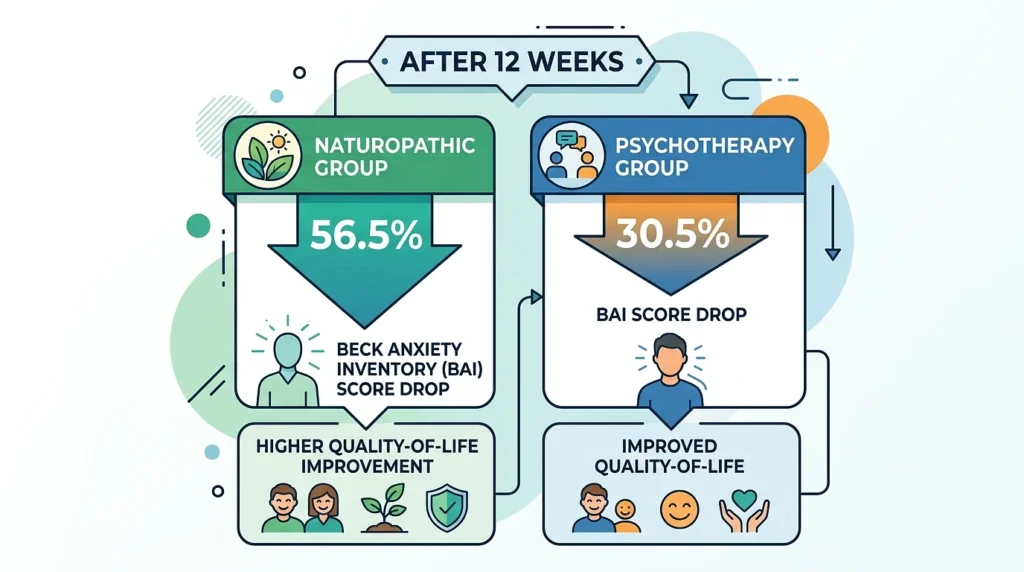
The naturopathic group also showed significantly greater improvements on several quality-of-life measures.
The Broader Review
A 2022 viewpoint paper, Naturopathic Doctors: An Underutilized Resource of Whole Health Delivery in Primary Care by Adam Sadowski, Luciano Garofalo, Alanna Welsh, and Ryan Bradley in Global Advances in Health and Medicine, summarized the growing evidence base for structured, whole-system naturopathic care in cardiometabolic disease prevention and mental health.
What the Evidence Does Not Support
Naturopathy is not a replacement for proven conventional treatment in serious disease.
The NCCIH Naturopathy fact sheet is explicit: regulations, licenses, or certificates don’t guarantee that any treatment conventional or complementary is safe or effective. Patients should always tell their doctors about any complementary approaches they’re using.
This matters most with herbs and supplements, which can interact with prescription medications in meaningful ways.
Where Naturopathy Fits Into Everyday Wellness

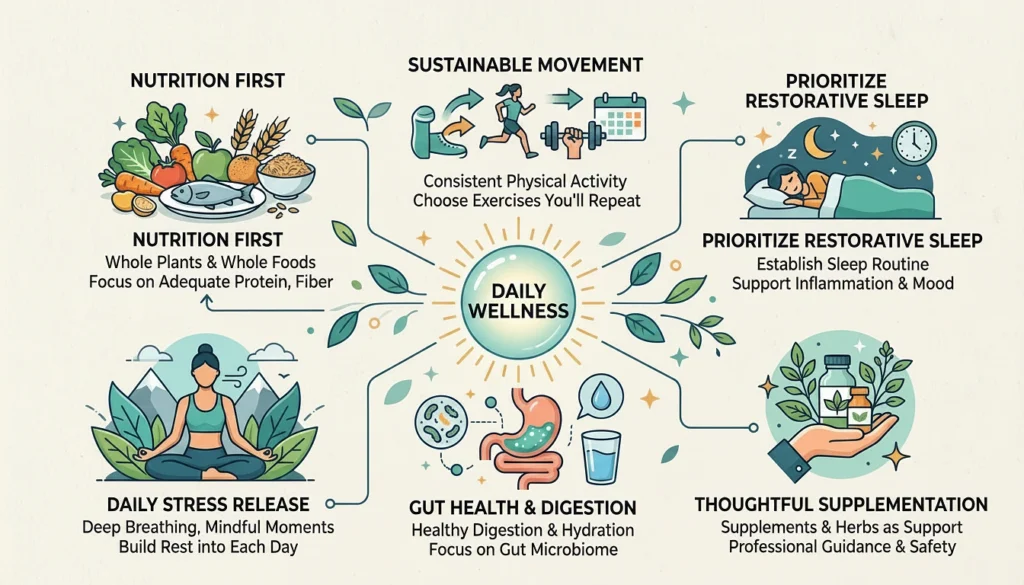
You don’t need to see a naturopath to borrow ideas from the tradition. Most of what drives its clinical results is simply consistent application of fundamentals that mainstream medicine agrees on. Naturopaths just emphasize them harder.
- Start with food, not supplements. The naturopathic order of operations almost always puts diet and lifestyle first, with supplements and herbs as support, not substitutes. Whole plants, adequate protein, fiber, and minimally processed foods form the non-negotiable base.
- Move your body in ways you’ll repeat. Walking, strength work, anything sustainable. Consistency matters more than intensity.
- Take sleep seriously. Poor sleep drives inflammation, insulin resistance, mood disorders, and impaired immune function. A naturopath will spend real time on your sleep routine because it touches almost everything else.
- Build stress-release into the day, not just the weekend. Deep breathing, short walks, time outdoors, and genuine rest are considered treatments in naturopathy, not luxuries. The 2009 Cooley anxiety trial used a simple deep-breathing practice as part of the protocol. Not because it’s magical, but because it reliably down-regulates the stress response.
- Pay attention to digestion and hydration. Naturopaths take gut health seriously, and research on the gut-brain and gut-immune connections has caught up with that intuition in recent years.
- Use herbs and supplements thoughtfully. Know what you’re taking and why. Check interactions with any medications. Work with someone trained in botanical medicine rather than guessing from social media.
References
- Naturopathy NIH National Center for Complementary and Integrative Health, updated April 2025 – https://www.nccih.nih.gov/health/naturopathy
- Naturopathy (Naturopathic Medicine): Benefits & Risks – Cleveland Clinic Health Library – https://my.clevelandclinic.org/health/articles/naturopathy
- Benchmarks for Training in Naturopathy World Health Organization, 2010 (ISBN 9789241599658) – https://www.who.int/publications/i/item/9789241599658
- Principles of Naturopathic Medicine American Association of Naturopathic Physicians – https://naturopathic.org/page/PrinciplesNaturopathicMedicine
- The Six Principles of Naturopathic Medicine – Association of Accredited Naturopathic Medical Colleges – https://aanmc.org/6-principles/
- Cody GW. The Origins of Integrative Medicine The First True Integrators: The Philosophy of Early Practitioners. Integrative Medicine: A Clinician’s Journal. 2018;17(2):16–18 – https://pmc.ncbi.nlm.nih.gov/articles/PMC6396756/
- Snider P, Zeff J. Unifying Principles of Naturopathic Medicine Origins and Definitions. Integrative Medicine: A Clinician’s Journal. 2019;18(4):36–39 – https://pmc.ncbi.nlm.nih.gov/articles/PMC7219457/
- Seely D, Szczurko O, Cooley K, et al. Naturopathic medicine for the prevention of cardiovascular disease: a randomized clinical trial. CMAJ. 2013;185(9):E409–E416
- Cooley K, Szczurko O, Perri D, et al. Naturopathic Care for Anxiety: A Randomized Controlled Trial ISRCTN78958974. PLoS ONE. 2009;4(8):e6628
- Sadowski A, Garofalo L, Welsh A, Bradley R. Naturopathic Doctors: An Underutilized Resource of Whole Health Delivery in Primary Care. Global Advances in Health and Medicine. 2022;11:2164957X221079787 – https://pmc.ncbi.nlm.nih.gov/articles/PMC8874159/
- Naturopathic Professional Formation by WHO Region – World Naturopathic Federation, 2021 – https://worldnaturopathicfederation.org/wp-content/uploads/2021/12/Section-2.pdf
- NHMRC Information Paper: Evidence on the effectiveness of homeopathy for treating health conditions – National Health and Medical Research Council (Australia), 2015 – https://www.nhmrc.gov.au/about-us/publications/homeopathy