


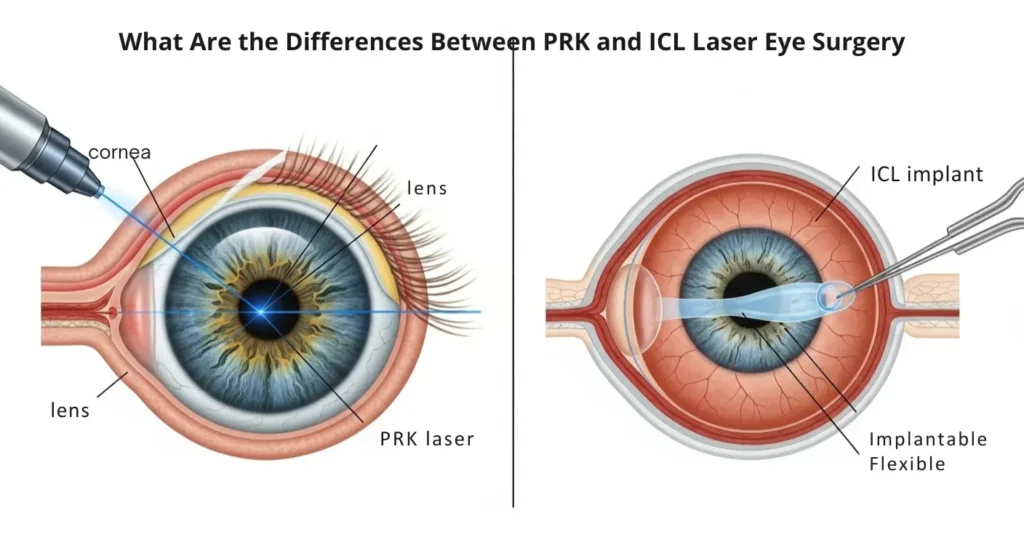
ICL involves implanting a lens behind the iris, LASIK creates a corneal flap for laser reshaping, and PRK removes surface tissue for laser reshaping. ICL is suitable for higher prescriptions and thinner corneas, while LASIK and PRK are better for moderate vision problems.
Here’s an updated comparison of Photorefractive Keratectomy (PRK) and Implantable Collamer Lens (ICL) (sometimes called “EVO ICL”) two distinct refractive-eye-surgery options. Always remember: actual suitability depends on a detailed examination by an eye-care specialist, as individual anatomy, prescription stability and eye health matter a lot.
PRK:
- PRK involves removing the very outer layer of the cornea (the epithelium), then using an excimer laser to reshape the underlying corneal tissue to correct refractive errors.
- There is no corneal flap cut (unlike in LASIK).
- Because the epithelium must regenerate, the initial healing is more prolonged compared to flap-procedures.
ICL:
- The ICL procedure involves implanting a thin, biocompatible lens (the Collamer® lens) inside the eye between the iris and the natural lens rather than changing the cornea’s shape.
- It does not remove corneal tissue (or create a flap) and can be reversed or removed later if necessary.
- It is especially designed for moderate-to-high myopia (nearsightedness) and sometimes astigmatism.
Key Differences
Candidate eligibility & corneal health:
- PRK is often chosen when the cornea is thin, or has irregularities, making flap-based surgeries more risky.
- ICL is favourable if you have high myopia (large prescription) or conditions (e.g. dry eye) that make corneal-reshaping procedures less ideal.
- With ICL, because the cornea is largely unaltered, the integrity of the cornea remains better (for some patients).
Range of prescription correction:
- PRK can correct myopia, hyperopia (farsightedness), and astigmatism depending on the equipment and patient.
- ICL is particularly strong for higher-level myopia (strong nearsightedness) and some astigmatism — though less often hyperopia.
Surgical method & tissue alteration:
- PRK alters the corneal surface: epithelium removed, stroma reshaped. This means some healing and regeneration are required.
- ICL leaves corneal surface mostly untouched: the lens is introduced via small incision, the procedure is intraocular (inside eye).
Recovery time & comfort:
- PRK: Because the outer layer must heal, patients often experience soreness, slower visual recovery. For example: “bandage contact lens for 3-5 days” etc.
- ICL: Faster visual recovery in many cases, less surface discomfort (since the cornea isn’t extensively reshaped) and minimal downtime in some practices.
Long-term stability & reversibility:
- PRK is permanent in its tissue removal/reshaping. Once corneal tissue is modified, that’s the new shape.
- ICL is reversible (in many cases) the implanted lens can be removed or replaced if needed.
- Some anecdotal discussion: for ICL there may be less regression (return toward original prescription) than surface procedures in some high-correction cases. > “With PRK there is a chance of having regression With ICL almost always choose ICL.”
Potential risks & side effects:
- PRK: risk of corneal haze, slower vision improvement, more discomfort early, more dryness in some cases.
- ICL: being intraocular, carries risks like increased intra-ocular pressure, cataract formation (in lens region), endothelial cell loss; also requires ongoing monitoring.
Cost and practicality:
- In many settings, ICL tends to cost more than surface ablation like PRK (because of implant cost, more intra-ocular procedure).
- Also, requirement for long term follow-up can differ.
- Some patients select PRK because it’s less expensive (though this depends heavily on region, surgeon, technology).
Ideal Candidates for ICL Surgery
ICL surgery is ideal for individuals with thin corneas and moderate-to-severe myopia, hyperopia, or astigmatism and has thin corneas. It is also suitable for individuals with dry eye syndrome and irregular corneas. Individuals with high refractive error are ideal candidates for this surgery as the procedure directly addresses the condition. The ideal candidate for ICL surgery should have stable vision and eye health. Schedule regular vision checkups with your eye doctor to determine whether you are a good candidate for this procedure.
Risks and Complications
Both PRK and ICL surgeries carry risks that patients should be aware of before undergoing the procedures. These risks include:
- Infection: There is a small risk of infection following any surgical procedure, including PRK and ICL surgeries. Patients will be prescribed antibiotics to reduce this risk, and it’s important to follow post-operative care instructions diligently to minimize the chance of infection.
- Dry Eye Syndrome: Dry eye syndrome is a common side effect of laser eye surgeries like PRK and ICL. It occurs when the eye does not produce enough tears to keep the surface moist. Patients may experience symptoms such as itching, burning, or a gritty sensation in the eyes. Lubricating eye drops can help alleviate these symptoms during the healing process.
- Glare/Halos: Some patients may experience glare or halos around lights, especially at night, following PRK or ICL surgery. This side effect is typically temporary and resolves as the eyes heal. However, it’s essential to discuss any persistent or bothersome symptoms with your eye surgeon.
Cost Considerations
Patients should consider the following cost factors when deciding between PRK and ICL procedures:
- Surgeon Fees: The cost of the surgeon’s services can vary based on their experience, reputation, and location. Patients should inquire about the surgeon’s fees during the consultation process.
- Facility Fees: The fees associated with the surgical facility where the procedure will be performed should also be considered. These fees may include operating room costs, equipment fees, and staff fees.
- Insurance Coverage: Some insurance plans may cover part or all of the cost of laser eye surgery, depending on the individual’s policy and the reason for the procedure. Patients should check with their insurance provider to determine coverage eligibility and any out-of-pocket expenses.
The End
PRK reshapes the cornea by removing surface tissue, suitable for moderate vision problems and thin corneas, with a longer initial recovery. In contrast, ICL implants a lens inside the eye, which is ideal for higher prescriptions and conditions like dry eye, offers a faster recovery, and is reversible. The best choice depends on a comprehensive eye examination to assess factors like prescription strength, corneal thickness, and overall eye health.