


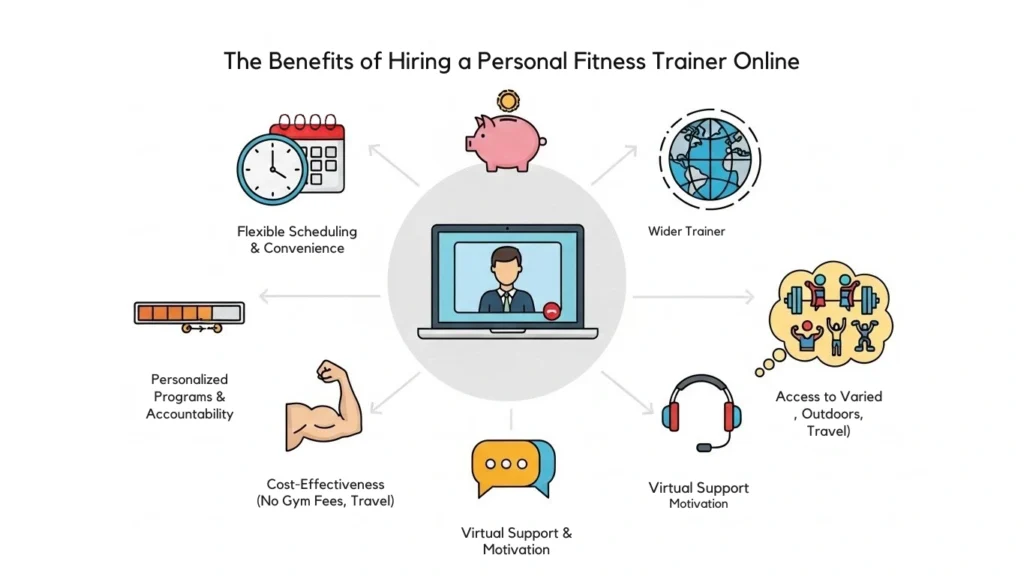
Key Takeaways
- An online personal trainer delivers the same accountability and personalized programming as an in-person trainer without geographic or schedule limitations.
- Human coaching produces significantly better fitness and weight loss outcomes than apps or self-directed training alone, as confirmed by peer-reviewed clinical research.
- Consistency is the #1 predictor of fitness success, and a trainer is the most proven external mechanism to create it.
- Online training removes the cost, commute, and scheduling barriers that cause most people to quit gym-based routines.
- The online fitness market is one of the fastest-growing health sectors globally, reflecting genuine, sustained consumer demand not a trend.
- Forming an exercise habit takes an average of 66 days; an online trainer who keeps you accountable through that window dramatically increases your chances of lasting change.
The Two Benefits That I Love Most:
Flexibility Remove the Excuse That Kill Consistency

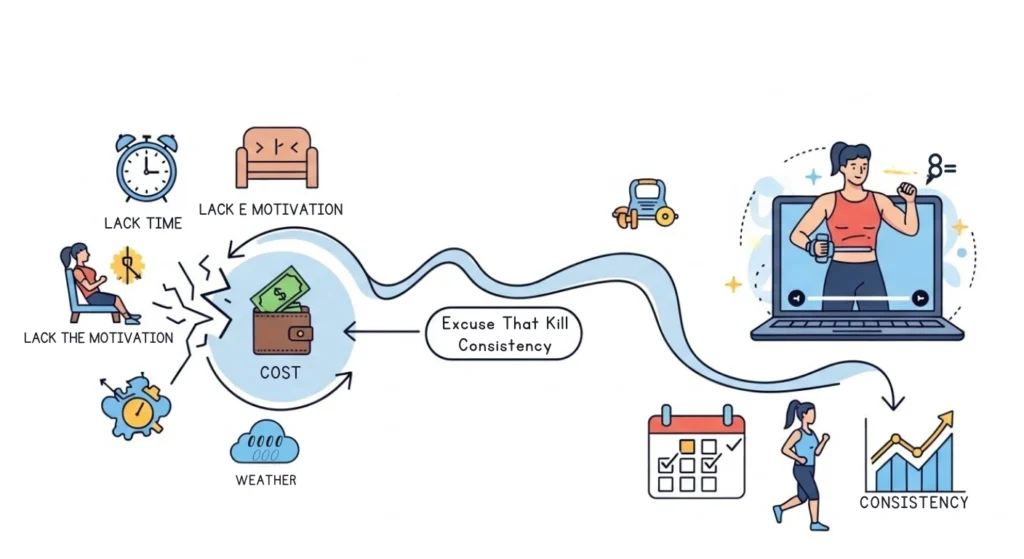
One of the most underrated advantages of online personal training is that it removes the logistical friction that causes most gym routines to fall apart.
No commute. No waiting for equipment. No fixed class schedule that conflicts with work or childcare.
You can train at 6am before the household wakes up, during a lunch break, or at 10pm after the kids are in bed.
This flexibility is especially valuable for parents, shift workers, frequent travelers, and anyone living in an area without access to quality gym facilities.
The barrier to showing up is dramatically lower and lower barriers mean better adherence.
Personalization You Cannot Get From a Generic Plan
A good online trainer designs programming around you specifically your injury history, your available equipment, your schedule, your weak points, and your goals.
This matters more than most people realize.
The 2024 Heliyon study by Lu et al. found that without trainer guidance, participants tended to neglect leg training entirely in favor of upper body exercises a common imbalance that compounds over time and leads to asymmetry and injury risk.
A trainer identifies and corrects these patterns from day one.
Certified trainers accredited through the National Academy of Sports Medicine (NASM) or the American Council on Exercise (ACE) must pass rigorous certification exams and complete continuing education hours annually.
Their expertise covers exercise science, movement mechanics, nutrition fundamentals, and progressive programming none of which is contained in a generic fitness app.
A Human Coach Online Trainer Results – Case Study
One of the strongest arguments for online personal training comes from a randomized clinical trial published in JAMA in May 2024 by researchers at Northwestern University.
The SMART trial enrolled 400 adults with obesity and compared two groups: those who used a fitness tracking app alone versus those who used the same app combined with telehealth coaching.
Those who had a human coach were significantly more likely to achieve clinically meaningful weight loss defined as at least 5% of body weight.
Lead author Professor Bonnie Spring of Northwestern University Feinberg School of Medicine stated plainly that giving people technology alone produced unacceptably worse weight loss than combining it with a human coach.
The gap between using an app and working with a real trainer is not a matter of preference. It is a measurable clinical difference.
Further evidence comes from a study published in Heliyon (January 2024, Elsevier) by Lu et al., conducted across three groups of 66 healthy male adults over 12 weeks.
Only the group trained by a personal trainer showed a statistically significant reduction in fat mass (-1.61 kg, p = 0.033). Neither the group training alone nor the group training with a partner achieved the same result.
The trainer group also demonstrated significantly greater adherence to a nutritional plan (p < 0.001) and a more notable injury prevention effect than either comparison group.
Accountability Fitness Trainer
Most people do not fail at fitness because they lack information.
The internet has more free workout plans than anyone could follow in a lifetime. People fail because consistency is genuinely difficult to sustain without external structure.
Research examining personal training effectiveness, published in PMC by Morrow et al., found that over a 10-week personal training program, 60% of participants moved up one stage in motivational readiness for exercise and 13% moved up two stages changes that were statistically significant at p < 0.01.
The trainer was not just delivering workouts. The trainer was changing the participant’s relationship with exercise itself.
A separate study published in PMC by researchers at North Carolina A&T State University and Wake Forest University identified motivational support as one of the core reasons clients continue working with personal trainers over time.
Trainers help build self-efficacy the belief that consistent effort will produce results through encouragement, goal tracking, and accountability between sessions.
When you hire an online trainer, you are not just buying a workout plan. You are buying a system that makes showing up difficult to avoid.
Do You Know: The Online Fitness Market Has Grown At Such High Rate!
The explosion of online personal training is not a marketing phenomenon.
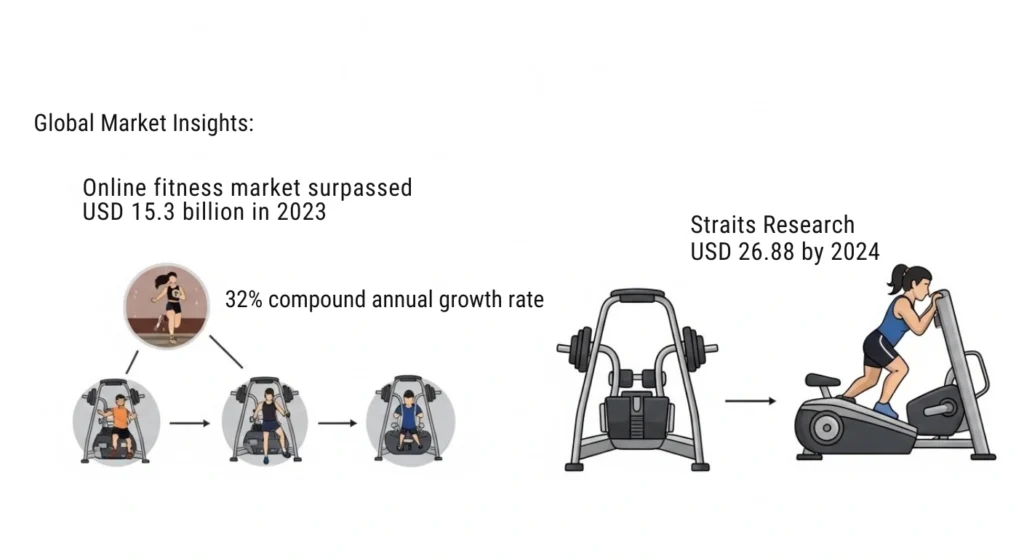
According to Global Market Insights, the online fitness market surpassed USD 15.3 billion in 2023 and is projected to grow at approximately 32% compound annual growth rate through 2032.
Straits Research estimated the broader virtual fitness market at USD 26.88 billion in 2024.
These numbers reflect a real, sustained shift in how people choose to train driven by results, convenience, and the growing recognition that quality coaching no longer requires physical proximity.
Proper Guidance Keeps You Training
Training with poor form does not just produce slower results. It creates injuries that can sideline you for weeks or months, undoing all the progress you have made.
An online trainer working via live video sessions observes your movement in real time, corrects technique before bad habits become ingrained, and adjusts programming when something is not working for your body.
The Heliyon 2024 study by Lu et al. confirmed this directly: the personal trainer group demonstrated a more notable injury prevention effect than both the solo training group and the partner training group across the same 12-week period.
Getting it right from the start is always faster than recovering from getting it wrong.
Is Online Personal Training Right for You?
Online personal training works best for people who have some basic setup either at home or at a gym and are ready to engage consistently with a coach.
It is not a passive service. The results come from the interaction between the trainer’s expertise and your follow-through.
But for the vast majority of people whether you are a complete beginner or someone who has been training for years and hit a plateau the combination of expert programming, genuine accountability, and the freedom to train on your own terms is difficult to match through any other approach.
References
- Spring, B., et al. “An Adaptive Behavioral Intervention for Weight Loss Management: A Noninferiority Randomized Clinical Trial.” JAMA, May 14, 2024.
- Lu, Y., et al. “Comparing the impact of personal trainer guidance to exercising with others: Determining the optimal approach.” Heliyon, Vol. 10, Issue 3, January 30, 2024 (Elsevier).
- Morrow, J.R., Jr., et al. “The Effectiveness of Personal Training on Changing Attitudes Towards Physical Activity.” PMC / PubMed Central, 2014.
- Melton, D.I., et al. “The Current State of Personal Training: an Industry Perspective of Personal Trainers in a Small Southeast Community.” Journal of Strength and Conditioning Research, 2008.
- Lally, P., van Jaarsveld, C.H.M., Potts, H.W.W. & Wardle, J. “How are habits formed: Modelling habit formation in the real world.” European Journal of Social Psychology, 40(6), 998–1009, 2010.
- Global Market Insights. “Online Fitness Market Size & Share, Statistics Report 2024–2032.”
- Straits Research. “Virtual Fitness Market Size, Trends, Demand & Growth Forecast by 2033.” https://straitsresearch.com/report/virtual-fitness-market